
Almost every country taxes people because they live there. The United States taxes them because of who they are, and moving abroad does not change it.
If you are a US citizen living in Lisbon, Dubai or Bali, the question is not whether you still have a US tax obligation. You do. The question is which reliefs reduce it, which of your income they reach, and what you must still report even when no tax is due.
The United States is one of only two countries in the world that taxes its citizens on worldwide income regardless of residence. Eritrea is the other. The obligation begins at birth or naturalisation and continues for life unless citizenship is formally renounced — which is itself a process with its own tax consequences.
The same applies to lawful permanent residents. A green card holder living permanently outside the United States remains a US tax resident until that status is formally abandoned, which is a distinct legal act rather than something that happens when the card expires.
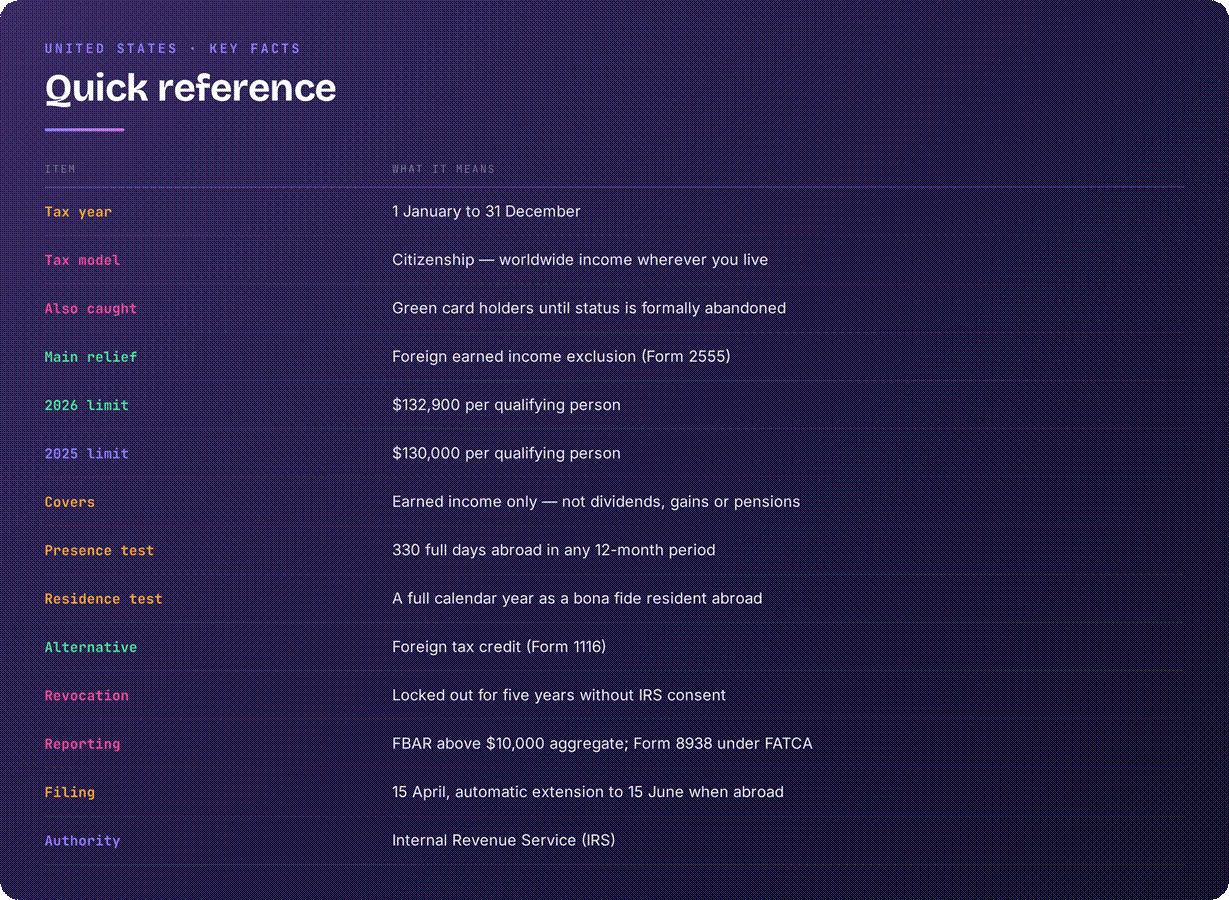
The US position at a glance.
Your residency status is not the first step
For most countries, residence is the starting point. For the United States it is close to irrelevant. A citizen is taxed on worldwide income whether they have spent a decade abroad or a weekend, and no amount of day tracking changes that.
What day tracking does decide is whether you qualify for relief. Before either qualifying test applies, you need a tax home in a foreign country — broadly, your main place of business or employment must be outside the United States. A foreign mailing address is not a tax home, and a genuinely temporary assignment generally does not create one.
Maintain accurate records of:
• Every day spent inside and outside the United States;
• Days spent in international waters or airspace, which count as neither;
• The location of your principal place of business;
• Housing arrangements and their cost;
• Foreign tax paid, by country and category; and
• The balances and highest values of all foreign financial accounts.
The foreign earned income exclusion
The main relief is the foreign earned income exclusion under section 911. For tax year 2026 it excludes up to $132,900 per qualifying person, up from $130,000 for 2025. The figure is indexed annually, so a number carried over from an older guide or a previous return will be wrong.
Two people who each qualify claim it separately on their own Form 2555, so a married couple both working abroad can exclude up to $265,800 between them for 2026. There is also a foreign housing exclusion or deduction for qualifying housing costs above a base amount, subject to a ceiling that varies by location.
The word doing the work is earned. The exclusion covers compensation for personal services performed abroad and nothing else:
Income | Covered by the exclusion? |
Salary and wages earned abroad | Yes — within the annual limit |
Professional and freelance fees | Yes — within the annual limit |
Earned element of business profits | Yes — within the annual limit |
Dividends, interest and royalties | No |
Capital gains | No |
Rental income | No |
Pensions and retirement distributions | No |
US government employee pay | No |
This is the most common misreading of the rule. Someone who has retired abroad and lives on investment income or a pension receives no benefit from the exclusion, however many years they have been outside the United States.
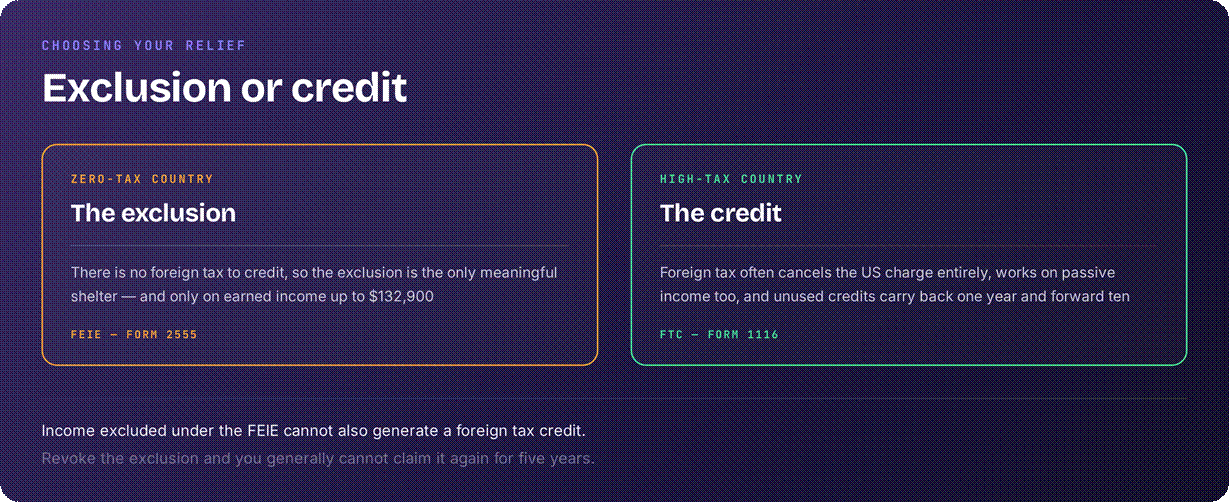
Which relief works depends on where you live, not on which sounds better.
The two qualifying tests
Given a foreign tax home, you qualify under one of two tests. The physical presence test requires you to be physically present in foreign countries for at least 330 full days in any period of 12 consecutive months. The bona fide residence test requires you to have been a bona fide resident of a foreign country for an uninterrupted period covering an entire calendar year.
The physical presence test is where day tracking earns its keep. A single mistimed trip can drop you below 330 days and cost the exclusion for that period. The 12-month window can also be moved to your advantage if you know precisely where you were, which is only possible with contemporaneous records.
Bona fide residence is a facts test rather than a count. Short trips back to the United States do not automatically break it, but a stated intention to return, a home maintained in the US, or a pattern of short foreign postings can all weigh against it.
When the foreign tax credit is the better answer
The alternative relief is the foreign tax credit on Form 1116, which credits foreign income tax paid against US tax on the same income. In a country with rates at or above US rates, the credit often eliminates the US liability entirely — and unlike the exclusion, it works on passive income.
The two do not stack. Income excluded under the FEIE cannot also generate a credit. The choice generally turns on where you live: in a high-tax country the credit usually wins, with excess credits carried back one year and forward ten; in a zero-tax country there is no foreign tax to credit, so the exclusion is the only meaningful shelter.
One warning about switching. If you revoke a FEIE election, you generally cannot claim it again for five years without IRS consent. This is not a choice to flip between annually.
Case study: Sofia in Dubai
Sofia is a US citizen working in Dubai on a salary equivalent to $185,000. The UAE levies no personal income tax, so she pays nothing locally.
There is no foreign tax to credit, which rules out Form 1116 as a practical shelter. She claims the FEIE on Form 2555 and excludes $132,900 for 2026, plus qualifying housing costs above the base amount. The balance of her salary is exposed to US tax at her marginal rate.
Sofia also has to file an FBAR, because her Dubai bank accounts exceeded $10,000 in aggregate, and she needs to satisfy the physical presence test — which means documenting her travel, including trips home for family events.
The reporting layer is separate from the tax
Even where no US tax is due, reporting obligations continue and carry their own penalties, which are frequently larger than the tax involved:
• FBAR (FinCEN Form 114), required if the aggregate value of your foreign financial accounts exceeded $10,000 at any point in the year — aggregate, not per account;
• Form 8938, reporting specified foreign financial assets under FATCA, with thresholds that are higher for taxpayers living abroad;
• Additional forms for interests in foreign companies, partnerships and trusts; and
• Reporting for certain foreign investment funds, which can also carry punitive tax treatment.
The FBAR is filed separately from the income tax return, through a different channel, on its own deadline.
Filing and the compliance calendar
The US tax year follows the calendar year. The return is due 15 April, but taxpayers whose tax home is abroad receive an automatic two-month extension to 15 June, with a further extension to 15 October available on Form 4868.
The extension is to file, not to pay. Interest runs from the April date on anything owed, so an extension does not remove the need to estimate and pay. State obligations may also continue depending on which state you left and whether you severed residence there.
Timing matters more than the headline number
Model your position before you move rather than after, considering:
• Whether you will meet 330 days in your first 12-month period;
• Which 12-month window produces the best result;
• Whether the exclusion or the credit suits the country you are moving to;
• How much of your income is earned rather than passive;
• Whether housing costs in your city support a housing exclusion;
• What reporting your foreign accounts and investments will trigger; and
• Whether a state tax obligation follows you.
Case study: Marcus compares two bases
Marcus is a software engineer choosing between Lisbon and Dubai. His income is around $140,000, almost entirely earned.
In Dubai he pays no local tax and excludes $132,900, leaving a small US liability on the balance. In Lisbon he may pay Portuguese tax, which generates a credit that can offset his US liability — potentially reducing it to nil — but leaves him paying Portuguese tax overall.
The comparison is not about which country has the lower US bill. It is about the combined burden across both systems, and the answer depends on his actual Portuguese position rather than on the US rules alone.
Your USA checklist
1. Confirm your tax home is outside the United States;
2. Track every day inside and outside the US, including transit;
3. Identify the 12-month window that best satisfies the 330-day test;
4. Separate earned income from passive income before assuming relief;
5. Compare the exclusion against the credit for your country of residence;
6. Check whether your housing costs support a housing exclusion;
7. Establish the highest aggregate balance of your foreign accounts;
8. Confirm whether Form 8938 applies alongside the FBAR;
9. Diarise 15 June and 15 October, and pay by 15 April regardless; and
10. Check whether your former state still claims you as resident.
Frequently asked questions
How much is the foreign earned income exclusion for 2026?
$132,900 per qualifying person, up from $130,000 for 2025. The amount is indexed annually, so it should be taken from the IRS inflation adjustment release for the relevant year rather than carried forward.
Do I still have to file if I earn less than the exclusion?
Yes. The exclusion is claimed on a filed return using Form 2555 and does not apply automatically. If you do not file, the income is not excluded and the liability stands.
Does the exclusion cover my investment income?
No. It covers compensation for personal services performed abroad. Dividends, interest, royalties, capital gains, rental income and pension distributions all fall outside it, which is why retirees abroad often get no benefit from it.
Can I use the exclusion and the foreign tax credit together?
Not on the same income. You can exclude earned income and claim a credit for foreign tax on other income, such as investment income, but you cannot claim a credit for foreign tax attributable to income you have already excluded.
What counts as a full day for the 330-day test?
A full 24-hour day present in a foreign country. Days spent in international waters or airspace count as neither foreign nor US days, which is why long-haul travel can quietly erode the count.
Does moving to a zero-tax country reduce my US bill?
It removes foreign tax, which means there is nothing to credit. The exclusion remains available on earned income, but everything above it, and all passive income, is exposed to US tax with no offset.
What happens if I have never filed while living abroad?
Filing obligations do not lapse through non-compliance, and the reporting penalties are often larger than the tax. There are established procedures for taxpayers whose failure to file was not wilful, and these should be discussed with a qualified US adviser before filing anything.
Does giving up my green card end my filing obligation?
Only if the status is formally abandoned. Letting the card expire does not by itself end US tax residence, and both renunciation of citizenship and abandonment of long-term resident status can trigger separate expatriation tax consequences.
Official sources and further reading
• IRS guidance on the foreign earned income exclusion
• IRS guidance on figuring the foreign earned income exclusion
Important information
This article is general information and does not constitute tax, legal, immigration or financial advice, and does not create a client relationship. Tax outcomes depend on travel history, income sources, treaty status and the law applying to the relevant year. Rates, thresholds and regimes change, and some measures described may be proposed rather than enacted; this article reflects our understanding as at the date of publication. Obtain advice from a suitably qualified professional before acting or refraining from action.
