
Guernsey taxes income at a flat 20% and then places a ceiling on the total. Which ceiling applies depends on your residence class and where your income arises, and the difference between them is substantial.
Guernsey applies a flat 20% income tax to resident individuals after allowances and deductions. There is no capital gains tax, no inheritance tax and no stamp duty.
What makes the island genuinely distinctive is not the rate but the caps. A resident can limit their total annual income tax liability to a fixed sum, and there are several of them depending on circumstances.
Guernsey also runs an unusual residence classification. An individual can be solely resident, principally resident, or resident only, and the class determines which caps and elections are available.
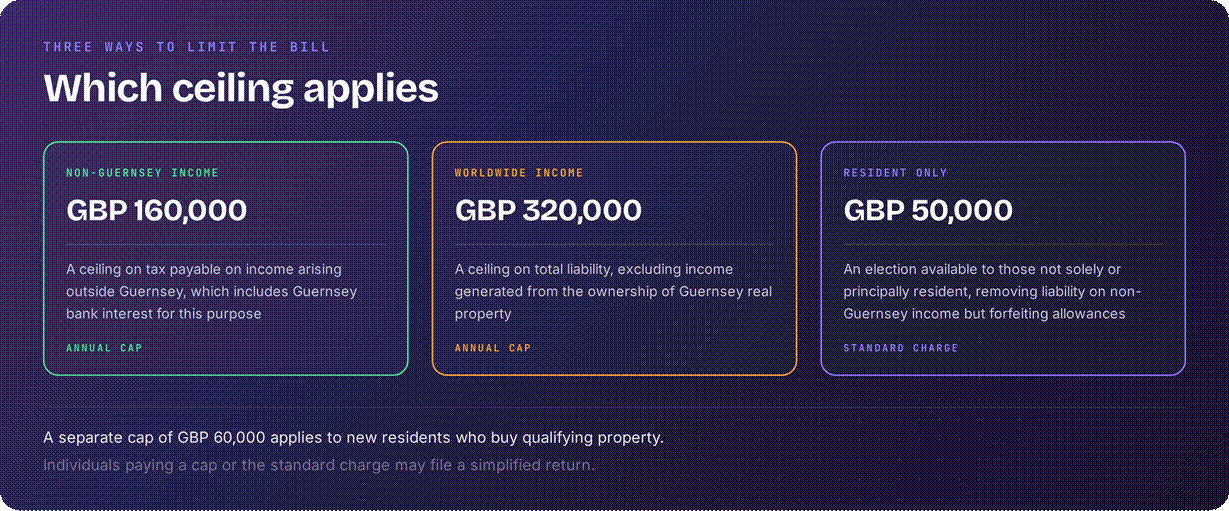
Three ceilings, and the one that applies depends on your position.
The rate and the allowances
The flat rate is 20%, applied after personal allowances and deductions. For 2026 the personal allowance is GBP 15,200 per person, and unused allowances are transferable between spouses and civil partners.
From 1 January 2026 that allowance is reduced by GBP 1 for every GBP 5 of total income above GBP 85,000, which withdraws it entirely at a relatively modest level of income. The abatement threshold was previously GBP 100,000, so the change bites earlier than it did.
The caps
Cap or charge | Amount and scope |
Non-Guernsey source income cap | GBP 160,000 a year |
Worldwide income cap | GBP 320,000 a year |
Excluded from the worldwide cap | Income from Guernsey real property |
New resident cap | GBP 60,000, year of arrival plus three years |
New resident condition | Document duty of GBP 50,000 or more on a qualifying property |
Standard charge, resident only | GBP 50,000 from 1 January 2026, or 20% of Guernsey income |
Personal allowance 2026 | GBP 15,200, abated above GBP 85,000 |
Capital gains, inheritance, stamp duty | None |
Guernsey bank interest counts as non-Guernsey source income for the purposes of the lower cap, which is a technical point with a real effect on how the two ceilings are used. The worldwide cap, by contrast, excludes income generated from owning Guernsey real property, so a landlord cannot shelter rental income under it.

Every condition must hold for the new resident cap.
The standard charge
An individual who is resident but not solely or principally resident — broadly someone spending less than six months on the island — can elect to pay a standard charge instead of tax on worldwide income. From 1 January 2026 that charge is GBP 50,000, raised from GBP 40,000.
Electing it means no liability on non-Guernsey source income at all, though liability still arises on total Guernsey source income other than bank deposit interest. The charge paid can be set against tax due on Guernsey source income, and someone electing it forfeits entitlement to allowances, reliefs and deductions.
Individuals paying either a cap or the standard charge may file a simplified return and are not obliged to declare full details of their income, though the Revenue Service retains the power to call for that information.
The new resident cap
The most generous ceiling is reserved for new arrivals who buy property. Someone who has not been Guernsey resident in the previous three years may claim a cap of GBP 60,000 for the year of arrival and the following three years.
The condition is a property purchase. The individual must pay GBP 50,000 or more in document duty on a qualifying property made available for occupation by persons who are not locally qualified residents, purchased within twelve months either side of taking up permanent residency.
A document duty bill of that size implies a substantial purchase, so this is a route for people relocating with capital rather than a general welcome for new residents.
Case study: Helen picks the wrong cap
Helen moves to Guernsey with a portfolio producing income well into seven figures, almost all of it from outside the island. She assumes the GBP 320,000 worldwide cap is the one that matters, because it is the larger number.
In fact the GBP 160,000 cap on non-Guernsey source income is the relevant ceiling for her, because that is where her income arises — and Guernsey bank interest counts toward it as well. The worldwide cap only becomes relevant where there is substantial Guernsey source income in the mix.
She also buys a house within twelve months of arriving, paying well over GBP 50,000 in document duty. Had anyone raised it at the time, she could have claimed the GBP 60,000 new resident cap for four years instead.
Filing and the compliance calendar
The Guernsey tax year follows the calendar year. Every individual now has their own tax reference and files a personal return regardless of marital status. Returns are generally due by 30 November of the year following the tax year, filed electronically or on paper.
Tax is payable in two instalments, by 30 June and 31 December, with a balancing payment once the final assessment is made. Penalties and surcharges apply to late filing and payment, and employment income is deducted at source.
Establish your class first
Consider:
• Which residence class you fall into, since it governs the options;
• Whether your income is Guernsey source or non-Guernsey source;
• That Guernsey bank interest counts as non-Guernsey source;
• Whether a property purchase would unlock the new resident cap;
• Whether the standard charge suits a part-year presence better;
• What losing allowances above GBP 85,000 costs you; and
• That there is no capital gains or inheritance tax to plan around.
Your Guernsey checklist
1. Establish whether you are solely, principally, or resident only;
2. Classify each income stream as Guernsey or non-Guernsey source;
3. Remember Guernsey bank interest counts as non-Guernsey source;
4. Compare the GBP 160,000 and GBP 320,000 caps against your actual mix;
5. Check whether a property purchase would unlock the GBP 60,000 cap;
6. Note the twelve-month window either side of taking up residency;
7. Consider the standard charge if you will be on the island under six months;
8. Model the loss of allowances above GBP 85,000;
9. Diarise 30 June and 31 December for instalments; and
10. File by 30 November of the following year.
Frequently asked questions
What is the Guernsey income tax rate?
A flat 20% for resident individuals, applied after personal allowances and deductions. There is no capital gains tax, inheritance tax or stamp duty.
How do the tax caps work?
Tax is capped at GBP 160,000 a year on non-Guernsey source income, and GBP 320,000 a year on worldwide income other than income from Guernsey real property. Guernsey bank interest counts as non-Guernsey source for the lower cap.
What is the new resident cap?
GBP 60,000 a year for the year of arrival and the following three years, available to someone not Guernsey resident in the previous three years who pays GBP 50,000 or more in document duty on a qualifying property bought within twelve months either side of taking up residency.
What is the standard charge?
An election available to individuals who are resident but not solely or principally resident. From 1 January 2026 it is GBP 50,000, raised from GBP 40,000, and removes liability on non-Guernsey source income while forfeiting allowances and reliefs.
What is the personal allowance?
GBP 15,200 per person for 2026, transferable between spouses and civil partners. From 1 January 2026 it is reduced by GBP 1 for every GBP 5 of total income above GBP 85,000, down from a GBP 100,000 threshold.
Do I need to pay a minimum amount to become resident?
No. There is no minimum tax contribution required simply to establish Guernsey residence, which distinguishes it from jurisdictions operating a compulsory annual charge.
Are there capital gains or inheritance taxes?
No. Guernsey levies no capital gains tax, no inheritance tax and no stamp duty, which is a significant part of the overall proposition.
When do I file and pay?
Returns are generally due by 30 November of the year following the tax year, which runs on the calendar. Tax is payable in two instalments, by 30 June and 31 December, with a balancing payment after final assessment.
Official sources and further reading
Important information
This article is general information and does not constitute tax, legal, immigration or financial advice, and does not create a client relationship. Tax outcomes depend on travel history, income sources, treaty status and the law applying to the relevant year. Rates, thresholds and regimes change, and some measures described may be proposed rather than enacted; this article reflects our understanding as at the date of publication. Obtain advice from a suitably qualified professional before acting or refraining from action.
