
Switzerland is known for its stability, infrastructure and financial services. One of its less-publicised features is lump-sum taxation also called expenditure-based taxation, the forfait fiscal, or Pauschalbesteuerung.
The regime lets certain foreign nationals who live in Switzerland without working there be taxed by reference to their living expenses rather than their actual worldwide income and wealth. For someone with substantial international income or assets, the difference can be very large.
What it is not. It is not a flat rate, not a negotiated discount on your real income, and not a substitute for genuine residence. Ordinary federal, cantonal and communal rates are applied to a deemed base. Whether that helps depends entirely on how your actual income compares with the base the canton will assess.
First, the ordinary position
It helps to know what the regime is an alternative to. Under ordinary Swiss taxation an individual resident is assessed on worldwide income, and separately on worldwide wealth, with tax charged at three levels: federal, cantonal and communal. Cantonal and communal rates vary enormously, which is why Switzerland cannot sensibly be treated as a single tax jurisdiction.
Feature | Ordinary Swiss taxation for an individual |
Basis | Worldwide income and worldwide wealth, for residents |
Where tax is charged | Federal, cantonal and communal, with rates varying widely by canton |
Private capital gains on securities | Generally not taxed for individuals holding privately |
Gains on Swiss real estate | Taxed at cantonal level through a separate property gains tax |
Wealth tax | Charged annually at cantonal and communal level |
Lump-sum alternative | Ordinary rates applied to a deemed expenditure base instead |
A point worth knowing whichever route you take. Private capital gains on movable assets — shares and securities held privately rather than as a trader — are generally not taxed for Swiss-resident individuals. Gains on Swiss real estate are a different matter, taxed at cantonal level through a separate property gains tax. Wealth tax, charged annually on net assets at cantonal and communal level, applies either way.
Residence itself is not decided by a day count alone. Swiss authorities look at where you have your home and centre of life, and physical presence is evidence rather than the whole test.
How the expenditure base is built
Under the lump-sum regime your taxable base is derived from your annual cost of living, including the expenses of dependants, and including costs incurred abroad as well as in Switzerland. Several calculations are run, and the highest figure wins.
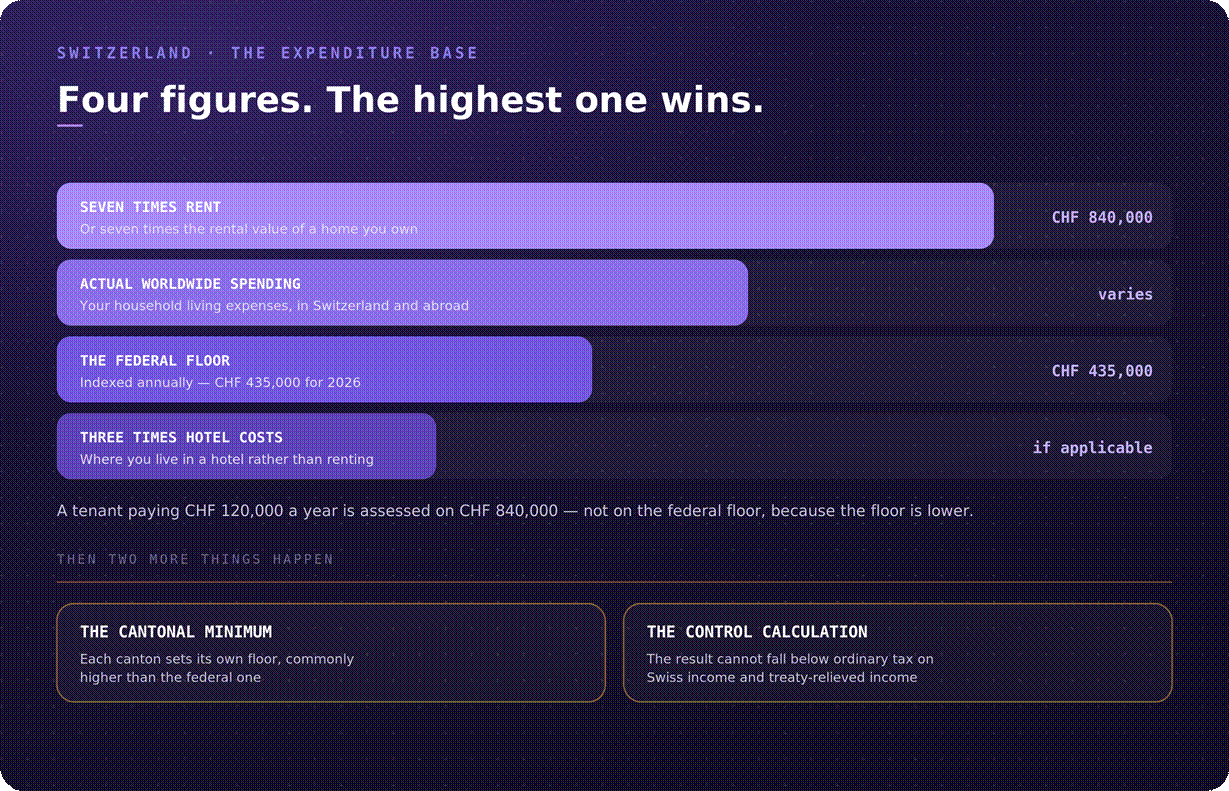
The base is whichever of these produces the largest number.
For 2026 the federal minimum taxable base is CHF 435,000, indexed annually — it rose from CHF 434,700 under an ordinance made in September 2025. That is a floor, not a target, and for most people who qualify it is not the figure that ends up applying.
Example: why accommodation decides it
Mark is a non-Swiss national who rents a property for CHF 120,000 a year. Seven times his annual rent produces a base of CHF 840,000.
Even though the federal floor is lower, he cannot use it. The canton applies the highest of the applicable calculations, its own minimum, and any control calculation. His accommodation choice has roughly doubled his assessed base compared with the federal floor — which is why rent should be modelled before a lease is signed or a property bought.
Cantonal minimums often bite before the federal one. Cantons set their own floors, commonly in the range of CHF 400,000 to CHF 600,000 or higher — Geneva, for instance, has been cited at around CHF 500,000. Where the cantonal minimum exceeds your rent-based figure, the cantonal minimum applies.
The control calculation
The control calculation is the safeguard that stops the arrangement producing a result below ordinary tax on certain income. It may take into account Swiss-source income, income from Swiss real estate, dividends or interest from Swiss securities, Swiss pensions, royalties, and foreign income on which you claim relief under a double taxation agreement.
The treaty point catches people out. If you claim treaty relief on a particular stream of foreign income, that income can be pulled into the minimum calculation under the control rules. Some treaties go further and require a modified lump-sum, under which income from that country is brought into the Swiss base before relief is available. Lump-sum taxation therefore does not mean nothing is disclosed — you still document what the control calculation and any treaty claim require.
Wealth tax is generally dealt with by deriving a deemed capital figure from the income base, rather than by assessing your actual worldwide assets.
The four gates
Four conditions have to be satisfied, and in a couple both spouses must qualify independently.
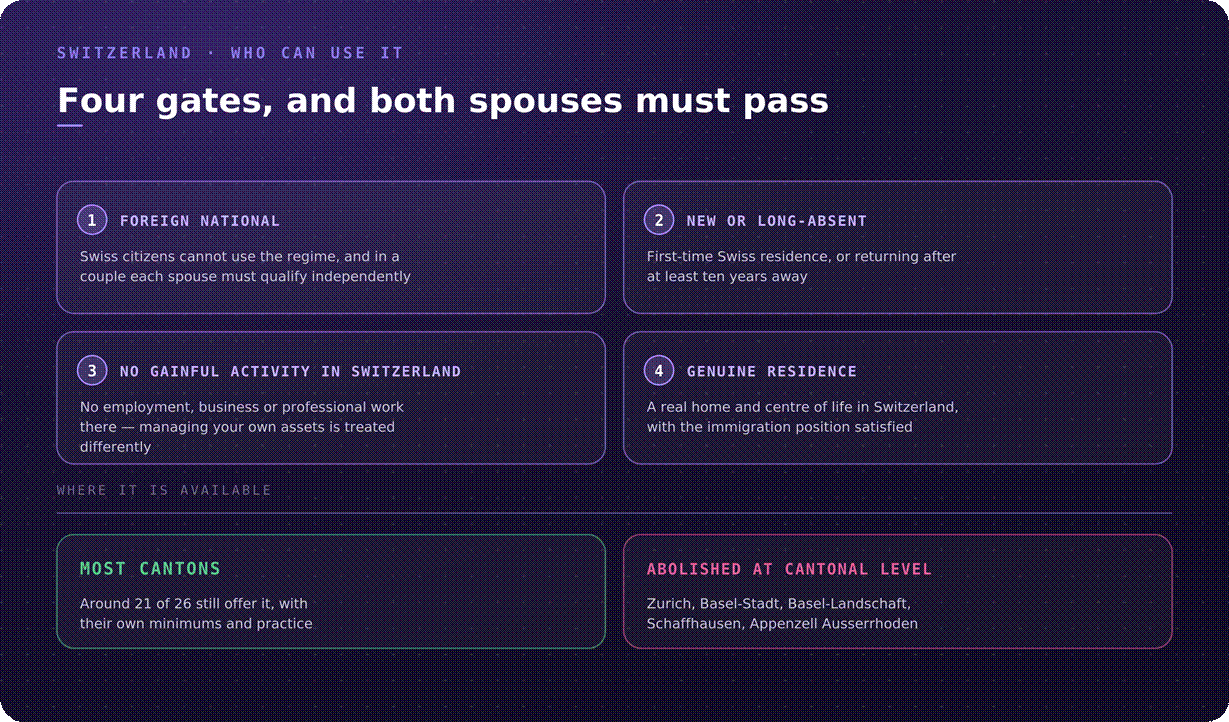
All four gates, plus the question of which canton.
You must be a foreign national — Swiss citizens cannot use the regime, and a mixed-nationality couple will not be treated the same way as two qualifying non-Swiss spouses. You must be establishing Swiss tax residence for the first time, or returning after at least ten years away, so a recent Swiss residence or a change of canton will not do.
You must not carry on gainful activity in Switzerland: no employment, no business, no professional work there. Managing your own private assets is generally treated differently from running a commercial enterprise, and some activity performed abroad may be permissible, but the analysis is fact-sensitive.
And you must genuinely establish Switzerland as your residence — a home and centre of life there, with the immigration requirements satisfied. Authorities may look at accommodation, family, economic interests, work pattern, travel history and personal ties.
Which canton
Around 21 of the 26 cantons still offer the regime. Five have abolished it at cantonal level: Zurich, Basel-Stadt, Basel-Landschaft, Schaffhausen and Appenzell Ausserrhoden. Relocating to one of those for lump-sum purposes does not work, because you would pay ordinary cantonal and communal tax regardless.
Among the cantons that retain it, practice varies on minimum bases, treatment of property ownership, wealth tax calculations, minimum annual bases, treatment of treaty-relieved foreign income, availability of an advance ruling, and local tax multipliers.
Get the ruling before you move. The standard approach is to approach the proposed canton in advance and obtain confirmation of the arrangement, documenting your expected residence, housing, family circumstances, income sources, assets and employment position. Doing this after arrival removes your ability to change course.
Is this suitable for a digital nomad?
Usually not, and the reason is structural rather than about income levels.
Felicity is a foreign national who wants to live in Switzerland while running a consultancy for international clients. Although her clients are abroad, she performs much of the work from her Swiss home. That may create Swiss employment, self-employment or business tax issues — the fact that clients are foreign does not put the professional activity outside Switzerland.
Sarah, by contrast, receives investment income and performs no professional services in Switzerland. She is the profile the regime is built for, subject to meeting the eligibility and immigration conditions.
The dividing line. The regime suits people who live from capital. It does not suit people who earn by working, because working in Switzerland is precisely what it prohibits. If you intend to keep earning actively from a Swiss base, ordinary taxation is the relevant comparison — and in a low-tax canton, ordinary taxation is not necessarily unattractive.
Advantages and limitations
On the positive side: a potentially much lower burden where worldwide income substantially exceeds the deemed base; predictability through an advance ruling; a simplified method of assessment; benefits for those with significant investment or pension income; and access to Switzerland without worldwide income being assessed in the ordinary way.
Against that: you generally cannot work or run a business in Switzerland; the nationality and residence-history conditions are strict; a household can lose eligibility if one spouse does not qualify; minimum bases are substantial; cantonal rules vary; wealth tax, inheritance tax, property taxes and VAT can still apply; and a move may create obligations in your former country.
The regime becomes unattractive quickly if your actual income is modest relative to the minimum base — at that point you are paying tax on income you do not have.
Your checklist
1. Confirm you are not currently Swiss tax resident, and review the last ten years of residence history;
2. Confirm that you and, where relevant, your spouse meet the nationality requirement independently;
3. Establish whether you will perform any employment, consultancy or business activity in Switzerland;
4. Compare eligible cantons on minimum bases, multipliers and administrative practice;
5. Model rent or rental value, worldwide living expenses, wealth and family costs before committing to a property;
6. Review your treaties and the likely treatment of pensions, dividends, investment income and business profits under the control calculation;
7. Obtain an advance ruling from the proposed canton before you move;
8. Compare the projected lump-sum liability against ordinary Swiss taxation and against staying where you are; and
9. Reassess whenever your work pattern, citizenship, family circumstances or residence change.
Frequently asked questions
Is lump-sum taxation a flat rate?
No. Ordinary federal, cantonal and communal rates are applied to a deemed expenditure base. The saving comes from the base being lower than your actual worldwide income, not from a preferential rate.
What is the minimum?
The federal minimum taxable base is CHF 435,000 for 2026, indexed annually. Cantons set their own minimums on top, commonly higher, and your actual base is the highest of the applicable calculations.
How is the base worked out?
It is the highest of seven times your annual rent or rental value, three times annual board and lodging if you live in a hotel, your actual worldwide living expenses, and the applicable federal and cantonal minimums.
Can I work in Switzerland under the regime?
No. Gainful activity in Switzerland is prohibited. Managing your own private assets is treated differently from running a business, but employment, consultancy and professional work there are not compatible with it.
Can Swiss citizens use it?
No. It is for foreign nationals only, and in a couple both spouses must qualify independently — a mixed-nationality couple can find the household falls outside it.
Which cantons still offer it?
Around 21 of 26. Zurich, Basel-Stadt, Basel-Landschaft, Schaffhausen and Appenzell Ausserrhoden have abolished it at cantonal level, so moving there for this purpose does not work.
Are capital gains taxed in Switzerland?
Private capital gains on movable assets such as privately held securities are generally not taxed for individuals. Gains on Swiss real estate are taxed separately at cantonal level, and wealth tax applies annually on net assets.
Does it mean I disclose nothing?
Not quite. You do not report your full worldwide income and assets in the ordinary way, but you still have to provide what the control calculation and any treaty claim require — and some treaties require foreign income from that country to be brought into the base.
Official sources and further reading
Important information
This article is general information and does not constitute tax, legal, immigration or financial advice, and does not create a client relationship. Tax outcomes depend on travel history, income sources, treaty status and the law applying to the relevant year. Rates, thresholds and regimes change, and some measures described may be proposed rather than enacted; this article reflects our understanding as at the date of publication. Obtain advice from a suitably qualified professional before acting or refraining from action.
