
Canada does not tax you for leaving. It taxes you on what you owned the day you left, as though you had sold it — and working out which day that was is harder than it sounds.
If you are leaving Canada, the question that matters is not when your flight departs. It is when the Canada Revenue Agency accepts that you stopped being a resident, because that date fixes both the end of your worldwide tax exposure and the value at which your worldwide assets are treated as sold.
Canada taxes on residence rather than citizenship. Residents are taxed on worldwide income; non-residents are taxed on Canadian-source income, generally through a 25% withholding that a treaty may reduce. Once you sever residence, Canada permanently loses the right to tax your future income — which is precisely why it wants a reckoning on the way out.
That reckoning is the departure tax, in subsection 128.1(4) of the Income Tax Act. On ceasing residence you are deemed to have disposed of most of your property at fair market value and immediately reacquired it at the same value. Accrued gains become taxable in your departure year even though you have sold nothing.

Significant ties carry far more weight than secondary ones.
Your residency status is the first step
Canadian residence is a facts-and-circumstances determination based on residential ties, and the CRA weighs their cumulative effect. Ties fall into two groups, and the first group carries far more weight than the second.
The significant ties are a dwelling place in Canada, a spouse or common-law partner in Canada, and dependants in Canada. The secondary ties include personal property such as a car or furniture, social and economic connections, a driver’s licence, a passport, provincial health coverage, bank accounts and credit cards, and memberships.
The CRA generally treats the date you become non-resident as the latest of the date you leave Canada, the date your spouse or dependants leave, and the date you become resident of another country. Keeping a home available or leaving a spouse behind to sell it can therefore push the date months beyond your departure.
Maintain accurate records of:
• The date you physically departed, and the date your family followed;
• The date you became tax resident in your destination country;
• The disposal or rental of any Canadian dwelling, with dates;
• Cancellation of provincial health coverage, licences and memberships;
• A full list of worldwide property held on the departure date, with values; and
• Any treaty that may apply between Canada and your new country.
Form NR73 asks the CRA for an opinion on your residency status. There is no statutory obligation to file it, and advisers frequently counsel against it because of how intrusive the questions are. It is a tool for genuinely uncertain cases rather than a routine step.
A treaty can also override the domestic analysis. Where a tie-breaker makes you resident of the other country, you become a deemed non-resident of Canada — and that triggers the departure tax exactly as physical emigration would.
What the departure tax actually catches
The deemed disposition sweeps in most capital property wherever it is located, which is the point people underestimate. Foreign real estate is routinely forgotten and is firmly inside the charge.
Asset | Treatment on emigration |
Shares, bonds and mutual funds | Deemed disposed at fair market value |
Foreign real estate | Deemed disposed at fair market value |
Cryptoassets and other investments | Deemed disposed at fair market value |
Personal-use property above $10,000 | Deemed disposed on the excess |
Canadian real property | Excluded — remains taxable Canadian property |
RRSPs, RRIFs and registered plans | Excluded |
Interests in certain Canadian trusts | Excluded |
Exclusion is not exemption. The items outside the deemed disposition stay within Canada’s reach after you leave — Canadian real property remains taxable Canadian property, and registered plan withdrawals attract withholding. They are deferred, not released.
Capital gains are included in income at one-half. The proposed increase to two-thirds, announced in the 2024 budget and then deferred, was cancelled outright in March 2025, so the familiar rate continues to apply.
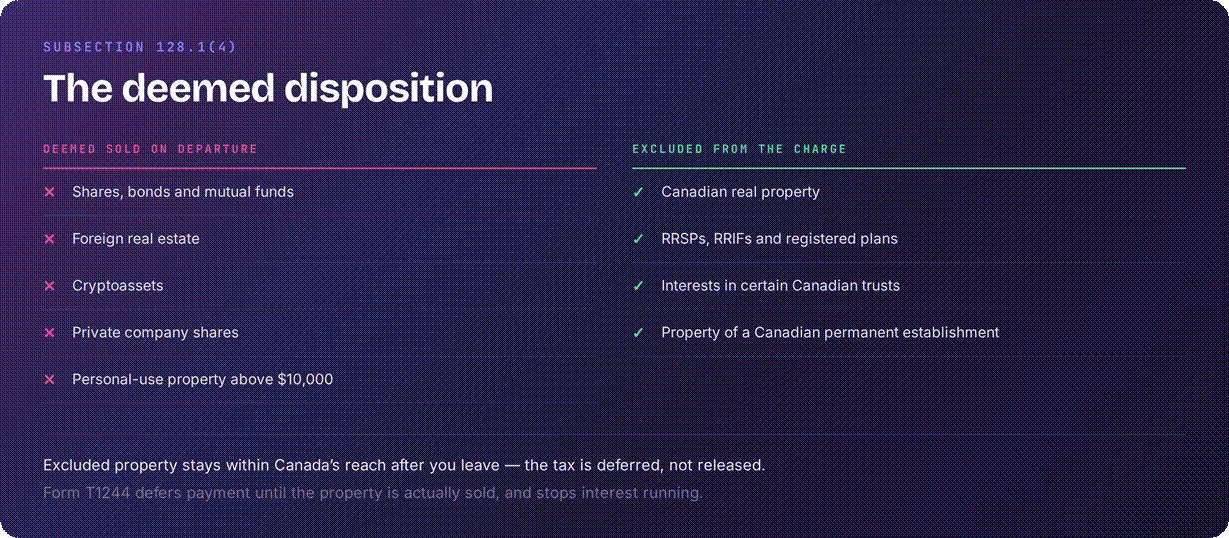
Exclusion from the deemed disposition is deferral, not release.
Deferring the payment
You can elect to defer payment of the tax arising on the deemed disposition by filing Form T1244 with your return, rather than paying it in the departure year. The election stops interest and penalties accruing on the deferred amount.
Security is generally required where the federal tax owing on the deemed disposition exceeds a threshold — broadly, no security is needed for the first $100,000 of capital gains. The election is filed regardless of the amount involved, and the deferred tax becomes payable when the property is actually sold.
If you come back
Emigrants who later resume Canadian residence often forget that the deemed disposition can be unwound. An election is available to reverse it, with a refund of departure tax paid, and it must be made with the return for the year you re-enter.
Because that election has a deadline and is easily missed, anyone returning to Canada should raise it before filing rather than after.
Case study: Élise leaves, Grant does not quite
Élise moves to Singapore in March. She sells her Toronto condo before leaving, her partner travels with her, she cancels her provincial health coverage, and she becomes tax resident in Singapore in April. Her departure date is April, she files a departure return, and the deemed disposition applies to her portfolio and her holiday property in France.
Grant moves to Dubai the same month, but keeps his Vancouver house empty "just in case", his wife stays until the school year ends, and he retains his provincial health card. On those facts the CRA may well treat him as a continuing factual resident, taxable in Canada on worldwide income — with no departure tax, because he never departed for tax purposes.
Grant’s position is worse than Élise’s in every respect. He gets the compliance burden of Canadian residence without the clean break he thought he had bought.
What non-residents still pay
After departure, Canada continues to tax Canadian-source income. Part XIII withholding at 25% applies to rents, dividends, royalties and registered plan withdrawals, reduced by treaty in many cases. Canadian employment income and gains on taxable Canadian property remain taxable directly.
Benefits stop as well, and this is where people get caught. Non-residents are generally ineligible for the GST/HST credit and the Canada Child Benefit, and continuing to receive them after departure leads to repayment demands. Provincial and territorial credits usually require residence on 31 December, so a mid-year departure can leave you taxed partly as a resident but unable to claim them.
Filing and the compliance calendar
The Canadian tax year follows the calendar year. For the year of emigration you file a departure return, reporting worldwide income to the departure date, Canadian-source income after it, and the deemed disposition. It is due by 30 April of the following year, with a 15 June deadline where you or your spouse carried on a business — though payment is still due 30 April.
Tell the CRA the date you left. It is not merely administrative: it stops benefit payments you are no longer entitled to, and it establishes the date on which the deemed disposition is measured.
Timing matters more than the headline charge
Model your position before you go, considering:
• Which ties you can realistically sever, and when;
• Whether your departure date can be brought forward by severing ties sooner;
• What your accrued gains look like, including on foreign real estate;
• Whether realising losses before departure would offset the deemed gains;
• Whether to pay the departure tax or elect to defer it;
• What treaty relief is available in your destination country; and
• Whether you may return, and what that would mean for the unwinding election.
Your Canada checklist
1. List every significant and secondary tie, and decide which you will sever;
2. Record the dates you left, your family left, and you became resident elsewhere;
3. Value all worldwide property as at the departure date, foreign real estate included;
4. Identify which assets fall outside the deemed disposition;
5. Consider realising losses before departure to offset deemed gains;
6. Decide whether to pay the departure tax or elect to defer it on Form T1244;
7. Check the treaty tie-breaker position with your destination country;
8. Tell the CRA your date of departure and stop any benefit payments;
9. File the departure return by 30 April of the following year; and
10. If you may return, note the election that unwinds the deemed disposition.
Frequently asked questions
Does leaving Canada automatically make me non-resident?
No. Residence turns on residential ties rather than physical presence. Someone who keeps a home available, leaves a spouse behind or retains provincial health coverage may remain a factual resident and continue to be taxed on worldwide income.
When exactly does my residence end?
The CRA generally treats it as the latest of the date you leave Canada, the date your spouse or dependants leave, and the date you become resident of another country. That can be months after your flight.
What does the departure tax apply to?
Most capital property wherever situated, deemed sold at fair market value on the day you cease residence. Foreign real estate is included and is the item most often overlooked. Canadian real property, registered plans and certain trust interests are excluded.
Can I defer paying it?
Yes. Form T1244 elects to defer payment until the property is actually sold, and stops interest accruing. Security is generally required where the federal tax owing exceeds a threshold, with no security needed for broadly the first $100,000 of capital gains.
Did the capital gains inclusion rate change?
No. The proposed increase from one-half to two-thirds was announced in the 2024 budget, deferred in January 2025 and then cancelled in March 2025. The one-half inclusion rate continues to apply.
What if a treaty makes me resident of my new country?
You become a deemed non-resident of Canada, and the same departure tax rules apply as if you had emigrated. A treaty tie-breaker does not avoid the charge — it can trigger it.
Do I still pay Canadian tax after I leave?
On Canadian-source income, yes. Part XIII withholding at 25% applies to rents, dividends, royalties and registered plan withdrawals, often reduced by treaty, and gains on taxable Canadian property remain taxable.
What happens if I move back to Canada?
An election is available to unwind the deemed disposition and recover departure tax paid. It must be made with the return for the year you re-enter, so it should be raised before that return is filed rather than afterwards.
Official sources and further reading
• Government of Canada guidance on income tax
Important information
This article is general information and does not constitute tax, legal, immigration or financial advice, and does not create a client relationship. Tax outcomes depend on travel history, income sources, treaty status and the law applying to the relevant year. Rates, thresholds and regimes change, and some measures described may be proposed rather than enacted; this article reflects our understanding as at the date of publication. Obtain advice from a suitably qualified professional before acting or refraining from action.
