
South Africans working abroad can shelter R1.25 million of foreign employment income. The cap has not moved since 2020, and it was never available to the self-employed.
South Africa taxes residents on worldwide income. Leaving the country does not by itself change that, which is why so many South Africans working abroad discover a SARS obligation they thought they had left behind.
There are two ways out of the worldwide charge, and they are very different in character. One is to stay resident and claim a capped exemption on foreign employment income under section 10(1)(o)(ii). The other is to cease residence altogether and accept the exit charge under section 9H.
Most people assume the first route is straightforward. It is narrower than its reputation.

Meeting either test makes you resident — the physical presence test has three limbs.
Your residency status is the first step
South Africa applies two tests, and meeting either makes you resident. The ordinarily resident test is not defined in the legislation and is assessed case by case, drawing on the factors set out in SARS Interpretation Note 3 — where your permanent home is, where your family and social ties sit, and where you habitually return.
The physical presence test is arithmetic. You are resident if you are present in South Africa for more than 91 days in the current year of assessment, more than 91 days in each of the five preceding years of assessment, and more than 915 days in aggregate across those five preceding years. All three limbs must be met.
Someone who becomes resident under the physical presence test ceases to be resident if they are outside South Africa for a continuous period of at least 330 full days. Someone who is ordinarily resident does not get that arithmetic exit — they have to show that South Africa is no longer the place to which they naturally return.
Maintain accurate records of:
• Arrival and departure dates by year of assessment, running March to February;
• Day counts for the current year and each of the five preceding years;
• Continuous days outside South Africa, and whether any period reaches 330;
• Where your permanent home is, and whether one remains available in South Africa;
• Where your family, social and economic ties sit; and
• Any treaty that may apply between South Africa and your new country.
The R1.25 million exemption, and its conditions
Section 10(1)(o)(ii) exempts the first R1.25 million of foreign employment income from South African tax for a resident who meets every condition. Income above the cap is taxed at marginal rates reaching 45%, with a section 6quat credit available for foreign tax paid on the excess.
The conditions are cumulative:
Condition | Requirement |
Residence | You must be a South African tax resident |
Employment | Income must be from employment — an employment contract is needed |
Days abroad | More than 183 days outside South Africa in any 12-month period |
Continuous period | At least 60 of those days must be unbroken |
Services | The services must be rendered outside South Africa for that employer |
Cap | Only the first R1.25 million is exempt |
Self-employed | Excluded entirely — the relief does not apply |
The self-employed exclusion is absolute. A consultant invoicing a foreign client through their own company, a freelancer with a portfolio of overseas clients, and an independent contractor on a services agreement all fall outside section 10(1)(o)(ii) however long they spend abroad. The relief was written for employees and has never been extended.
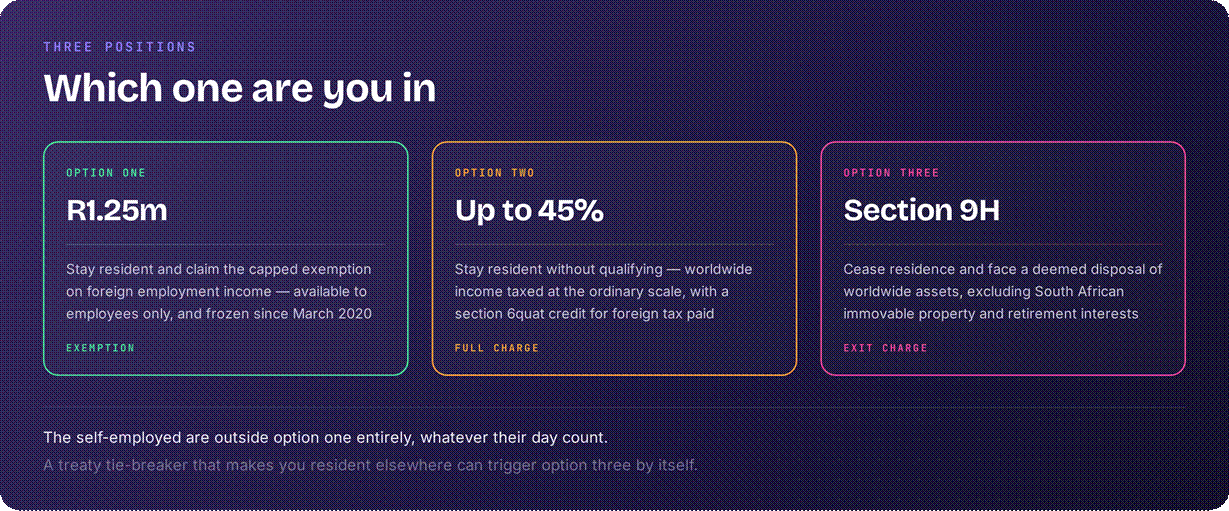
Three routes, and only one of them shelters anything.
Ceasing residence and the section 9H charge
The alternative is to cease South African residence. On doing so, section 9H deems you to have disposed of your worldwide assets at market value on the day before residence ends. Accrued gains become taxable even though nothing has been sold.
Two categories sit outside the deemed disposal: South African immovable property and retirement interests. Both remain within the South African net afterwards, so the exclusion is a deferral rather than an escape. Assets of a South African permanent establishment are similarly carved out.
Importantly, the charge is not limited to physical emigration. Where a treaty tie-breaker makes you exclusively resident in another country, you cease to be South African resident for treaty purposes and the same consequences can follow.
Case study: Thandi and Pieter, both in Dubai
Thandi works in Dubai on an employment contract with a UAE employer. She spends more than 183 days outside South Africa, including an unbroken stretch of four months, and remains South African tax resident. The first R1.25 million of her salary is exempt; the balance is taxed in South Africa at her marginal rate, with no UAE tax to credit because the UAE levies none.
Pieter does the same work for the same company, but through his own consultancy on a services agreement. Every condition he meets on days and continuity is irrelevant, because he is not an employee. His full foreign income is taxable in South Africa.
The two are indistinguishable in substance and worlds apart in tax. Anyone weighing a contractor arrangement against employment should price that difference before signing.
Rates, and what else is in scope
South African personal income tax is progressive, with a top marginal rate of 45%. Capital gains are brought in at an inclusion rate of 40% for individuals, giving an effective maximum rate of around 18%.
Residents are taxable on worldwide income, so foreign dividends, interest, rental income and gains all need declaring, subject to any specific exemption and to section 6quat credits for foreign tax paid. A foreign pension may have its own treatment under the relevant treaty.
Filing and the compliance calendar
The South African year of assessment runs 1 March to the end of February. Filing season for individuals generally opens in July, with deadlines falling in the following months and a later deadline for provisional taxpayers, typically in January. SARS publishes the dates annually and they move, so confirm them for your year.
An exemption is not an exemption from filing. Foreign employment income within the R1.25 million cap still has to be declared, and SARS expects to see the evidence supporting the claim. Prepare in good time:
• Your employment contract and payslips from the foreign employer;
• A precise travel record supporting the 183-day and 60-day tests;
• Passport stamps, boarding passes and flight records;
• Evidence of foreign tax paid, for section 6quat purposes;
• Details of all foreign investment income and gains; and
• Documentation of your residence position, if you have ceased residence.
Timing matters more than the headline cap
Model your position before you go, considering:
• Whether you will be an employee or a contractor, because only one qualifies;
• Whether your 12-month qualifying period straddles two years of assessment;
• Whether you can structure an unbroken 60-day period abroad;
• How much of your income will sit above the frozen R1.25 million cap;
• Whether the destination country levies tax that would generate a credit;
• Whether ceasing residence is better than claiming the exemption; and
• What the section 9H charge would cost if you did cease residence.
Your South Africa checklist
1. Establish whether you are ordinarily resident, present-test resident, or neither;
2. Count days by year of assessment, running March to February;
3. Check all three limbs of the physical presence test, not just the first;
4. Confirm whether you are an employee or a contractor before anything else;
5. Track the 183 days and the unbroken 60-day period precisely;
6. Keep passport stamps and flight records as supporting evidence;
7. Model how much income sits above the frozen R1.25 million cap;
8. Collect evidence of foreign tax paid for section 6quat credits;
9. Price the section 9H exit charge before deciding to cease residence; and
10. Declare foreign employment income even where it is exempt.
Frequently asked questions
Has the R1.25 million cap increased?
No. It has been unchanged since 1 March 2020 and was left unchanged again at Budget 2026. Because it is not indexed, its real value falls every year while salaries rise.
Can a freelancer or contractor claim the exemption?
No. Section 10(1)(o)(ii) applies to employees. Independent contractors, consultants and the self-employed are excluded entirely, regardless of how many days they spend outside South Africa.
What are the day requirements?
More than 183 days outside South Africa in any 12-month period, including a continuous period of more than 60 full days, with the services rendered outside South Africa for that employer during those periods.
What happens to income above the cap?
It is taxable in South Africa at marginal rates reaching 45%, with a section 6quat credit available for foreign tax paid on that income. In a zero-tax country there is no foreign tax to credit, so the full South African charge applies.
What is the section 9H exit charge?
On ceasing South African residence you are deemed to have disposed of your worldwide assets at market value the day before, and accrued gains become taxable. South African immovable property and retirement interests are excluded, but they remain within the South African net afterwards.
Does ceasing residence require physically leaving?
Not necessarily. Where a treaty tie-breaker makes you exclusively resident in another country, you can cease to be South African resident for treaty purposes and the same exit consequences can follow.
Do I still have to file if my income is under the cap?
Yes. The exemption limits what is taxed, not whether you report. Foreign employment income within the cap must still be declared, and SARS expects supporting evidence for the claim.
When does the South African tax year run?
1 March to the end of February. Filing season for individuals generally opens in July, with a later deadline for provisional taxpayers. SARS publishes the exact dates each year and they change, so check them rather than assuming.
Official sources and further reading
Important information
This article is general information and does not constitute tax, legal, immigration or financial advice, and does not create a client relationship. Tax outcomes depend on travel history, income sources, treaty status and the law applying to the relevant year. Rates, thresholds and regimes change, and some measures described may be proposed rather than enacted; this article reflects our understanding as at the date of publication. Obtain advice from a suitably qualified professional before acting or refraining from action.
