
Germany has two provisions aimed at people who leave. One charges you on the way out. The other keeps taxing you for ten years afterwards, and almost nobody sees it coming.
For anyone with a shareholding leaving Germany, the central provision is section 6 of the Außensteuergesetz — the Wegzugsbesteuerung, or exit tax. It treats departure as a sale of your shares, taxing gains you have not realised and cannot fund from the transaction, because there is no transaction.
Germany taxes residents on worldwide income. Residence follows from having a Wohnsitz under section 8 of the Abgabenordnung — a dwelling you keep and may use — or a habitual abode under section 9, broadly more than six months of continuous presence.
The Wohnsitz test is the quieter trap. A flat retained in Germany and available to you can sustain unlimited tax liability on a modest day count, which is the same structural problem Kenya’s permanent home rule creates. Genuinely ending German residence means giving up the dwelling, not simply spending time elsewhere.
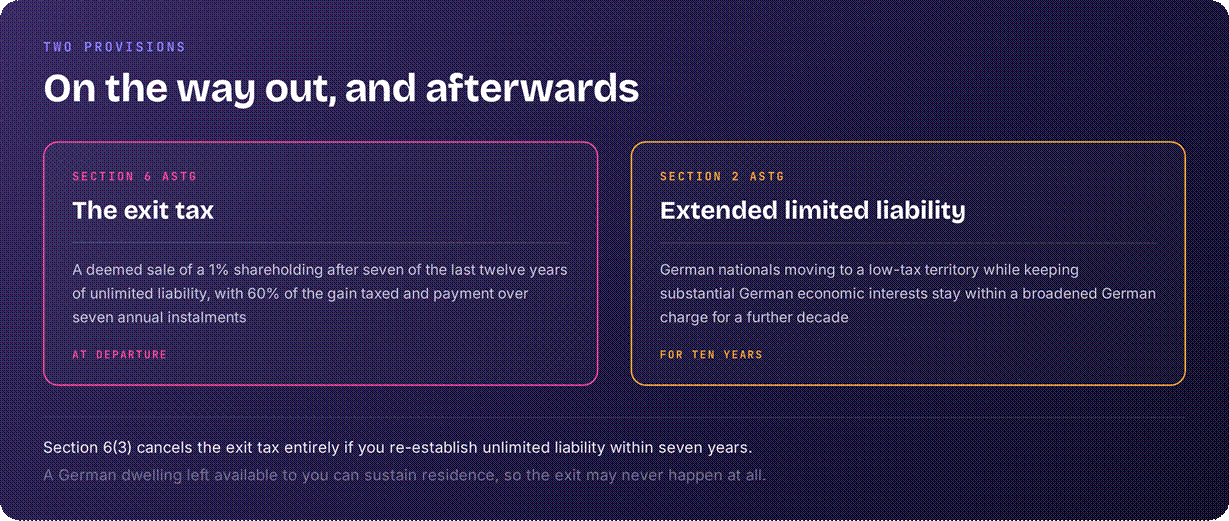
Two provisions, one before you leave and one for ten years afterwards.
Your residency status is the first step
Unlimited tax liability arises from a Wohnsitz or a habitual abode. A Wohnsitz means holding a dwelling in circumstances suggesting you will keep and use it — ownership is not required, and neither is regular occupation. Deregistering with the local authority does not settle the question if the flat is still there and still yours.
Maintain accurate records of:
• The dates any German dwelling was disposed of or let on arm’s-length terms;
• Deregistration dates, and what happened to the property afterwards;
• Days spent in Germany across rolling periods;
• The years in which you were subject to unlimited liability;
• All shareholdings of 1% or more, with acquisition costs and current values; and
• Any treaty that may apply between Germany and your new country.
The exit tax, and who it reaches
Section 6 applies where you have been subject to unlimited German tax liability for at least seven years within the last twelve, and hold at least 1% of the shares in a domestic or foreign corporation. On departure you are deemed to have sold those shares at market value.
The gain is taxed under the Teileinkünfteverfahren, so 60% of it enters taxable income at your personal rate. The result is a charge on what German commentary calls dry income — tax due on value you have not received and may never receive.
Element | Position |
Qualifying period | Seven of the last twelve years of unlimited liability |
Shareholding | At least 1% in a domestic or foreign corporation |
Trigger | Departure, gift to a non-resident, or loss of German taxing rights |
Base | Market value less acquisition cost |
Inclusion | 60% of the gain, under the partial income method |
Payment | Seven equal annual instalments, generally against security |
Cancellation | Returning within seven years, extendable to twelve |
The 2022 reform removed the easy route. Before it, EU and EEA citizens moving within the EU or EEA could defer the charge indefinitely, interest-free and without security. That deferral was abolished and replaced with the seven-year instalment arrangement, which generally requires security.

Seven of twelve years, and a 1% holding — both are needed.
The returnee rule
Section 6(3) is the most useful provision in the section and the one most often overlooked. If you re-establish unlimited German tax liability within seven years of departure, the exit tax assessment is cancelled. The period can be extended to twelve years where the intention to return is demonstrated.
For someone taking a defined posting abroad rather than emigrating permanently, this can change the analysis entirely. It also means the charge should not be treated as final at the moment of departure if a return is genuinely possible.
Extended limited liability under section 2 AStG
The second provision catches people after they have gone. Where a German national who was subject to unlimited liability for at least five of the last ten years moves to a low-tax territory and retains substantial economic interests in Germany, section 2 AStG extends German taxing rights over a broader range of German-source income for ten years.
It is narrower than it sounds — it needs nationality, the low-tax destination and the retained interests together — but it is genuinely surprising to people who believed departure ended the relationship. Anyone moving to a Gulf state or a similar jurisdiction while keeping German business interests should have it checked specifically.
Case study: Lukas keeps the flat
Lukas moves to Dubai, deregisters, and takes a role there. He keeps his Munich apartment empty because he expects to return in a few years and does not want to sell into a weak market.
The apartment is available to him, which is capable of sustaining a Wohnsitz and therefore unlimited German tax liability. On that footing he never ceased to be German resident, so his worldwide income — including his Dubai salary — remains within the German charge.
The irony is that he was worrying about the exit tax on his shareholding. That charge never arose, because he never exited. The larger bill was the one nobody modelled.
Rates and the compliance calendar
German income tax is progressive, reaching 42%, with a further band at 45% on the highest incomes, plus the solidarity surcharge where it still applies and church tax for members. Investment income is generally taxed under the Abgeltungsteuer at a flat 25% plus surcharges.
The tax year follows the calendar year. The return is generally due by 31 July of the following year, extended well into the following year again where a Steuerberater files on your behalf. Prepare in good time:
• Share registers and acquisition cost documentation;
• Valuations supporting any deemed disposal;
• Evidence of the disposal or letting of German property;
• Records of your unlimited liability years;
• Documentation of any intention to return, for section 6(3); and
• Details of German-source income retained after departure.
Timing matters more than the rate
Model your position before you go, considering:
• Whether you have reached seven of the last twelve years of unlimited liability;
• Whether any holding reaches the 1% threshold;
• Whether a genuine return within seven years is likely;
• Whether security can be provided for the instalment arrangement;
• Whether any German dwelling will remain available to you;
• Whether your destination is a low-tax territory for section 2 purposes; and
• Whether restructuring before departure is feasible, and defensible.
Your Germany checklist
1. Count your years of unlimited liability against the seven-of-twelve test;
2. Identify every holding of 1% or more, domestic and foreign;
3. Value those holdings and document acquisition cost before departure;
4. Dispose of or genuinely let any German dwelling you are leaving behind;
5. Consider whether a return within seven years is realistic, for section 6(3);
6. Establish whether security can be provided for the instalments;
7. Check whether your destination counts as a low-tax territory;
8. Assess section 2 AStG separately if you are a German national;
9. Confirm the treaty position with your new country; and
10. Take advice before restructuring rather than afterwards.
Frequently asked questions
Who does the German exit tax apply to?
Individuals who have been subject to unlimited German tax liability for at least seven years within the last twelve and hold at least 1% of the shares in a domestic or foreign corporation. Below either threshold, section 6 does not apply.
How much of the gain is taxed?
60% of it, under the partial income method, at your personal income tax rate. The charge falls due even though no sale has taken place and no proceeds have been received.
Can I still defer the tax indefinitely within the EU?
No. The interest-free, unlimited deferral for moves within the EU and EEA was abolished by the 2022 reform and replaced with payment over seven equal annual instalments, generally against security.
What happens if I move back to Germany?
Section 6(3) cancels the assessment where unlimited tax liability is re-established within seven years of departure, and that period can be extended to twelve where an intention to return is demonstrated.
Does deregistering end my German tax residence?
Not by itself. Unlimited liability follows from holding a dwelling you may use — a Wohnsitz — or a habitual abode. A flat kept available can sustain residence regardless of what the registration office records.
What is extended limited liability?
Section 2 AStG keeps a broadened German charge in place for ten years where a German national who was an unlimited taxpayer for five of the last ten years moves to a low-tax territory and retains substantial German economic interests.
Does the exit tax apply to my property or my bank accounts?
No. Section 6 targets shareholdings of 1% or more in corporations. Real estate and ordinary bank deposits are not within it, though German-source income from property continues to be taxable after departure.
When is the German return due?
Generally 31 July following the calendar tax year, with a considerably later deadline where a registered tax adviser files on your behalf.
Official sources and further reading
• Bundeszentralamt für Steuern
Important information
This article is general information and does not constitute tax, legal, immigration or financial advice, and does not create a client relationship. Tax outcomes depend on travel history, income sources, treaty status and the law applying to the relevant year. Rates, thresholds and regimes change, and some measures described may be proposed rather than enacted; this article reflects our understanding as at the date of publication. Obtain advice from a suitably qualified professional before acting or refraining from action.
