
Angola is replacing its employment income tax with an entirely new personal income tax code from January 2027 — six bands, a 30% ceiling, and tax refunds for the first time.
Angola currently taxes employment income through the IRT — Imposto sobre o Rendimento do Trabalho. From 1 January 2027 it is expected to be replaced by an entirely new code: the IRPS, Imposto sobre o Rendimento das Pessoas Singulares.
The new tax has six bands with a maximum rate of 30% on annual income above 240 million kwanzas. According to the head of the tax authority, it reduces the burden on the lowest salaries by up to 76% and permits tax refunds to taxpayers for the first time.
The comparative figures presented by the AGT are specific. Someone on 175,000 Kz a month would pay 4,000 Kz instead of the current 16,500 Kz — a reduction of nearly 76%. The relief tapers as income rises: around 42% at 390,000 Kz, 26% at 712,000 Kz and 11% at 2.243 million. At 21 million a month, the charge rises by about 0.96%.
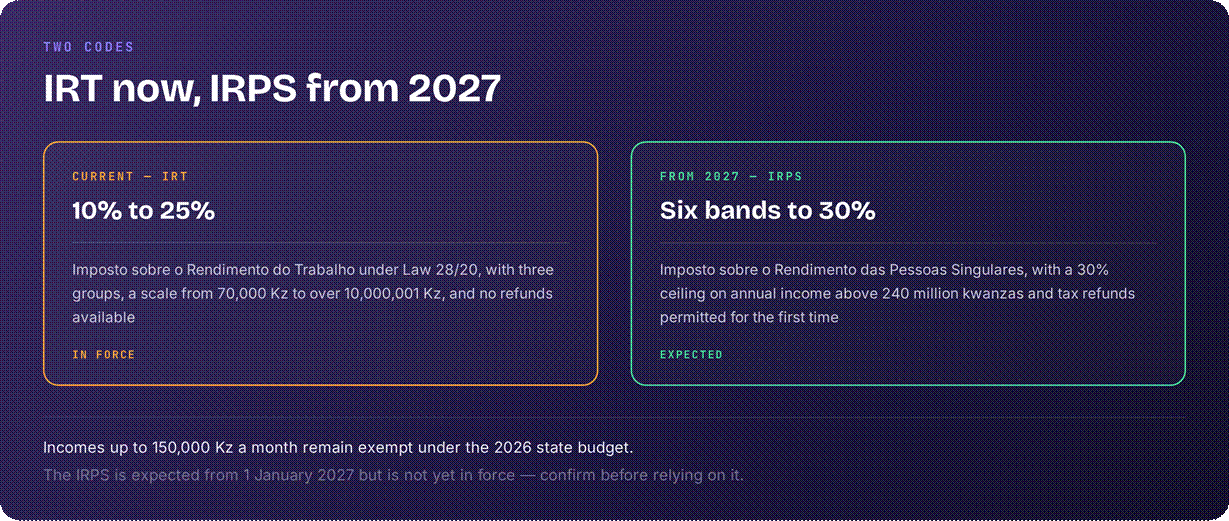
The tax now, and the tax coming.
The current position: the IRT
Until the new code takes effect, the IRT governs. It operates under Law 28/20 of 22 July 2020, which restructured the bands so that rates run from 10% to 25% across a scale beginning at 70,000 Kz and reaching above 10,000,001 Kz — replacing an earlier structure of 7% to 17%.
The IRT divides taxpayers into three groups:
• Group A — all salaries paid by companies to employees;
• Group B — salaries paid to self-employed workers and to holders of administrative or corporate office; and
• Group C — income from industrial and commercial activities.
Which group you fall into determines the computation, so it should be established before anything else.
The exemption threshold has climbed repeatedly
The point at which IRT begins has moved four times in recent years, and each move is worth knowing because older guidance quotes superseded figures:
• 34,450 Kz a month under the earlier structure;
• 70,000 Kz from 1 September 2020, under Law 28/20;
• 100,000 Kz from January 2024, under the 2024 state budget, which also reduced the table from 13 bands to 12; and
• 150,000 Kz a month under the 2026 state budget.
One quirk worth noting from the 2020 change: once income reaches or exceeds the threshold, withholding applies to the total amount placed at the worker’s disposal, not merely to the excess.
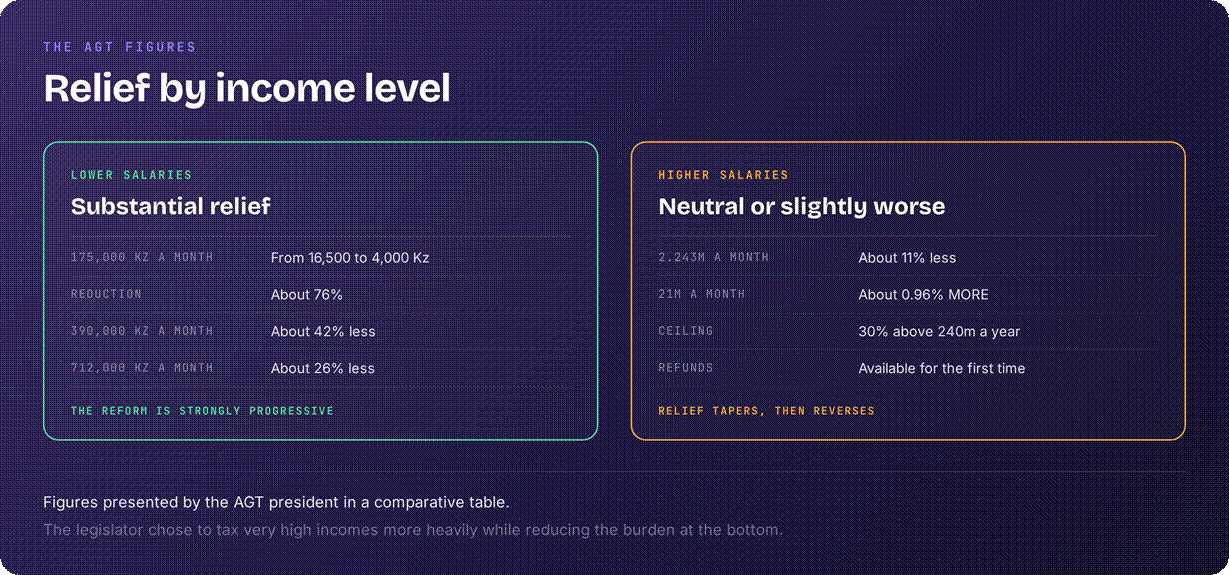
How the relief varies by income.
What the reform means for planning
For anyone considering Angola, the reform changes the analysis in three ways.
First, the ceiling falls to 30% and only engages at 240 million kwanzas of annual income — a high threshold that leaves most earners well below it. Second, refunds become possible, which they were not under the IRT. Third, the structure moves from a fragmented set of groups toward a single personal income tax.
The qualification is timing. The code is expected to enter into force on 1 January 2027, and Angolan trade unions publicly objected in December 2025 to what they described as unilateral preparation of the new diploma. Anyone planning around it should confirm the position before relying on it.
What makes Angola workable
The direction of travel is favourable:
• A rising exemption threshold, now at 150,000 Kz a month under the 2026 budget;
• A 30% ceiling under the new IRPS, against 25% currently but with a very high threshold;
• Tax refunds for the first time, which the IRT did not permit;
• Relief of up to 76% for the lowest salaries under the new code;
• A clear three-group structure under the current IRT, making the applicable rules easy to identify; and
• A substantial economy with significant international business presence.
The honest qualifications are that the IRPS is not yet in force, that the reform increases the charge at the very top, and that the current IRT withholds on the total amount rather than the excess once the threshold is crossed.
Case study: the same salary, before and after
Take someone earning 175,000 Kz a month. Under the current IRT they pay roughly 16,500 Kz. Under the proposed IRPS the same salary would attract about 4,000 Kz — a reduction of nearly 76%.
Now take someone on 2.243 million a month. Their reduction is around 11% — real, but far smaller. And at 21 million a month, the charge rises by around 1%.
The reform is therefore strongly progressive in its effect. For most people moving to Angola on a professional salary, it is a meaningful improvement; for the highest earners it is broadly neutral or slightly worse.
Filing and the compliance calendar
The system is administered by the Administração Geral Tributária. Employers withhold IRT from employees’ salaries and remit it alongside contributions to the INSS, the national social security institute, to which both employer and employee contribute.
Prepare in good time:
• Registration with the AGT;
• Confirmation of which IRT group applies to you;
• Payroll records showing the correct exemption threshold;
• Awareness that withholding applies to the total once the threshold is crossed;
• INSS contribution records; and
• Confirmation of whether the IRPS has taken effect for the period concerned.
Confirm which code applies
Consider:
• Whether the period you are computing falls under the IRT or the IRPS;
• That the IRPS is expected from 1 January 2027 but is not yet in force;
• Which of the three IRT groups applies to you;
• That the exemption threshold is now 150,000 Kz a month;
• That older guidance quotes 34,450, 70,000 or 100,000 Kz;
• That the IRT withholds on the total once the threshold is crossed; and
• That the new code permits refunds, which the IRT does not.
Your Angola checklist
1. Establish whether the IRT or IRPS applies to your period;
2. Confirm the IRPS has actually entered into force before relying on it;
3. Identify which of the three IRT groups you fall into;
4. Use the current exemption threshold of 150,000 Kz a month;
5. Discard guidance quoting 34,450, 70,000 or 100,000 Kz;
6. Note that IRT withholds on the total once the threshold is crossed;
7. Model your own position against the AGT comparative figures;
8. Note that refunds become available under the new code;
9. Record INSS contributions separately; and
10. Register with the Administração Geral Tributária.
Frequently asked questions
Is Angola changing its income tax?
Yes. The IRPS — Imposto sobre o Rendimento das Pessoas Singulares — is expected to replace the current IRT from 1 January 2027, with six bands, a 30% maximum on annual income above 240 million kwanzas, and tax refunds permitted for the first time.
How much does the reform save?
It depends sharply on income. The AGT figures show someone on 175,000 Kz a month paying 4,000 Kz instead of 16,500 — about 76% less. Relief falls to around 42% at 390,000 Kz, 26% at 712,000 Kz and 11% at 2.243 million, while 21 million a month pays around 1% more.
What applies now?
The IRT under Law 28/20 of 22 July 2020, with rates from 10% to 25% across a scale running from 70,000 Kz to over 10,000,001 Kz, and three separate taxpayer groups.
What are the three IRT groups?
Group A covers salaries paid by companies to employees, Group B covers self-employed workers and holders of administrative or corporate office, and Group C covers income from industrial and commercial activities.
What is the exemption threshold?
150,000 Kz a month under the 2026 state budget. It has risen repeatedly — from 34,450 Kz, to 70,000 Kz in September 2020, to 100,000 Kz in January 2024, and now to 150,000 Kz.
Does the threshold work as an allowance?
Not under the IRT. Once income reaches or exceeds the threshold, withholding applies to the total amount placed at the worker’s disposal rather than only to the excess.
Is the new code certain?
It is expected from 1 January 2027 but is not yet in force, and Angolan trade unions publicly objected in December 2025 to the preparation of the new diploma. Confirm the position before planning around it.
What about social security?
Both employer and employee contribute to the INSS, the national social security institute, alongside IRT withholding operated by the employer.
Official sources and further reading
• Administração Geral Tributária, Angola
Important information
This article is general information and does not constitute tax, legal, immigration or financial advice, and does not create a client relationship. Tax outcomes depend on travel history, income sources, treaty status and the law applying to the relevant year. Rates, thresholds and regimes change, and some measures described may be proposed rather than enacted; this article reflects our understanding as at the date of publication. Obtain advice from a suitably qualified professional before acting or refraining from action.
