
Puerto Rico extended its resident investor programme to 2055 and ended the 0% rate in the same statute. Applications filed by 31 December 2026 keep the old deal. Those filed afterwards do not.
Puerto Rico occupies a position no country can replicate. It is a United States territory, so an American moving there does not emigrate, does not need a visa and does not renounce anything. But it runs its own income tax system, and a bona fide resident of Puerto Rico is generally outside the US federal charge on Puerto Rico-source income under section 933 of the Internal Revenue Code.
That structural quirk is what the incentive programme is built on. Act 60-2019, the Puerto Rico Incentives Code, consolidated the older Act 20 and Act 22 regimes. Its Resident Individual Investor chapter historically gave a 0% Puerto Rico rate on Puerto Rico-source interest, dividends and capital gains accruing after the move.
On 10 March 2026, Governor Jenniffer González-Colón signed Act 38-2026, the most significant amendment to the Incentives Code since it was enacted. It extends the programme by twenty years and ends the 0% rate for anyone applying after this year.
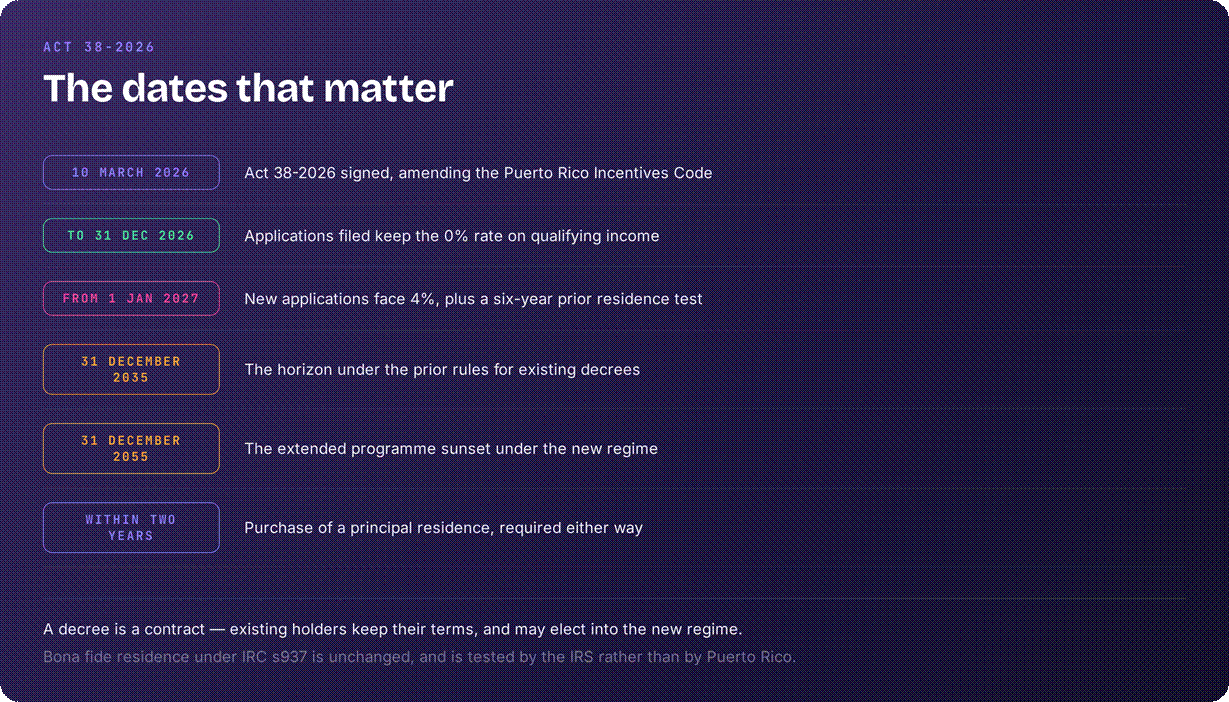
The dates that decide which regime applies to you.
Your residency status is the first step, and it is federal
The benefits work only for a bona fide resident of Puerto Rico as the IRS defines it, under section 937 and Publication 570. Three tests must all be satisfied:
• The presence test — generally at least 183 days physically in Puerto Rico during the tax year, with alternative ways to satisfy it;
• The tax home test — no tax home outside Puerto Rico, meaning your main place of business is on the island; and
• The closer connection test — no closer connection to the US mainland or a foreign country than to Puerto Rico.
These are federal tests applied by the IRS, not Puerto Rican ones, and the closer connection test is the one that fails in practice. Someone who keeps a mainland home, mainland family and mainland social life while clearing 183 days on the island is vulnerable, and the IRS has pursued exactly that pattern.
Maintain accurate records of:
• Days physically present in Puerto Rico, the mainland and elsewhere;
• Where your principal place of business is located;
• Housing arrangements retained on the mainland;
• Where your family lives and where your personal ties sit;
• The date the decree application was filed; and
• Valuations of assets as at the date you became a resident.
What the decree gives, and what it never covered
Income | Treatment under a decree |
Puerto Rico-source interest | Exempt under the pre-2027 rules |
Puerto Rico-source dividends | Exempt under the pre-2027 rules |
Gains accruing after residency | Exempt under the pre-2027 rules |
Gains accrued before the move | Generally within the US federal charge |
US-source income | Remains federally taxable |
Foreign-source income | Outside the decree — check the federal position |
Estate and gift | US federal estate and gift tax on worldwide assets still applies |
The decree is not a general escape from US tax. It exempts a defined category of Puerto Rico-source passive income from Puerto Rico tax, and section 933 keeps that income outside the federal charge for a bona fide resident. Everything else — mainland income, pre-move appreciation, estate and gift exposure — is unaffected.
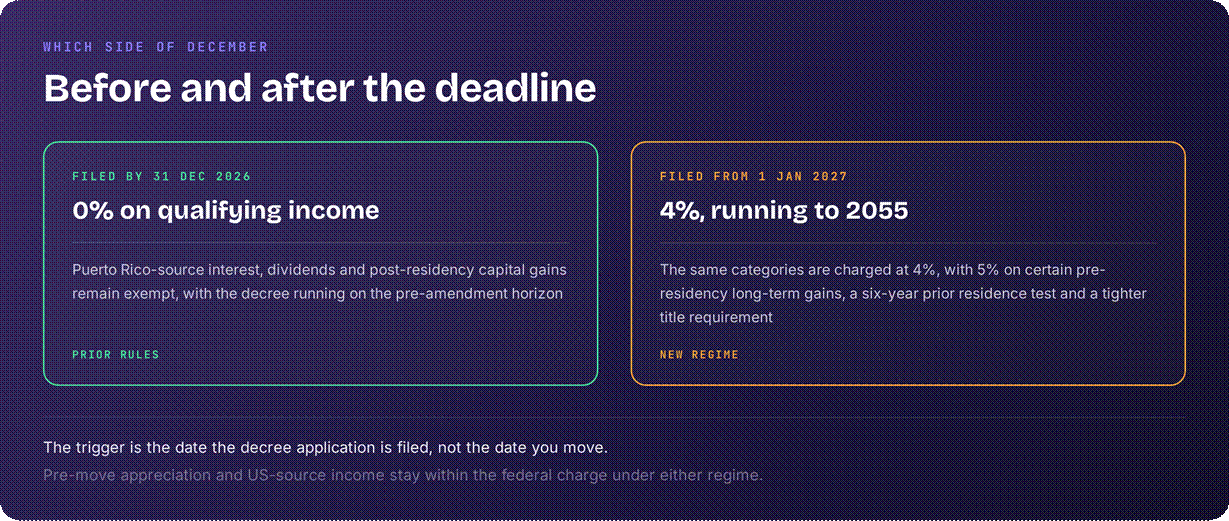
Same facts, different filing date, different deal.
What Act 38-2026 changed
The amendment does three things at once:
• It extends the Resident Individual Investor programme from a sunset of 31 December 2035 to 31 December 2055;
• It ends the 0% rate for new applicants — decree applications filed from 1 January 2027 fall under a regime charging generally 4% on interest, dividends and post-residency capital gains, and 5% on certain pre-residency long-term gains, running to 2055; and
• It adds a six-year prior residence test — applicants after 2026 must show they were not Puerto Rico residents for at least six years before relocating.
There is also a tightened property requirement. All individual resident investors must purchase a principal residence within two years, but applicants from 2027 must additionally evidence that title is registered, or pending registration, in the Property Registry in their own name, jointly with a spouse, or in a qualifying trust.
What did not change
Everything that makes the programme demanding survives. Bona fide residency under the three federal tests. The annual charitable contribution, currently $10,000, half directed to government-listed non-profits. The purchase of a principal residence within two years. The annual report to the Department of Economic Development and Commerce, with its filing fee.
Case study: two applications, ten weeks apart
Marcus files his decree application in November 2026. He falls under the prior rules: 0% Puerto Rico tax on qualifying interest, dividends and post-residency gains, with the exemption running to 2035 under his decree terms.
Elena files in February 2027 on identical facts. She falls under the new regime: 4% on the same categories, running to 2055, and she must also demonstrate six years of prior non-residence and register title to her residence in her own name.
Elena gets twenty more years of certainty. Marcus gets a lower rate for a shorter period. Neither is straightforwardly better — but only one of them had a choice, and the deadline decided it.
If you already hold a decree
Existing individual investor decree holders keep the terms they signed. A decree operates as a contract and cannot be modified unilaterally, which is why the amendment applies to future applicants rather than to the existing population.
Act 38-2026 also gives existing holders an option: they may elect to modify their decree to adopt the new regime and its longer 2055 horizon. For someone whose decree expires in 2035 and who intends to stay considerably longer, trading 0% for 4% in exchange for two extra decades may be the better arithmetic. That calculation depends entirely on your expected income and time horizon.
Filing and the compliance calendar
Puerto Rico operates its own tax administration through the Departamento de Hacienda, with its own returns and deadlines, alongside the federal obligations that continue to apply. Decree holders file an annual report with the DDEC evidencing residency, income sources and charitable contributions.
Prepare in good time:
• The decree application and its filing date;
• Evidence supporting all three bona fide residence tests;
• Day counts for Puerto Rico, the mainland and elsewhere;
• Documentation of the annual charitable contribution;
• Property purchase and title registration records; and
• Valuations establishing pre-residency appreciation.
The deadline is the whole question this year
If Puerto Rico is under consideration at all, the timing decision has to be made now rather than reviewed later. Consider:
• Whether an application can realistically be filed before 31 December 2026;
• Whether 0% to 2035 or 4% to 2055 suits your horizon better;
• Whether you could satisfy the six-year prior residence test if you applied later;
• How much of your gain accrued before any move, since that stays federally taxable;
• Whether the closer connection test is genuinely satisfiable on your facts;
• What the annual obligations cost against the benefit; and
• Whether federal estate and gift exposure changes the picture.
Your Puerto Rico checklist
1. Decide now whether an application before 31 December 2026 is achievable;
2. Model 0% on a shorter horizon against 4% to 2055;
3. Test whether you can satisfy the closer connection test honestly;
4. Count days for Puerto Rico, the mainland and elsewhere from the outset;
5. Value your portfolio as at the date residency begins;
6. Separate pre-move appreciation, which stays federally taxable;
7. Budget for the annual charitable contribution and filing fee;
8. Plan the residence purchase within the two-year window;
9. If you hold a decree, consider electing into the 2055 horizon; and
10. Check federal estate and gift exposure separately.
Frequently asked questions
What exactly changed in 2026?
Act 38-2026, signed on 10 March 2026, extended the Resident Individual Investor programme from 2035 to 2055 and ended the 0% rate for new applicants. Applications filed from 1 January 2027 face generally 4% on interest, dividends and post-residency gains.
What is the deadline?
31 December 2026. A decree application filed on or before that date falls under the prior rules; one filed afterwards falls under the new regime. The trigger is the filing date of the application, not the date you relocate.
Do existing decree holders lose their 0% rate?
No. A decree is a contract between the grantee and the government and cannot be modified unilaterally, so amendments enacted afterwards generally do not reach it. Existing holders may, however, elect into the new regime to gain the longer 2055 horizon.
Does Act 60 exempt me from US federal tax?
Not generally. It exempts qualifying Puerto Rico-source passive income from Puerto Rico tax, and section 933 keeps that income outside the federal charge for a bona fide resident. US-source income, pre-move appreciation and federal estate and gift exposure are unaffected.
How is bona fide residence decided?
By the IRS under section 937 and Publication 570, using three tests that must all be met: presence, generally at least 183 days on the island; tax home, meaning no tax home outside Puerto Rico; and closer connection, meaning no closer connection to the mainland or a foreign country.
What are the ongoing obligations?
An annual charitable contribution, currently $10,000 with half to government-listed non-profits; purchase of a principal residence within two years; and an annual report to the DDEC with a filing fee. None of these changed in 2026.
What is the new six-year rule?
Applicants filing from 1 January 2027 must demonstrate they were not Puerto Rico residents for at least six years before relocating. It does not apply to applications filed by the end of 2026.
Are gains I made before moving exempt?
Generally not. Appreciation that accrued before you became a resident remains subject to US federal tax when realised, with special rules including a preferential rate after a ten-year holding period in certain circumstances.
Official sources and further reading
• Departamento de Hacienda de Puerto Rico
• Departamento de Desarrollo Económico y Comercio (DDEC)
Important information
This article is general information and does not constitute tax, legal, immigration or financial advice, and does not create a client relationship. Tax outcomes depend on travel history, income sources, treaty status and the law applying to the relevant year. Rates, thresholds and regimes change, and some measures described may be proposed rather than enacted; this article reflects our understanding as at the date of publication. Obtain advice from a suitably qualified professional before acting or refraining from action.
