
The Dutch expat facility has been rewritten twice in three years, reversing itself along the way. Where it has landed is simple: 30% now, 27% from 2027, and the date your ruling starts fixes which you get.
The Dutch expat facility — universally called the 30% ruling — lets an employer pay part of a qualifying employee’s salary as a tax-free allowance for extraterritorial costs, without the employee having to evidence those costs. It applies to the salary itself, which makes it immediately visible in take-home pay.
It is one of the most valuable inbound reliefs in Europe, and it has also been one of the least stable. A stepped reduction legislated in 2024 would have tapered the benefit from 30% to 20% to 10% across the five-year term. That taper was withdrawn before it fully took effect and replaced with a single lower flat percentage arriving later.
The Netherlands otherwise follows a residence model, taxing residents on worldwide income through a three-box system. Non-residents are taxed on Dutch-source income. The ruling reduces the charge on employment income and, since 2025, on nothing else.
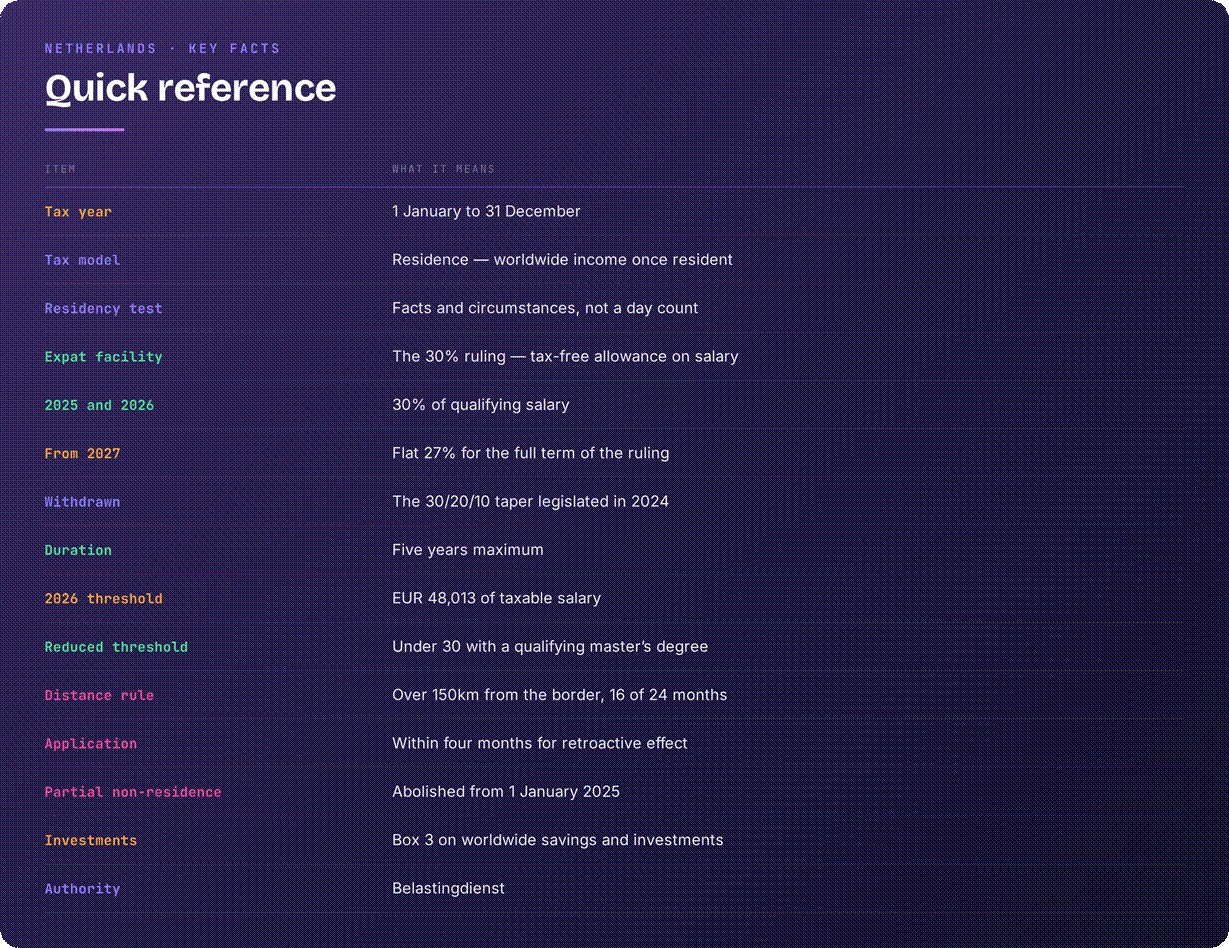
The Dutch position at a glance.
Your residency status is the first step
Dutch tax residence is determined on facts and circumstances rather than a day count. There is no statutory 183-day test for domestic purposes. What matters is where your permanent home is, where your family lives, where you work, where you are registered and where your economic interests sit.
The 183-day figure does appear in treaties, where it helps allocate taxing rights when two countries both claim you. It is not the domestic test, and treating it as one is a common error among people arriving from countries that do use a day count.
Maintain accurate records of:
• Municipal registration dates;
• Where your spouse or partner and children live;
• Housing arrangements in the Netherlands and in your previous country;
• Where your employment duties are physically performed;
• The location of your bank accounts, investments and other economic ties; and
• Any other country that may also treat you as resident.
Where the tax rate has landed
The final design is straightforward, which is more than could be said for the two versions before it:
Period | Percentage of salary paid tax free |
2025 and 2026 | 30% |
Rulings starting from 1 January 2027 | 27%, flat for the full term |
Rulings under earlier rules | Existing treatment, under the transitional provisions |
The 30/20/10 taper legislated in 2024 | Withdrawn before taking full effect |
There is no taper in the final version. A ruling granted from 2027 runs at 27% for its whole duration rather than declining year by year, which makes the position far easier to model than the design that was legislated and then reversed.
The start date is what matters. Someone beginning Dutch employment in December 2026 and someone beginning in January 2027 are on different percentages for the next five years, on identical facts. Where a start date is negotiable, it is worth negotiating.
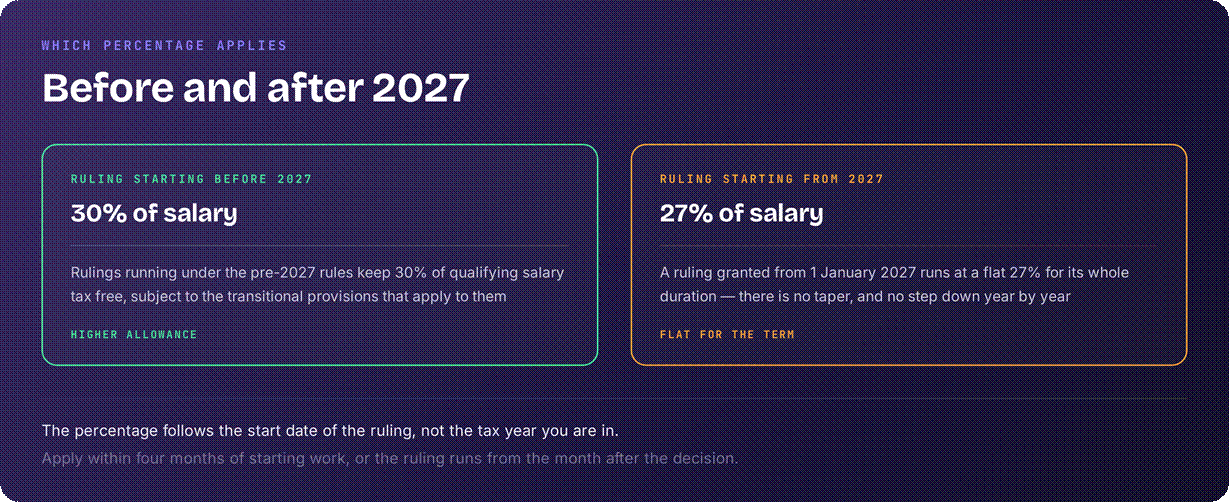
The percentage follows the start date of the ruling, not the current tax year.
The salary threshold
The ruling is available only where the employee’s salary meets a minimum. For 2026 the general threshold is EUR 48,013 of taxable salary after the allowance has been applied, which means the gross figure needs to be meaningfully higher for the test to be met.
A reduced threshold applies to employees under 30 who hold a qualifying master’s degree. Both figures are indexed annually, and the test is applied throughout the year rather than once at the start — an employee whose salary drops below the threshold loses the ruling for the remainder of that year.
The 150 kilometre rule
To qualify, the employee must have lived more than 150 kilometres from the Dutch border for at least 16 of the 24 months before the first day of Dutch employment. It is a straight-line distance test, and it excludes most of Belgium, a large part of western Germany, Luxembourg and parts of northern France.
The test looks at where you lived before starting the job. Someone who moves to the Netherlands first and finds employment afterwards can fail it on the strength of a short period living locally, which is a needless way to lose a five-year benefit.
Five years, and what eats into it
The maximum duration is five years. Previous periods of stay or employment in the Netherlands are generally deducted from that term, so a returning employee may receive considerably less than five years — and in some cases nothing at all.
The ruling must be applied for jointly by employer and employee. Apply within four months of the start of employment and it takes effect retroactively from the first day; apply later and it runs from the month after the decision, permanently shortening the benefit.
Case study: Jonas and the January start
Jonas is offered a role in Amsterdam with a start date of 1 December 2026. He asks to push it to 5 January 2027 so he can finish a project and move over the winter break.
That request costs him three percentage points of his salary, tax free, for five years. A December start places his ruling under the 30% rules; a January start places it under the 27% rate for the whole term.
On a qualifying salary of EUR 90,000, that is a material sum over five years. The point is not that December is always better — it is that the start date is a tax decision, and almost nobody treats it as one.
Partial non-resident status has gone
Ruling holders used to be able to elect partial non-resident status, which kept Box 2 income from a substantial shareholding and Box 3 savings and investments largely outside the Dutch charge. That election was abolished from 1 January 2025, with transitional protection for people who already held a ruling before 2024 running to the end of 2026.
For anyone arriving now, the ruling reduces tax on employment income and does nothing else. Worldwide investment assets fall inside Box 3, and for an expat with a portfolio that is frequently a larger issue than the income tax rate.
What Box 3 means for your savings
The Dutch system taxes income in three boxes: Box 1 for employment and home ownership at progressive rates, Box 2 for income from a substantial shareholding, and Box 3 for savings and investments.
Box 3 has historically charged tax on a deemed return rather than on actual income, an approach that has been repeatedly litigated and is being reformed toward taxing actual return. Anyone moving with a substantial portfolio should model the Box 3 position specifically, and should not assume the outcome will match the rules in force when they first researched the move.
Filing and the compliance calendar
The Dutch tax year follows the calendar year. The annual income tax return is generally filed from 1 March, with a standard deadline of 1 May for the preceding year, and extensions available on request or through a registered adviser.
Prepare in good time:
• The ruling decision letter and its start and end dates;
• Salary records confirming the threshold is met throughout the year;
• Evidence supporting the 150 kilometre condition;
• Details of any previous Dutch stay or employment;
• A full statement of worldwide savings and investments for Box 3;
• Any substantial shareholding details for Box 2; and
• Foreign tax paid and treaty positions claimed.
Timing matters more than the headline percentage
Model your position before accepting an offer, considering:
• Whether the start date falls before or after 1 January 2027;
• Whether your salary clears the threshold with headroom, not marginally;
• Whether you meet the 150 kilometre condition on your pre-move address;
• Whether any previous Dutch period will be deducted from the five years;
• Whether the application will be submitted within four months;
• What Box 3 will charge on your existing portfolio; and
• Whether a treaty affects income the ruling does not touch.
Your Netherlands checklist
1. Check whether your start date falls before or after 1 January 2027;
2. Confirm your salary clears the 2026 threshold with headroom;
3. Check the reduced threshold if you are under 30 with a master’s degree;
4. Measure your pre-move address against the 150 kilometre condition;
5. Establish whether any previous Dutch period will be deducted;
6. Submit the joint application within four months of the first working day;
7. Assume no shelter for savings and investments — partial non-residence has gone;
8. Model the Box 3 charge on your existing portfolio before you move;
9. Keep the ruling decision letter with its start and end dates; and
10. Monitor the salary threshold throughout the year, not just at the start.
Frequently asked questions
Is the 30% ruling being abolished?
No, it is being reduced. It remains 30% for 2025 and 2026 and becomes a flat 27% for rulings starting from 1 January 2027. The stepped 30/20/10 taper legislated in 2024 was withdrawn before taking full effect.
Which percentage applies to me?
It follows the start date of your ruling rather than the current tax year. A ruling running under the pre-2027 rules keeps its treatment under the transitional provisions; a ruling starting from January 2027 runs at 27% for its whole term.
What is the salary threshold for 2026?
EUR 48,013 of taxable salary for the general threshold, with a lower figure for employees under 30 holding a qualifying master’s degree. Both are indexed annually and tested throughout the year, not only at the start.
Can I get the ruling if I already live near the Dutch border?
Generally not. You must have lived more than 150 kilometres from the Dutch border for at least 16 of the 24 months before your first day of Dutch employment, which excludes most of Belgium, Luxembourg and western Germany.
Does the ruling protect my savings and investments?
Not any more. The partial non-resident status that kept Box 2 and Box 3 assets largely outside the Dutch charge was abolished from 1 January 2025, with transitional relief only for rulings held before 2024, running to the end of 2026.
What happens if we apply late?
Apply within four months of the first working day and the ruling applies retroactively from day one. Apply later and it starts from the month after the decision, which permanently shortens the benefit rather than delaying it.
I worked in the Netherlands years ago. Does that matter?
Yes. Previous periods of stay or employment in the Netherlands are generally deducted from the five-year maximum, so a returning employee may receive a shorter term or no entitlement at all.
Is there a 183-day rule for Dutch residence?
Not for domestic purposes. Dutch residence is decided on facts and circumstances — your home, family, work and economic ties. The 183-day figure appears in treaties, where it helps allocate taxing rights when two countries both claim you.
Official sources and further reading
Important information
This article is general information and does not constitute tax, legal, immigration or financial advice, and does not create a client relationship. Tax outcomes depend on travel history, income sources, treaty status and the law applying to the relevant year. Rates, thresholds and regimes change, and some measures described may be proposed rather than enacted; this article reflects our understanding as at the date of publication. Obtain advice from a suitably qualified professional before acting or refraining from action.
