
Kazakhstan replaced its flat 10% with a progressive scale from January 2026. Residency now turns on a rolling day count or a three-part vital interest test, and treaty protection requires a certificate.
For years Kazakhstan’s appeal rested on a simple proposition: a flat 10% on personal income, with no bands and no progression. A new Tax Code took effect on 1 January 2026 and ended that.
The rate is now progressive. Income up to 8,500 MCI is taxed at 10%, and income above that threshold at 15%. In practice the higher rate engages at roughly KZT 35 million of annual income.
Dividends were banded at the same time. Up to 230,000 MCI they are taxed at 5%, and above that at 15%. Dividends arising from deals on the Kazakhstan Stock Exchange remain exempt entirely. Private practitioners saw their rate reduced from 10% to 9%, and pension payments from the state fund are fully exempt from personal income tax.
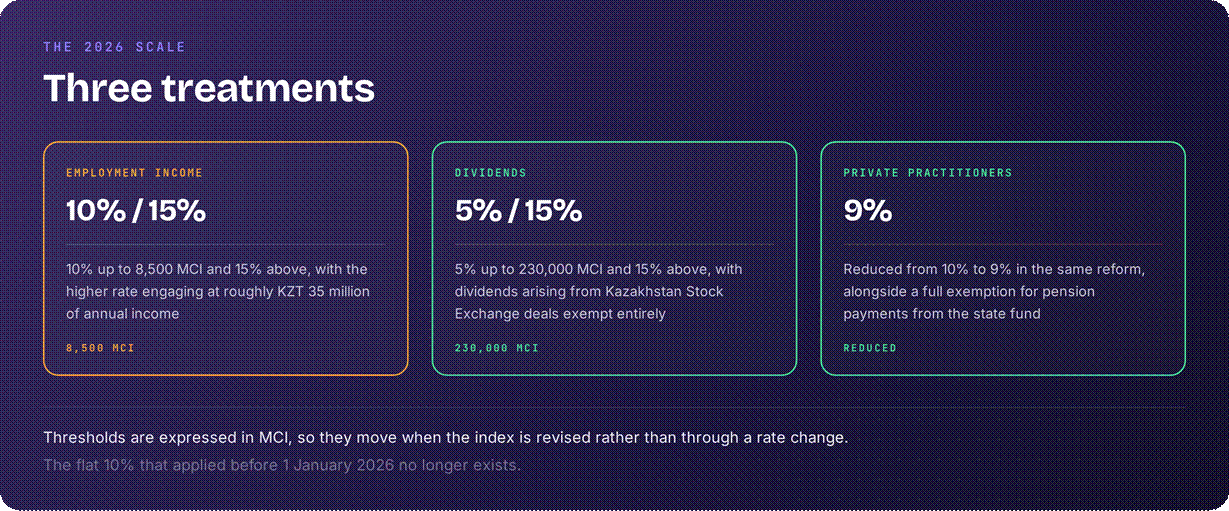
Where each rate applies from 2026.
Your residency status is the first step
An individual is a Kazakhstan tax resident through either of two routes.
The first is presence. Someone who has spent 183 or more days in Kazakhstan within any twelve-month rolling period ending in the reporting period is resident. Days of arrival and departure both count, which quietly costs two days on every trip.
The second is the centre of vital interest, and it applies to someone who has spent fewer than 183 days. It is met only where all three of the following are satisfied simultaneously during the reporting year:
• The individual held Kazakhstan citizenship or a residence permit;
• The individual’s family or close relatives lived in Kazakhstan; and
• The individual or their family members owned real estate in Kazakhstan that was available to them at any time.
The cumulative requirement is the important part. All three must be present together. Someone holding a residence permit and owning an apartment, but whose family lives abroad, does not meet the test on those facts alone.
Non-residence, and the certificate that proves it
An individual is a Kazakhstan tax non-resident either by failing the tests above, or by being recognised as non-resident under an effective double tax treaty.
That second route carries a formal requirement. Under the Tax Code, a certificate of foreign tax residency must be provided by the tax return filing deadline, being 15 September of the year following the reporting one. It must be properly legalised or apostilled, and a notarised translation into Russian or Kazakh must be enclosed.
Kazakhstan issues its own equivalent in the other direction. Under Article 702 of the Tax Code, a residency certificate is the official document confirming that the recipient of income is a resident of a state with which Kazakhstan has concluded an international treaty. Someone living in Kazakhstan with their family but physically outside the country for more than 183 days may need one to confirm their status.
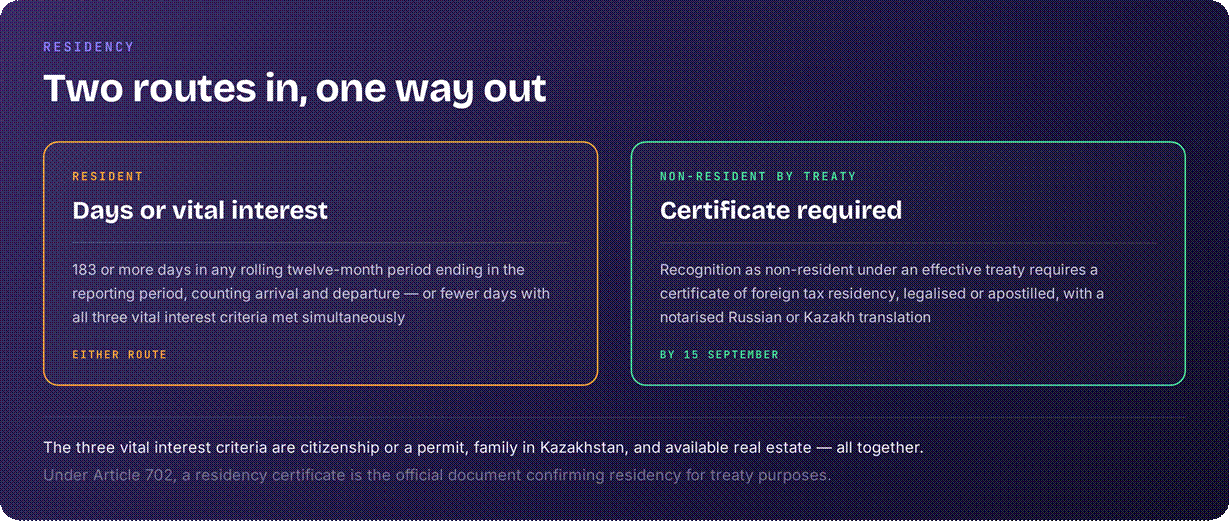
Two routes in, and one way out.
The tax rates from 2026
Item | Rate |
Income up to 8,500 MCI | 10% |
Income above 8,500 MCI | 15% |
Approximate threshold | Around KZT 35 million a year |
Dividends up to 230,000 MCI | 5% |
Dividends above that | 15% |
Dividends from KASE deals | Exempt |
Private practitioners | 9%, reduced from 10% |
State fund pension payments | Exempt |
Because the thresholds are expressed in MCI, the monthly calculation index, they move when that index is revised rather than through a change to the rates themselves. Any figure should be converted using the MCI value for the year in question.
Treaties and why the certificate matters
Kazakhstan has concluded international tax treaties with a wide range of countries, and applying one generally requires proof of tax status in the form of a residency certificate. Without it the treaty position is asserted rather than evidenced.
This is a practical point rather than a theoretical one. Foreign specialists working for Kazakhstani companies, and foreign nationals starting businesses in Kazakhstan, are routinely connected to two jurisdictions at once. The question of where tax is due is resolved by the treaty, and the treaty is applied on the strength of the certificate.
Note the deadline is not the same as the filing date for the tax itself. The certificate must be in hand by 15 September of the year following the reporting year, legalised and translated, which means the process should start well before that.
Case study: Aigul and the rolling count
Aigul arrives in Almaty in September and stays through to the following July. Under a calendar-year test she would have been present for four months in the first year and seven in the second, and would not be resident in either.
Kazakhstan applies a rolling twelve-month period. Counting from her arrival, she passes 183 days in the following March, and both her arrival and departure days count toward the total. She becomes resident during a period that a calendar-year analysis would have missed entirely.
The lesson is the one that applies wherever a rolling test is used. The question is not how many days you spent in a given year but whether any twelve-month window ending in the reporting period reaches the threshold.
What makes Kazakhstan attractive
Even after the reform the position is competitive:
• A 10% entry rate, still low by international standards;
• A 15% top rate that engages only at around KZT 35 million of annual income;
• Dividends at 5% below 230,000 MCI, well under the employment rate;
• Dividends from Kazakhstan Stock Exchange deals exempt entirely;
• Private practitioners at 9%, reduced in the same reform;
• State fund pension payments fully exempt; and
• A wide treaty network, with a defined certificate procedure for claiming protection.
The honest qualifications are that the flat rate has gone, that the rolling residency count catches stays a calendar-year test would miss, and that treaty protection depends on a legalised certificate delivered by a fixed deadline.
Filing and the compliance calendar
The tax year follows the calendar year. The return filing deadline is 15 September of the year following the reporting one, which is also the deadline for providing a certificate of foreign tax residency where non-resident status is claimed under a treaty.
Prepare in good time:
• Day-count records across rolling twelve-month periods, including arrival and departure days;
• Evidence bearing on each of the three vital interest criteria;
• A certificate of foreign tax residency, apostilled where required;
• A notarised translation into Russian or Kazakh;
• The MCI value applying to the year being computed; and
• Records of dividend income against the 230,000 MCI threshold.
Count on a rolling basis
Consider:
• That the flat 10% ended on 1 January 2026;
• That 15% now applies above 8,500 MCI;
• That the day count is rolling, not by calendar year;
• That arrival and departure days both count;
• That the vital interest test requires all three criteria together;
• That treaty non-residence needs a legalised certificate by 15 September; and
• That thresholds in MCI move when the index is revised.
Your Kazakhstan checklist
1. Apply the 2026 scale, not the former flat 10%;
2. Convert 8,500 MCI using the index for your year;
3. Count days across rolling twelve-month periods;
4. Include both arrival and departure days;
5. Test all three vital interest criteria together, not separately;
6. Obtain a certificate of foreign tax residency if claiming treaty non-residence;
7. Have it apostilled and translated into Russian or Kazakh;
8. Deliver it by 15 September of the following year;
9. Track dividend income against the 230,000 MCI threshold; and
10. Check whether any dividends arose from KASE deals.
Frequently asked questions
Does Kazakhstan still have a flat 10% rate?
No. A new Tax Code took effect on 1 January 2026, replacing the flat rate with a progressive scale — 10% on income up to 8,500 MCI and 15% above, which engages at roughly KZT 35 million a year.
How do I become tax resident?
Through either of two routes. By spending 183 or more days in Kazakhstan within any rolling twelve-month period ending in the reporting period, counting arrival and departure days. Or by spending fewer days while meeting all three centre of vital interest criteria simultaneously.
What are the vital interest criteria?
Holding Kazakhstan citizenship or a residence permit, having family or close relatives living in Kazakhstan, and owning real estate in Kazakhstan available to you or your family at any time. All three must be met together during the reporting year.
Why does the rolling count matter?
Because a stay straddling two calendar years can cross 183 days in a rolling window without reaching it in either year. The test asks whether any twelve-month period ending in the reporting period reaches the threshold.
How are dividends taxed?
At 5% up to 230,000 MCI and 15% above. Dividends arising from deals on the Kazakhstan Stock Exchange remain exempt entirely.
How do I claim treaty non-residence?
By providing a certificate of foreign tax residency by the tax return filing deadline, 15 September of the year following the reporting one. It must be properly legalised or apostilled, with a notarised translation into Russian or Kazakh enclosed.
What is a Kazakhstan residency certificate?
Under Article 702 of the Tax Code, it is the official document confirming that the recipient of income is a resident of a state with which Kazakhstan has an international treaty. It is what you produce to apply treaty terms.
Are there other reduced rates?
Private practitioners were reduced from 10% to 9% in the same reform, and pension payments from the state fund are fully exempt from personal income tax.
Official sources and further reading
• State Revenue Committee, Ministry of Finance of Kazakhstan
Important information
This article is general information and does not constitute tax, legal, immigration or financial advice, and does not create a client relationship. Tax outcomes depend on travel history, income sources, treaty status and the law applying to the relevant year. Rates, thresholds and regimes change, and some measures described may be proposed rather than enacted; this article reflects our understanding as at the date of publication. Obtain advice from a suitably qualified professional before acting or refraining from action.
