
Armenia charges a flat 20% on personal income, 5% on dividends, and nothing at all on gifts, inheritance, wealth or gains from securities. For a small business the position is better still.
Armenia replaced its progressive scale with a flat 20% personal income tax from January 2023. It applies to salaries, self-employment and business income and most other earnings, with employers withholding at that rate as a final tax on employment income.
What sits around the flat rate is more interesting than the rate itself. Dividends are taxed at 5%, royalties and rental income at 10%, and there is no wealth tax, no gift tax and no inheritance tax. Following a 2022 reform there is also no capital gains tax on the disposal of Armenian company shares, with real estate gains taxed at 10% for residents.
For a business, three regimes run in parallel depending on scale: a micro-business regime for turnover under AMD 24 million, a turnover tax regime up to AMD 115 million, and standard corporate tax at 18% above that.
💡 The high-tech incentive gives qualifying companies a 1% turnover tax running from 2025 to 2031.
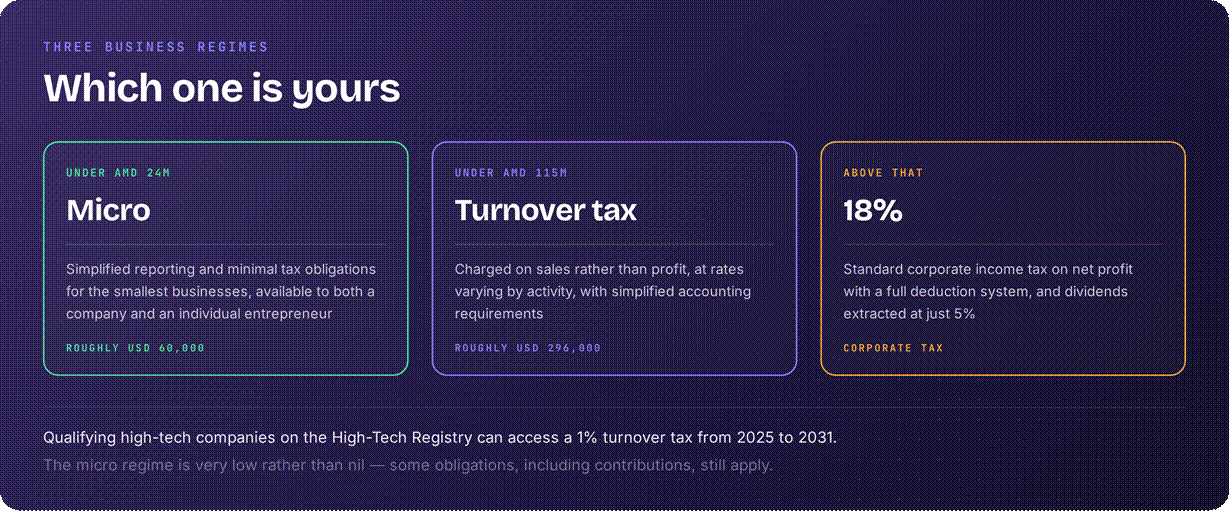
Three regimes, and turnover decides which applies.
Your residency status is the first step
You become an Armenian tax resident by spending 183 days or more in Armenia during a twelve-month period, or by having your centre of vital interests there. Residents are taxed on worldwide income; non-residents only on Armenian-source income.
The separation between immigration status and tax status is genuine and useful. Holding a residence permit does not by itself bring you into the Armenian tax net, so someone who holds a permit but spends most of the year elsewhere can remain outside it — while still benefiting from Armenia’s treaty network where applicable.
Maintain accurate records of:
• Days present in Armenia across the relevant twelve-month period;
• Where your centre of vital interests lies;
• Whether you hold a residence permit, and that it is separate from tax status;
• Income by source, Armenian and foreign;
• Business turnover against the micro and turnover tax thresholds; and
• Any other country that may also treat you as resident.
The tax rates
Item | Rate |
Personal income tax | 20% flat on most income |
Dividends | 5% |
Royalties and rental income | 10% |
Capital gains on Armenian company shares | Nil |
Capital gains on real estate, residents | 10% |
Wealth, gift and inheritance tax | None |
Corporate income tax | 18% |
VAT | 20% |
The 5% dividend rate is the figure to notice. Combined with an 18% corporate rate, an owner-manager extracting profit faces a total burden well below what most of Europe charges on the same arrangement, and there is no additional layer on wealth or succession.
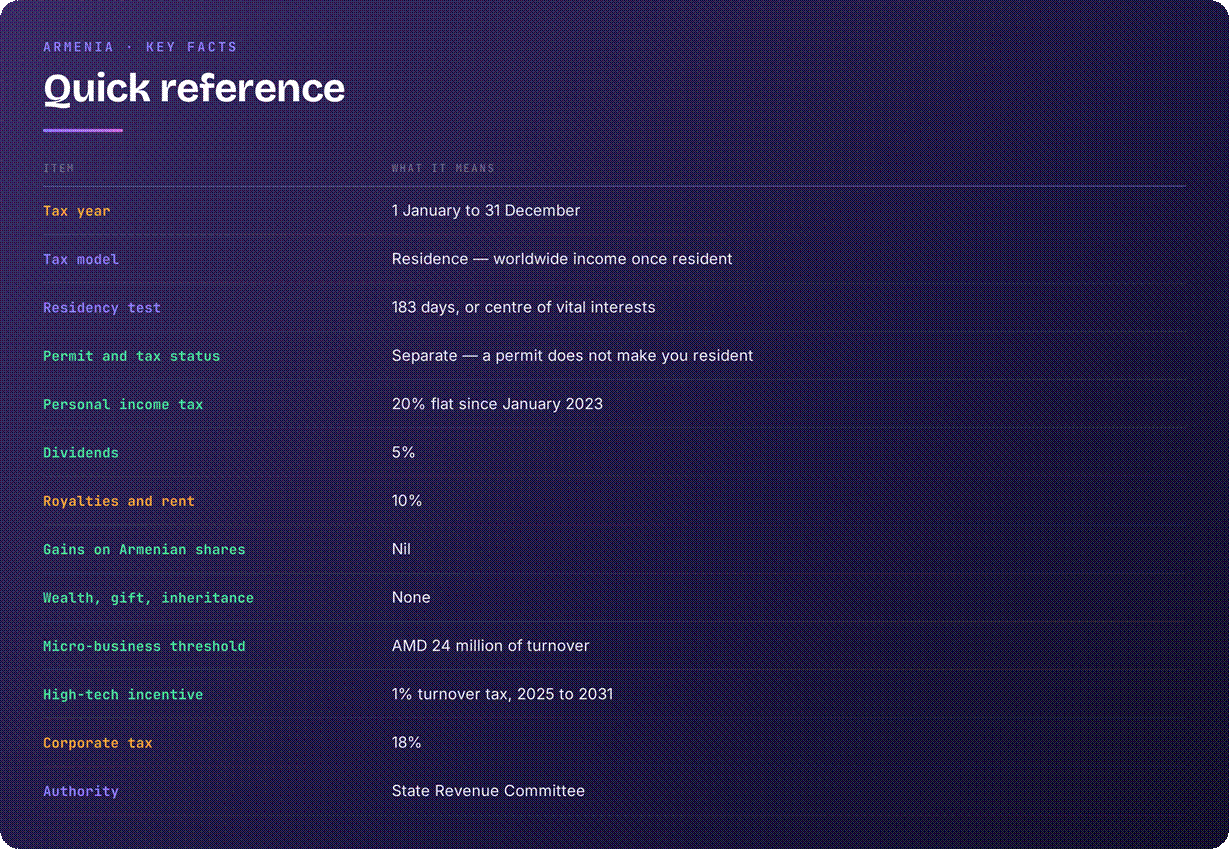
The Armenian position at a glance.
What makes Armenia attractive
Armenia is one of the clearer cases in this series where the positives outweigh the caveats:
• A flat 20% with no brackets, no phase-outs and no cliffs, so the calculation is the same at every income level;
• 5% on dividends and nil on gains from Armenian company shares, which is unusually favourable for owner-managers and investors;
• No wealth, gift or inheritance tax of any kind, which removes an entire layer of succession planning;
• A micro-business regime for turnover under AMD 24 million — roughly USD 60,000 — with simplified reporting and minimal obligations;
• A 1% turnover tax for qualifying high-tech companies on the High-Tech Registry, running from 2025 to 2031;
• Free economic zones offering 0% profit tax for qualifying activities;
• Tax residence separated from immigration status, so a permit does not force you into the tax net; and
• A low cost of living in Yerevan, and a technology sector that has grown substantially since 2022.
The main qualification is administrative rather than fiscal. Armenia has been rolling out a universal income declaration system, which has changed reporting obligations and deadlines, so anyone relying on an older description of the filing process should confirm the current position.
The three business regimes
Which regime applies depends on annual turnover:
• Micro-business — turnover under AMD 24 million, roughly USD 60,000, with simplified reporting and minimal tax obligations, available to both a limited company and an individual entrepreneur;
• Turnover tax — turnover under AMD 115 million, roughly USD 296,000, charged on sales at rates varying by activity, with simplified accounting; and
• Standard corporate tax — 18% on net profit above that threshold, with a full deduction system.
The micro regime is frequently described as "0% tax", and that overstates it. Micro-businesses still carry some obligations, including social contributions and other mandatory payments, so the practical position is very low rather than nil.
Case study: Sevan compares two structures
Sevan earns the equivalent of USD 55,000 a year from software development for clients in Europe. As a micro-business under the AMD 24 million threshold, his reporting is simplified and his tax obligations are minimal.
His colleague Ani earns USD 200,000 through a company. She falls above the micro threshold and into the turnover tax regime, or into standard corporate tax at 18% with dividends extracted at 5% — a combined burden still well below most European equivalents.
If either operates through a company certified on the High-Tech Registry, the 1% turnover incentive may apply instead. The right answer depends on scale and activity, which is why the threshold figures matter more than the headline rate.
Filing and the compliance calendar
The Armenian tax year follows the calendar year. Employment income is withheld by the employer at 20% as a final tax, so many employees have nothing further to do. Residents with other income file an annual declaration, and the rollout of the universal declaration system has moved deadlines from their traditional dates — confirm the current timetable rather than assuming.
Non-residents who received Armenian-source income not subject to withholding file separately. Prepare in good time:
• A taxpayer identification number;
• Day-count records against the 183-day test;
• Records of worldwide income, where you are resident;
• Business turnover against the micro and turnover thresholds;
• High-Tech Registry certification, if claiming the 1% incentive; and
• Evidence of foreign tax paid, for the credit system.
Match the regime to the scale
Consider:
• Whether 183 days or your centre of vital interests would make you resident;
• That a residence permit does not decide tax residence;
• Where your turnover sits against AMD 24 million and AMD 115 million;
• Whether High-Tech Registry certification is realistic for your activity;
• How the 5% dividend rate changes the salary-and-dividend mix;
• That the micro regime is very low rather than genuinely nil; and
• That the universal declaration system has changed filing obligations.
Your Armenia checklist
1. Check whether 183 days or vital interests would make you resident;
2. Remember a residence permit does not decide tax residence;
3. Measure turnover against AMD 24 million and AMD 115 million;
4. Assess whether High-Tech Registry certification is available to you;
5. Model the salary and dividend mix against the 5% dividend rate;
6. Treat the micro regime as very low rather than nil;
7. Check whether a free economic zone suits your activity;
8. Confirm the current filing timetable under the universal declaration system;
9. Keep evidence of foreign tax paid for the credit system; and
10. Confirm your former country accepts that you have left.
Frequently asked questions
What is the Armenian income tax rate?
A flat 20% on most personal income, in place since January 2023, replacing the previous progressive bands. Employers withhold it from salaries as a final tax.
How are dividends taxed?
At 5%, which is low by any standard. Combined with an 18% corporate rate, an owner-manager extracting profit faces a total burden well below most European equivalents.
Is there capital gains tax?
Not on the disposal of Armenian company shares, following a 2022 reform. Real estate gains are taxed at 10% for residents. There is also no wealth tax, gift tax or inheritance tax.
What is the micro-business regime?
A simplified regime for businesses with annual turnover under AMD 24 million, roughly USD 60,000, available to both a limited company and an individual entrepreneur. It is often described as 0% tax, which overstates it — some obligations, including contributions, still apply.
What is the high-tech incentive?
Qualifying companies registered on the High-Tech Registry can access a 1% turnover tax, running from 2025 to 2031. It is aimed at technology businesses and sits alongside broader incentives for the sector.
Does a residence permit make me tax resident?
No, and this is an important distinction. Tax residence is determined separately by the 183-day test or by your centre of vital interests, which gives genuine flexibility to someone who holds a permit but spends most of the year elsewhere.
When am I tax resident?
By spending 183 days or more in Armenia during a twelve-month period, or by having your centre of vital interests there. Residents are taxed on worldwide income; non-residents only on Armenian-source income.
How does filing work?
Employment income is withheld at 20% as a final tax, so many employees have nothing further to do. Residents with other income file an annual declaration, though the rollout of the universal declaration system has changed deadlines — confirm the current timetable.
Official sources and further reading
Important information
This article is general information and does not constitute tax, legal, immigration or financial advice, and does not create a client relationship. Tax outcomes depend on travel history, income sources, treaty status and the law applying to the relevant year. Rates, thresholds and regimes change, and some measures described may be proposed rather than enacted; this article reflects our understanding as at the date of publication. Obtain advice from a suitably qualified professional before acting or refraining from action.
