
Ukraine taxes personal income at a flat 18%, with a military levy on top that quintupled in late 2024. For IT specialists inside the Diia City regime, the income tax rate drops to 5%.
Ukraine has a flat personal income tax of 18%, applied to most categories of income. Sitting alongside it is the military levy, a separate charge that was raised from 1.5% to 5% in late 2024 and is explicitly temporary.
For one sector the picture is very different. Diia City, a special legal regime for the IT industry introduced for at least twenty-five years, taxes the income of resident companies’ specialists at 5% rather than 18%. Over 1,500 companies had joined by the end of 2024.
Ukraine taxes residents on worldwide income and non-residents on Ukrainian-source income. Residence runs through a sequence: domicile in Ukraine, then centre of vital interests, then 183 days, with citizenship as the final tie-breaker.
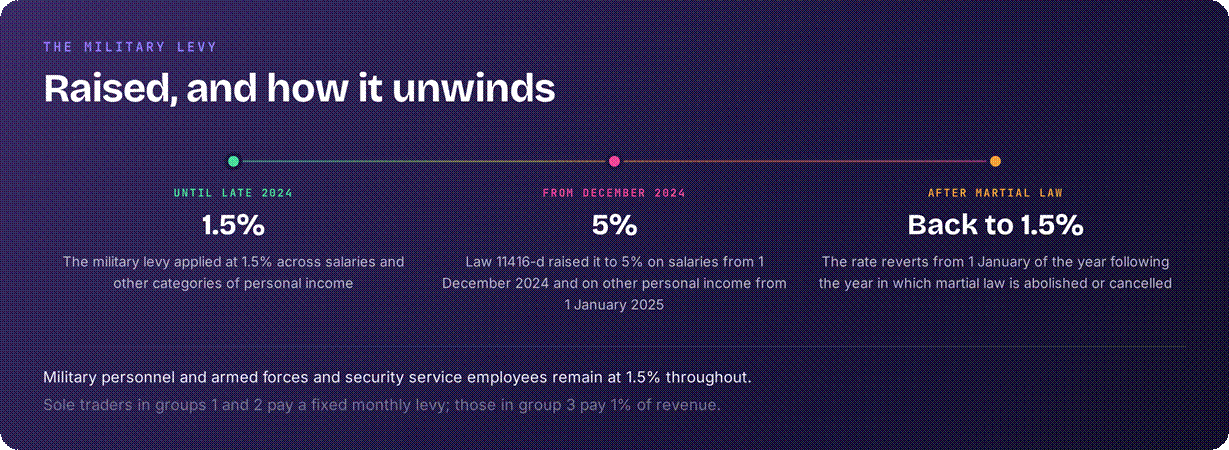
The levy rose in stages, and has a defined end point.
The standard position
The flat 18% applies broadly across employment income, civil law contract remuneration, interest on deposits, dividends and other categories. On top of it, the military levy applies at 5%.
The increase came through Law 11416-d, signed in late November 2024. It applied to salaries from 1 December 2024 and to other categories of personal income from 1 January 2025. Military personnel and employees of the armed forces and security services remain at 1.5%.
Item | Position |
Personal income tax | 18% flat |
Military levy, general | 5%, raised from 1.5% |
Applied to salaries from | 1 December 2024 |
Applied to other income from | 1 January 2025 |
Reverts to 1.5% | From 1 January after martial law is abolished |
Military and security personnel | Remain at 1.5% |
Sole traders, groups 1 and 2 | Levy at 10% of the minimum wage monthly |
Sole traders, group 3 | Levy at 1% of revenue |
The levy is not a permanent feature of the system. The statute that raised it also fixes the point at which it falls back, which matters for anyone modelling Ukraine over a multi-year horizon rather than for the current year alone.

Two regimes, and the month that decides which applies.
Diia City
Diia City is a special legal regime for the IT industry, designed to build the sector and introduced on a guaranteed footing of at least twenty-five years. It operates throughout the country rather than in a defined zone, and entry is voluntary.
For specialists of a Diia City resident company, the personal income tax rate on qualifying income is 5% instead of 18%. The qualifying categories are salary, remuneration under a gig contract, and royalties for the creation of and transfer of rights to service works.
On the corporate side, a resident company elects between a 9% exit capital tax — charged only on distributed profits rather than on profits retained for development — and the standard 18% corporate income tax.
The conditions, and the month that catches people
To apply the 5% rate to its specialists, a Diia City resident must meet two ongoing requirements in the relevant month: an average monthly remuneration of employees and engaged gig specialists of at least the equivalent of EUR 1,200, and an average number of employees and gig specialists of at least nine.
Law 4113 clarified the start point. The 5% rate applies from the calendar month following the month in which Diia City resident status was acquired. Income accrued or paid in the month of acquisition itself is taxed at 18%.
For companies joining on a start-up basis, the headcount requirement is relaxed: the 5% rate may still apply until 31 December of the calendar year following the year residency was acquired, even where the nine-person threshold is not met in a given month.
Case study: Oksana joins in the wrong week
Oksana’s employer acquires Diia City resident status on 20 March. Her salary for March is accrued and paid in the normal way at the end of that month.
That March salary is taxed at 18%, not 5%, because the reduced rate applies from the month after status is acquired. Her April salary is the first taxed at 5%.
The difference on a single month is not large. The point is that the rule is a bright line rather than an apportionment, and where a joining date is within the company’s control, moving it a few days either side of a month end changes which rate applies to a full month of payroll.
Filing and the compliance calendar
The Ukrainian tax year follows the calendar year. Employment income is subject to withholding by the employer, who accounts for both the income tax and the military levy. Individuals with other income sources file an annual declaration with the State Tax Service.
Prepare in good time:
• A taxpayer identification number and electronic cabinet access;
• Records separating income taxed at 18% from income taxed at 5%;
• The date Diia City residency was acquired, if relevant;
• Evidence that the remuneration and headcount conditions were met each month;
• Gig contract documentation, where applicable; and
• Records of foreign income and any foreign tax paid.
Model the levy as temporary
Consider before committing to a position:
• Whether your income falls inside a Diia City qualifying category;
• Whether your employer meets the remuneration and headcount conditions each month;
• Which month the 5% rate actually begins for you;
• Whether start-up relief from the headcount condition applies;
• How the 5% military levy affects a multi-year projection;
• Whether the sole trader route suits you better than employment; and
• Which limb of the residence sequence applies to you.
Your Ukraine checklist
1. Establish which limb of the residence sequence applies to you;
2. Separate income taxed at 18% from Diia City qualifying income;
3. Confirm the date Diia City residency was acquired;
4. Remember the 5% starts the month after, not the month of, acquisition;
5. Check the remuneration and headcount conditions are met each month;
6. Establish whether start-up relief from the headcount applies;
7. Account for the military levy separately from income tax;
8. Model the levy reverting to 1.5% in a multi-year projection;
9. Keep gig contract documentation where relevant; and
10. File the annual declaration where you have non-employment income.
Frequently asked questions
What is the Ukrainian personal income tax rate?
A flat 18%, applied across most categories of income including employment, civil law contract remuneration, interest and dividends. The military levy applies on top.
How much is the military levy now?
5%, raised from 1.5% by Law 11416-d. It applied to salaries from 1 December 2024 and to other personal income from 1 January 2025. Military and security service personnel remain at 1.5%.
Is the 5% levy permanent?
No. The statute provides that the rate reverts to 1.5% from 1 January of the year following the year in which martial law is abolished or cancelled, so it has a defined end trigger.
What is Diia City?
A special legal regime for the IT industry, established on a guaranteed footing of at least twenty-five years and operating throughout Ukraine. Entry is voluntary, and specialists of resident companies are taxed at 5% on qualifying income.
What income qualifies for the 5% rate?
Salary, remuneration under a gig contract, and royalties for the creation of and transfer of rights to service works, where paid by a Diia City resident meeting the monthly conditions.
What are the conditions the company must meet?
In the relevant month, an average monthly remuneration of employees and engaged gig specialists of at least the equivalent of EUR 1,200, and an average of at least nine employees and gig specialists.
When does the 5% rate start?
From the calendar month following the month in which Diia City resident status was acquired. Income accrued or paid in the acquisition month itself is taxed at 18%.
What if the company is a start-up?
Companies joining on a start-up basis may apply the 5% rate until 31 December of the calendar year following the year residency was acquired, even in months where the nine-person headcount condition is not met.
Official sources and further reading
• State Tax Service of Ukraine
Important information
This article is general information and does not constitute tax, legal, immigration or financial advice, and does not create a client relationship. Tax outcomes depend on travel history, income sources, treaty status and the law applying to the relevant year. Rates, thresholds and regimes change, and some measures described may be proposed rather than enacted; this article reflects our understanding as at the date of publication. Obtain advice from a suitably qualified professional before acting or refraining from action.
