
Uzbekistan charges a flat 12%. From January 2026 a foreign citizen can buy their way out of tax on foreign income entirely, for a one-off fee of USD 50,000.
Uzbekistan replaced a multi-bracket progressive scale with a flat 12% personal income tax in January 2023. It applies to employment income, self-employment income, rental income and capital gains alike, with no brackets. Non-resident income from Uzbek sources was also reduced to 12%, down from 20%.
Two reduced rates sit alongside it. Dividends are taxed at 5% for residents, and residents of the country’s IT Park pay 7.5% rather than 12% on employment income.
What changed at the start of 2026 is more unusual. A presidential decree signed in October 2025 introduced a special tax regime for foreign citizens that exempts income earned abroad from personal income tax entirely. Qualifying requires a one-time special fee of USD 50,000 and opening a bank account at an authorised commercial bank, or a wallet on an approved cryptocurrency exchange.
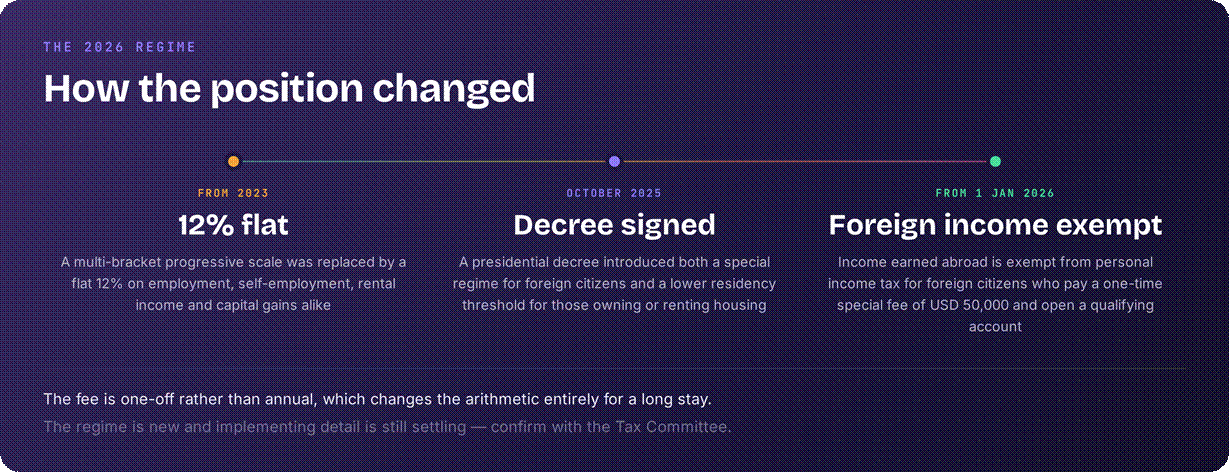
What the October 2025 decree introduced, and from when.
Your residency status is the first step
A foreign individual is an Uzbek tax resident if they permanently reside in Uzbekistan. An individual is deemed to permanently reside there for the current tax year if their presence exceeded 183 calendar days — counting both arrival and departure days — in any consecutive twelve-month period ending in the current tax year.
The October 2025 decree added an alternative route. A foreign citizen who owns or rents housing in Uzbekistan and has spent more than 30 days in the country within a year is eligible for tax residency status. That is a remarkably low threshold, and it exists to make the new foreign-income regime accessible rather than to catch people.
Where an individual is simultaneously resident in Uzbekistan and in a treaty country, the treaty tie-breaker rules prevail over domestic law — but claiming treaty protection requires a residency certificate from the other country.
Maintain accurate records of:
• Days present across consecutive twelve-month periods, counting arrival and departure days;
• Whether you own or rent housing in Uzbekistan, for the 30-day route;
• Income by source, Uzbek and foreign;
• A residency certificate from any treaty country you also claim;
• Documentation of the special fee, if using the 2026 regime; and
• Whether your employer is an IT Park resident.
The tax rates
Item | Rate |
Personal income tax | 12% flat, since January 2023 |
IT Park residents | 7.5% on employment income |
Dividends, residents | 5% |
Dividends, non-residents | 10% |
Non-resident Uzbek-source income | 12%, reduced from 20% |
Capital gains | Within the 12% flat charge |
Corporate income tax | 15% |
Foreign income under the 2026 regime | Exempt, on payment of the special fee |
The flat rate applies across categories rather than carving investment income onto a separate schedule, which makes the system unusually simple to model. The only material departures are the 5% on dividends and the 7.5% IT Park rate.
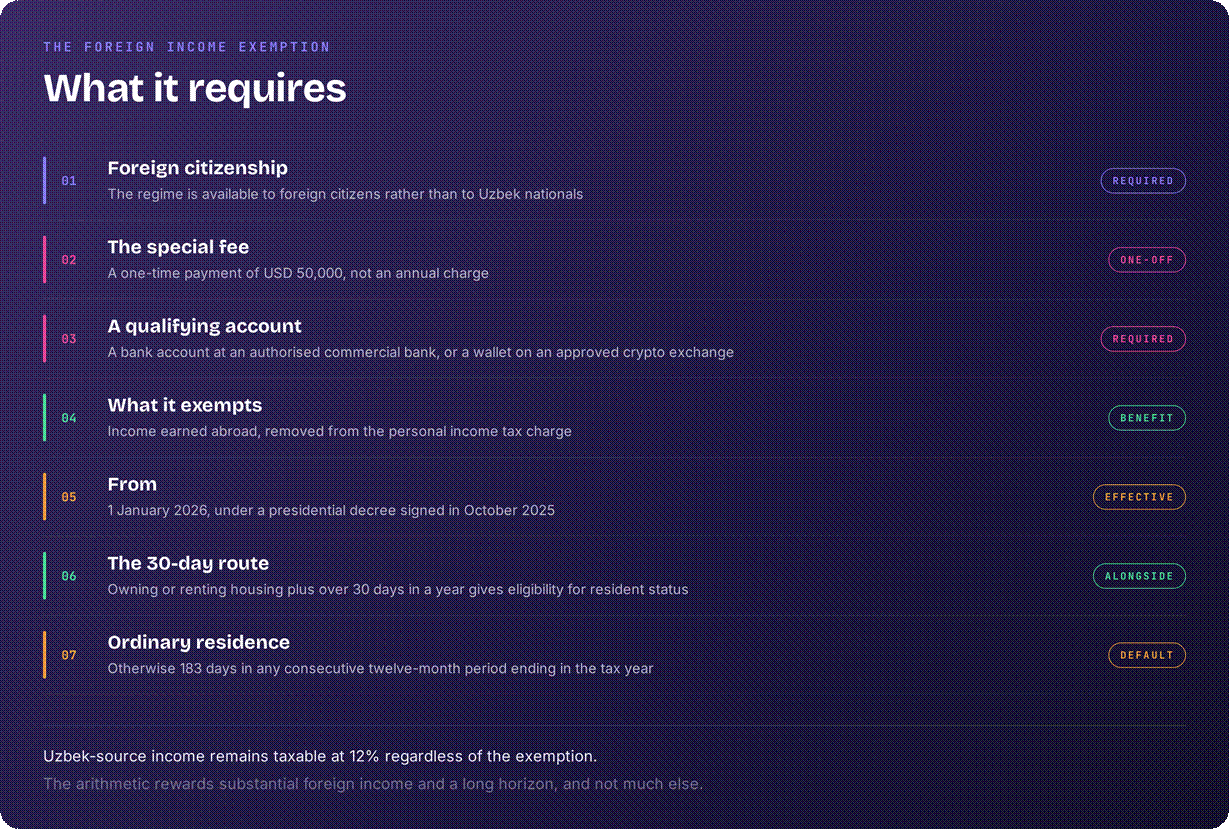
Every condition for the foreign income exemption.
The 2026 foreign income regime
This is the provision worth understanding, because nothing quite like it exists elsewhere. From 1 January 2026, a foreign citizen can obtain exemption from Uzbek personal income tax on income earned abroad by meeting two conditions:
• Payment of a one-time special fee of USD 50,000; and
• Opening a bank account at an authorised Uzbek commercial bank, or a crypto wallet on an approved cryptocurrency exchange.
It converts a worldwide system into a territorial one for the individual who pays, and the price is fixed rather than annual. For someone with substantial foreign income intending to stay several years, the arithmetic is straightforward: USD 50,000 once, against 12% of foreign income every year.
The regime is new and the implementing detail is still settling. Anyone considering it should confirm the current conditions with the Tax Committee directly rather than relying on the announcement, and should establish how the exemption interacts with the low residency threshold introduced in the same decree.
What makes Uzbekistan attractive
The combination is one of the more compelling in the region:
• A 12% flat rate with no brackets, applying to employment, self-employment, rental income and gains alike;
• Dividends at 5% for residents, well below the main rate;
• A 7.5% rate for IT Park residents on employment income;
• The 2026 regime exempting foreign income for a one-off fee rather than an annual charge;
• Non-resident Uzbek-source income reduced to 12%, the same as the resident rate;
• A 30-day residency route for those owning or renting housing, which is exceptionally accessible; and
• A low cost of living in Tashkent and one of Central Asia’s faster-growing economies.
The honest qualification is that without the special regime, residents are taxed on worldwide income at 12% — so the exemption is what turns an already low rate into a genuinely territorial position, and it carries a substantial entry price.
Case study: Dmitri does the arithmetic
Dmitri has foreign investment and consulting income of around USD 180,000 a year and is considering Tashkent. Without the special regime he would be resident and taxed at 12% on the lot — roughly USD 21,600 a year.
Under the 2026 regime he pays the one-off USD 50,000 fee and his foreign income falls outside the Uzbek charge. On his numbers the fee pays for itself in a little over two years, and everything after that is clear.
For someone with USD 40,000 of foreign income the calculation reverses entirely — the fee would take more than ten years to recover. The regime rewards scale and a long horizon, and it is not a general-purpose answer.
Filing and the compliance calendar
The Uzbek tax year follows the calendar year and the annual return is due by 1 April of the following year. A foreign individual who becomes tax resident before 1 April of the current reporting year must submit a declaration on income earned during the previous reporting year.
Registration with the tax authorities matters. Late registration carries fixed penalties that escalate sharply beyond thirty days, and are calculated by reference to income rather than as a flat sum.
Prepare in good time:
• Registration with the tax authorities, promptly;
• Day-count records across consecutive twelve-month periods;
• Housing ownership or rental documentation, if using the 30-day route;
• Evidence of the special fee, if claiming the 2026 exemption;
• A treaty residency certificate, if relevant; and
• Income records separated by source and category.
Model the fee against the years
Consider:
• How much foreign income you have, and for how many years;
• That the special fee is one-off rather than annual;
• Whether the 30-day housing route applies to you;
• That the ordinary position is worldwide taxation at 12%;
• Whether IT Park residency would give you 7.5% instead;
• That dividends are 5% for residents; and
• That the regime is new, so confirm the detail with the Tax Committee.
Your Uzbekistan checklist
1. Calculate your annual foreign income against the USD 50,000 fee;
2. Establish how many years you realistically intend to stay;
3. Confirm the current conditions with the Tax Committee, as the regime is new;
4. Check whether the 30-day housing route applies to you;
5. Count days across consecutive twelve-month periods, not calendar years;
6. Include arrival and departure days in the count;
7. Check whether IT Park residency would give 7.5% on employment income;
8. Register with the tax authorities promptly, as penalties escalate;
9. Obtain a treaty residency certificate if claiming protection; and
10. Diarise the 1 April filing deadline.
Frequently asked questions
What is the Uzbek income tax rate?
A flat 12% since January 2023, applying to employment income, self-employment income, rental income and capital gains. Dividends are 5% for residents, and IT Park residents pay 7.5% on employment income.
Can foreign income really be exempt?
From 1 January 2026, yes. A presidential decree introduced a special regime exempting income earned abroad from personal income tax for foreign citizens who pay a one-time fee of USD 50,000 and open a qualifying bank account or crypto wallet.
Is the fee annual?
No, it is a one-time payment. That is what makes the arithmetic work for someone with substantial foreign income and a long horizon — the cost is fixed rather than recurring.
When is it worth paying?
It depends on your foreign income and how long you stay. At USD 180,000 of foreign income the 12% charge is around USD 21,600 a year, so the fee recovers in a little over two years. At USD 40,000 it would take more than a decade.
How do I become tax resident?
By being present for more than 183 calendar days, counting arrival and departure days, in any consecutive twelve-month period ending in the current tax year. A newer route gives eligibility to foreigners who own or rent housing and spend more than 30 days in a year.
What about non-residents?
Non-resident income from Uzbek sources is taxed at 12%, reduced from 20% by presidential resolution. Dividends paid to non-residents are taxed at 10%.
What is the IT Park rate?
7.5% on employment income for residents of the park, against the standard 12%. It sits alongside broader incentives aimed at the technology sector.
When is the return due?
By 1 April of the year following the reporting year. A foreign individual who becomes resident before 1 April must submit a declaration covering the previous reporting year.
Official sources and further reading
• State Tax Committee of the Republic of Uzbekistan
Important information
This article is general information and does not constitute tax, legal, immigration or financial advice, and does not create a client relationship. Tax outcomes depend on travel history, income sources, treaty status and the law applying to the relevant year. Rates, thresholds and regimes change, and some measures described may be proposed rather than enacted; this article reflects our understanding as at the date of publication. Obtain advice from a suitably qualified professional before acting or refraining from action.
