
Aruba is a constituent country of the Kingdom of the Netherlands, and its tax system reflects that far more than its location. It is not a Caribbean tax haven. It runs a European-style progressive income tax and a layered turnover tax, and the combined effect on a salary is substantial.
The island’s reputation and its tax law point in opposite directions. People arrive expecting something like the Cayman Islands or the Bahamas and find a top marginal rate of 52%. If you are weighing Aruba against other Caribbean bases, that is the first thing to get straight.
This guide covers how residence is decided, the rate structure, the expatriate regime and the two routes into it, the turnover taxes and social premiums that sit alongside income tax, and the treaty problem that catches most people out.
The tax rate structure
Residents are taxed on worldwide income from employment, business, property, movable capital and certain periodic receipts. Non-residents are taxed only on Aruban sources. The tax year is the calendar year.
Annual taxable income (AWG) | Rate for 2026 |
Up to 34,930 | 0% |
34,931 to 63,904 | 21% |
63,905 to 135,527 | 42% |
Above 135,527 | 52% |
Severance and similar pay-offs | 25% |
Substantial-interest gains | 25% |
The thresholds move. Aruba revises the income tax table by ministerial regulation, so figures published even a year ago may be out of date. The top rate of 52% has been stable since 2019, but check the current table with the Departamento di Impuesto before modelling anything.
Capital gains on privately held assets are generally outside the charge. The exception is a substantial interest — broadly a holding of 25% or more in a company, counting shares held by close relatives — where gains on disposal are taxed at 25%. Gains on real estate held as a business asset are taxed at the ordinary bands. There is no wealth tax, but there is an annual land tax on property, running from 0.3% to 0.6% by value for residents and at a flat 0.6% for non-residents and legal entities.
Becoming resident — and the one-day rule for everyone else
Aruba does not decide residence with a day count. It is determined on the facts of each case — where you actually live, where your home and family are, where your life is centred. That makes it less mechanical than a 183-day test and harder to manage by careful travel planning.
Non-residence does not mean nothing is due. A non-resident individual falls within Aruban income tax as soon as they work one day or more in Aruba. Employment performed on the island, Aruban real estate, director’s and supervisory board fees from an Aruban company, and substantial-interest income and gains are all in the net regardless of where you live.
For a remote worker, that first point is the one that matters. Where your employer is incorporated is not the test. Where you physically perform the duties is.
The expatriate regime
The expatriate regime is Aruba’s answer to the rate. It does not reduce the rate on your salary. It allows your employer to pay a defined set of relocation and living costs free of wage tax, for a limited period.
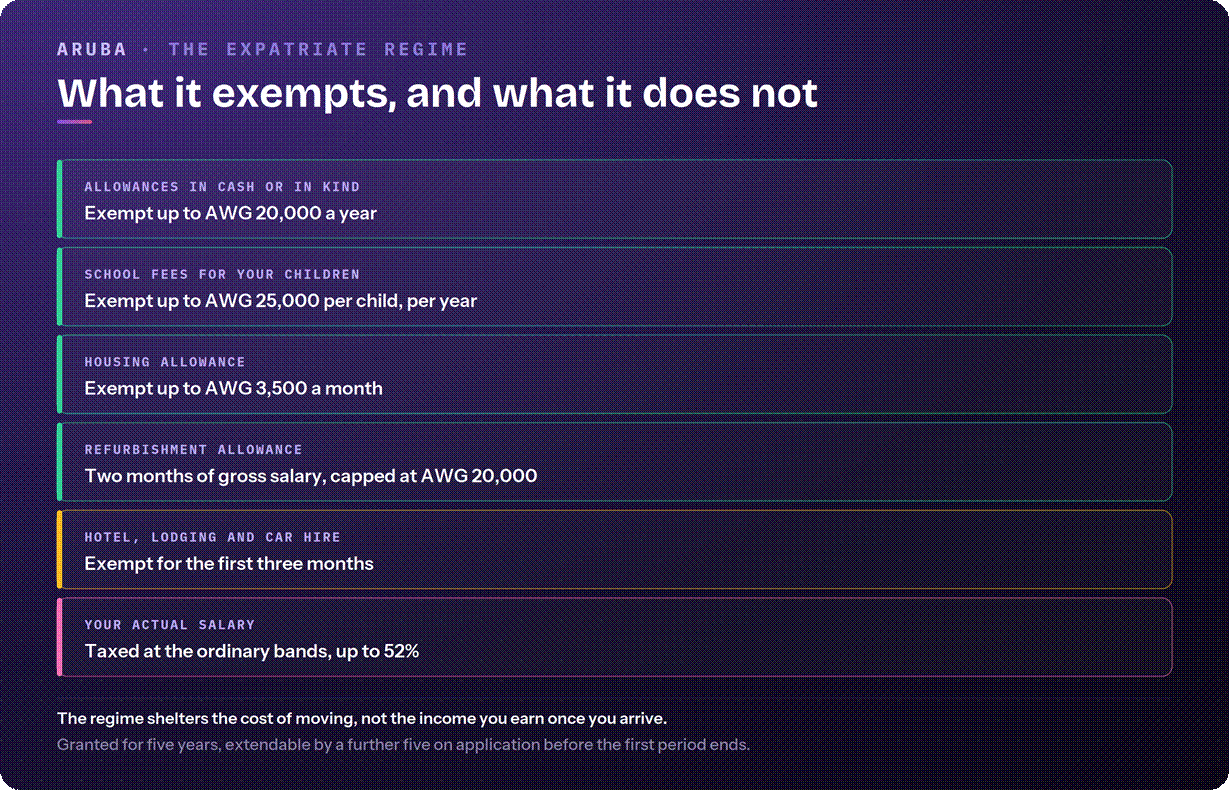
The exemptions run to the cost of relocating, not to the salary itself.
Several of these amounts were adjusted upwards for 2026. The annual allowance in cash or in kind rose from AWG 15,000 to AWG 20,000, and the housing allowance from AWG 2,500 to AWG 3,500 a month. The refurbishment allowance can now be paid in cash rather than only reimbursed.
The regime runs for five years. It can be extended by a further five on application before the first period expires, provided the employer can still make a credible case that the expertise remains unavailable locally.
Example: Daniel
Daniel moves from Rotterdam to Oranjestad on a two-year contract with an Aruban employer. He has not lived in Aruba before. His employer pays AWG 3,500 a month towards his rent and AWG 20,000 a year in allowances, and covers his flights and shipping.
Under the regime, those payments fall outside his taxable wage. His salary itself does not. He is taxed at the ordinary bands on the whole of it. The regime improves the package; it does not change the marginal rate on the pay.
Two ways to qualify, and one deadline
Until recently there was effectively one route: a gross salary of at least AWG 150,000 a year, with the employer showing that the employee’s expertise was scarce on the Aruban labour market. From 2026 a second route opened, and it changes who the regime is realistically available to.
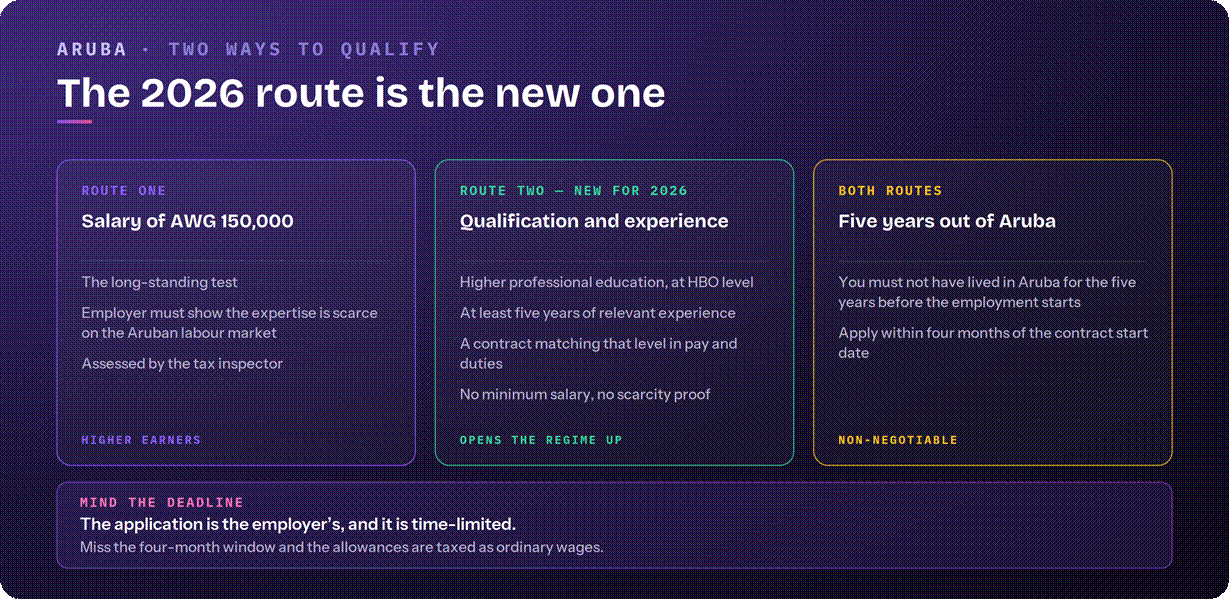
The qualification route removes both the salary floor and the scarcity test.
The application belongs to your employer, not to you. It must be filed within four months of the contract start date, with CV, diplomas, employment contract, work permit and residence permit. Miss that window and the allowances are treated as ordinary taxable wages. Raise it during the offer stage, not after you land.
Both routes share a hard condition: you must not have lived in Aruba during the five years immediately before the employment begins. Returning Arubans and people who spent an earlier stint on the island need to check that period carefully.
The treaty problem
Aruba’s treaty position is the weakest part of the picture for anyone with income arising elsewhere. It relies principally on the Tax Arrangement of the Kingdom, the internal instrument that allocates taxing rights between Aruba, Curaçao, Sint Maarten and the Netherlands, together with a very small number of other agreements and information-exchange arrangements.
A thin treaty network is a real cost, not a technicality. If you hold rental property, a pension or a business in a country Aruba has no agreement with, there may be no treaty mechanism to allocate taxing rights or to force a credit. Relief then depends on domestic law on both sides, which is a much weaker position. Check the specific countries your income arises in before you move, not after.
The turnover taxes
Aruba does not have VAT. It has a layered turnover tax — BBO, BAVP and BAZV — charged at a combined 7% on business turnover. Because it applies at each stage rather than only on value added, it compounds through a supply chain. Since 2019 these taxes cannot be shown as a separate line on an invoice, so the price a customer sees already includes them.
If you are self-employed or running a small company, that combination matters more than the income tax table. Turnover tax is filed monthly, by the fifteenth of the following month, and it is charged on receipts rather than profit.
Your checklist
• Decide whether you will be resident on the facts, since there is no day count to plan around;
• Remember that one day of work performed in Aruba creates a non-resident charge;
• Model the current income tax table rather than any figure you find online;
• Identify which expatriate route fits — the salary test or the qualification test;
• Confirm you have been outside Aruba for the full five years beforehand;
• Get the employer to file the expatriate application within four months of the start date;
• Diarise the five-year point so the extension is applied for in time;
• Check whether Aruba has any agreement with each country your other income arises in;
• Remember that gains on a substantial interest are charged at 25%, not at the ordinary bands; and
• If you will trade or freelance, price the 7% turnover tax into what you charge.
Frequently asked questions
Is Aruba a tax haven?
No. Residents are taxed on worldwide income at progressive rates reaching 52%, with a 7% turnover tax alongside. Its neighbours in the Dutch Caribbean and the wider region are structured very differently.
When does the 52% rate start?
At the top of the table, above AWG 135,527 of taxable income under the 2026 structure. The thresholds below it are revised periodically, so confirm the current table before relying on it.
Does the expatriate regime cut the rate on my salary?
No. It exempts a defined list of allowances and relocation costs from wage tax and premiums. The salary itself is taxed at the ordinary bands.
How long does the expatriate regime last?
Five years, extendable by a further five on application before the first period ends, if the employer can still show the expertise is not available locally.
Can I qualify without earning AWG 150,000?
From 2026, yes. A second route accepts higher professional education at HBO level, at least five years of relevant experience and a contract matching that level in pay and duties, with no minimum salary and no scarcity proof.
I work remotely for a foreign company from Aruba. Am I taxed?
Very likely. A non-resident is within the charge from the first day of work performed in Aruba, and where the duties are physically carried out is what counts, not where the employer is incorporated. It can also raise payroll and permanent establishment questions for your employer.
Does Aruba tax capital gains?
Not generally on privately held assets. Gains on a substantial interest — broadly 25% or more of a company — are taxed at 25%, and gains on real estate held as a business asset are taxed at the ordinary bands.
Are there many tax treaties?
No, and this is the weak point. Relief rests mainly on the Tax Arrangement of the Kingdom, covering the Netherlands, Curaçao and Sint Maarten, plus a very short list of other agreements. Check your own countries specifically.
Official sources and further reading
• Departamento di Impuesto — Aruba Tax Department
• Departamento di Impuesto — filing deadlines
• Departamento di Impuesto — international and treaty information
Important information
This article is general information and does not constitute tax, legal, immigration or financial advice, and does not create a client relationship. Tax outcomes depend on travel history, income sources, treaty status and the law applying to the relevant year. Rates, thresholds and regimes change, and some measures described may be proposed rather than enacted; this article reflects our understanding as at the date of publication. Obtain advice from a suitably qualified professional before acting or refraining from action.
