
Tanzania has a middle category between resident and non-resident that keeps foreign income out of the charge. It is rarely mentioned, and for a new arrival it is the most valuable feature of the system.
Tanzanian residence is not binary. Between the non-resident and the full resident sits the short-term resident, and the distinction is consequential: income tax is payable by individuals resident in Tanzania other than short-term residents on their worldwide income, while short-term residents and non-residents are taxable only on income from a Tanzanian source.
For someone arriving on a posting or a fixed-term engagement, that is a genuine transitional window. It removes foreign investment income, foreign rent and foreign business income from the Tanzanian base while the status holds.
Residence itself is decided by four limbs, and the third of them — an average of more than 122 days across three years — catches a pattern of regular visits that never reaches 183 days in any single year.
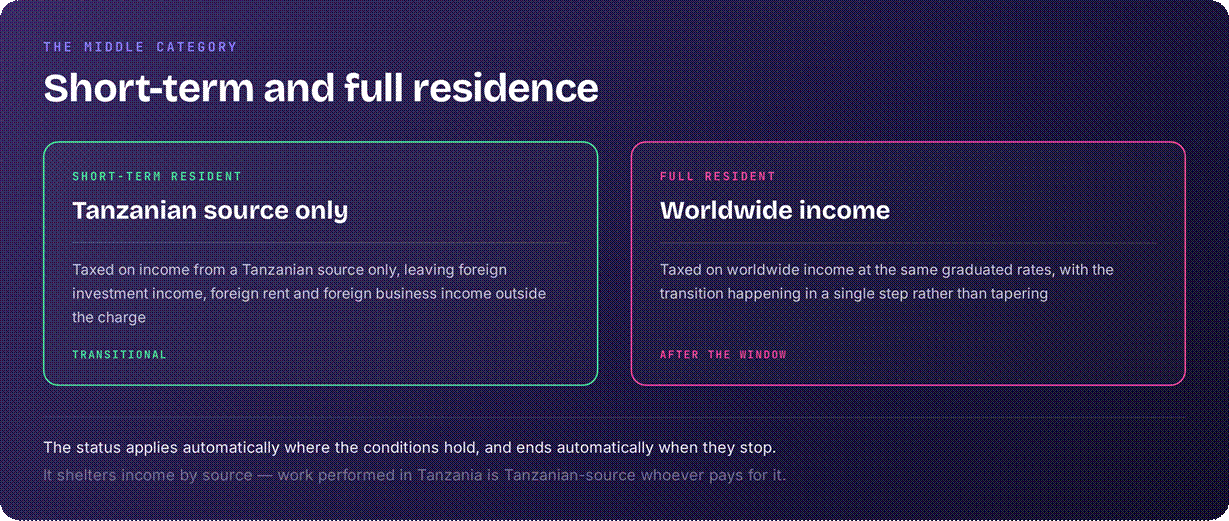
Short-term resident against full resident — the same rates, different scope.
Your residency status is the first step
An individual is resident in Tanzania for a year of income if they:
• Have a permanent home in Tanzania and were present in Tanzania during any part of the year;
• Were present in Tanzania for 183 days or more in that year;
• Were present in that year and in each of the two preceding years for periods averaging more than 122 days a year; or
• Are an employee or official of the government of the United Republic posted abroad during the year.
The permanent home limb requires only presence during any part of the year, so a single day can be enough where a home exists — the same structure that catches people in Kenya. The 122-day average looks backwards across three years and can crystallise residence in a year when nothing about the pattern changed.
Maintain accurate records of:
• Days present in each year of income and the two preceding years;
• Whether any Tanzanian dwelling constitutes a permanent home;
• Cumulative years of Tanzanian residence, for short-term resident status;
• Where personal services are physically performed;
• Income by source, Tanzanian and foreign; and
• Any other country that may also treat you as resident.
The tax rates
Monthly taxable income (TZS) | Rate |
Up to 270,000 | Nil |
270,000 to 520,000 | 8% of the excess |
520,000 to 760,000 | TZS 20,000 plus 20% of the excess |
760,000 to 1,000,000 | TZS 68,000 plus 25% of the excess |
Above 1,000,000 | TZS 128,000 plus 30% of the excess |
Non-resident employment income | 15% flat, final tax |
Other non-resident income | 30% |
Business turnover up to TZS 100 million | Presumptive regime applies |
Zanzibar administers certain taxes separately, and the position for a resident of the semi-autonomous region should be confirmed against the relevant authority rather than assumed to follow the mainland in every respect. Income tax schedules have been published covering both, but the administrative split is real.
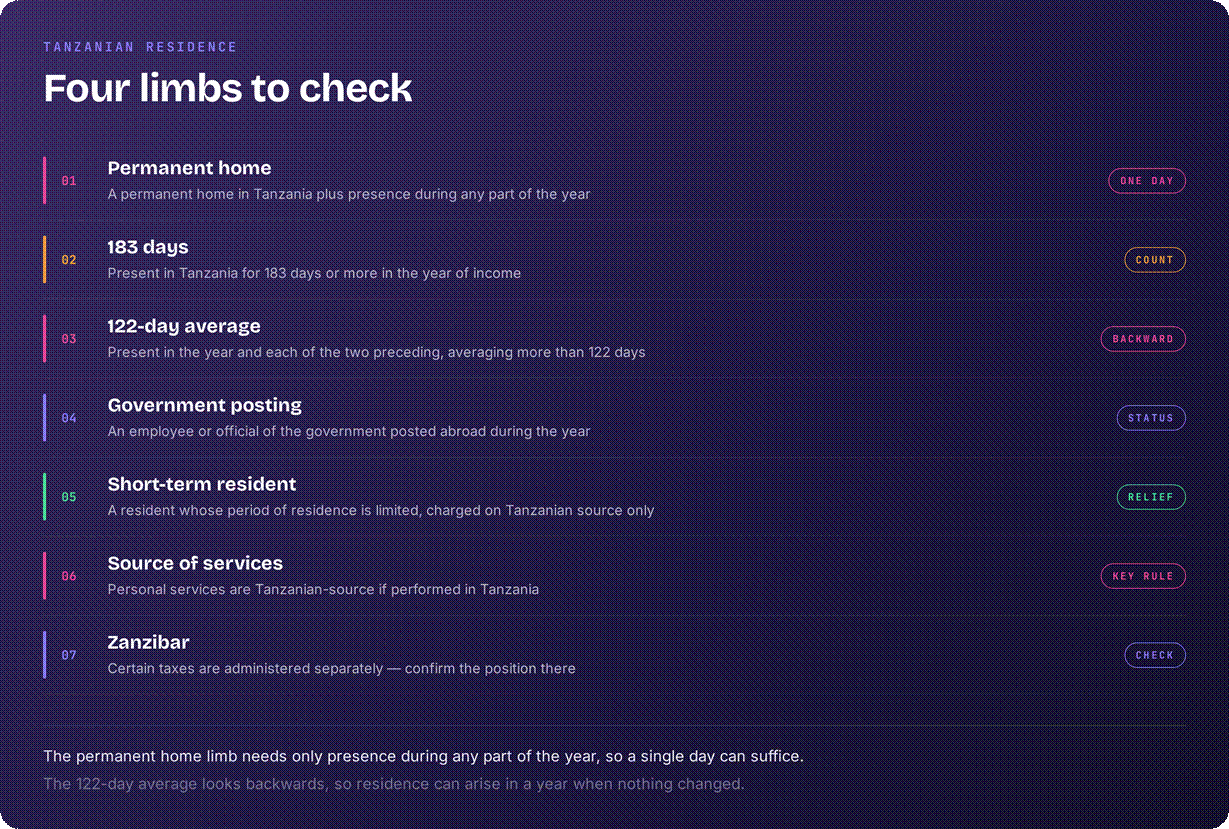
Four limbs, and two of them do not involve 183 days.
The short-term resident window
The short-term resident is a resident whose period of Tanzanian residence is limited, and the effect is that they are taxed on Tanzanian-source income only rather than worldwide income.
That is close in effect to the transitional regimes found in New Zealand and Chile, though it operates through the definition of who is charged on what rather than as a named exemption. Because it turns on cumulative residence rather than on an application, it applies automatically where the conditions hold — and ends automatically when they stop.
Anyone arriving on a fixed-term basis should establish at the outset how long the status will last and what happens at the point it ends, since the transition is from Tanzanian-source only to worldwide in a single step.
Where personal services have their source
Personal services have a Tanzanian source if they are performed in Tanzania, or performed outside Tanzania where the payer is the government of Tanzania.
For a remote worker that is the operative rule. Work carried out physically in Tanzania is Tanzanian-source income regardless of where the client, the contract and the payment sit — so the short-term resident status does not shelter it, and neither would non-residence.
Case study: Marcus assumes the wrong shelter
Marcus takes an eighteen-month contract in Dar es Salaam and keeps a portfolio of European shares and a rental property in Lisbon. He is resident, but as a short-term resident his foreign investment income and Portuguese rent sit outside the Tanzanian charge.
What he also does, in his spare time, is consultancy work for clients in Kenya and South Africa, performed from his flat in Dar. Because those services are performed in Tanzania, the fees are Tanzanian-source income and fall squarely inside the charge — short-term resident status does nothing for them.
The status shelters income by source, not by client. That distinction decides his position and he had assumed the opposite.
Filing and the compliance calendar
Employment income is withheld at source and remitted monthly by the employer, and each individual is required to file a return — joint filing is not permitted. Resident individuals with business turnover not exceeding TZS 100 million a year fall within a presumptive regime based on turnover rather than profit, with lower rates for those maintaining proper records.
Prepare in good time:
• A taxpayer identification number;
• Day-count records for the year and the two preceding years;
• Evidence of cumulative Tanzanian residence;
• Records showing where services were physically performed;
• Income separated by source; and
• Business turnover records, for the presumptive regime.
Establish the status, then the source
Consider:
• Whether a permanent home makes you resident on a single day;
• Whether the 122-day average catches you across three years;
• How long short-term resident status will last on your facts;
• What changes at the point it ends;
• Whether any work is performed physically in Tanzania;
• Whether the presumptive regime applies to business turnover; and
• Whether the Zanzibar position differs for your circumstances.
Your Tanzania checklist
1. Work all four residence limbs, not just the 183-day one;
2. Check whether a permanent home makes a single day sufficient;
3. Calculate the 122-day average across three years;
4. Establish whether short-term resident status applies to you;
5. Work out how long that status will last;
6. Plan for the single-step transition to worldwide taxation;
7. Identify any services performed physically in Tanzania;
8. Check whether business turnover falls under the presumptive regime;
9. Confirm the Zanzibar position if relevant; and
10. Keep day-count records for three years, not one.
Frequently asked questions
What is a short-term resident?
A resident whose period of Tanzanian residence is limited. Short-term residents are taxed on income from a Tanzanian source only, rather than on worldwide income, which makes it a genuine transitional window for a new arrival.
How do I become Tanzanian resident?
Through any of four limbs: a permanent home plus presence during any part of the year; 183 days or more in the year; presence in the year and each of the two preceding averaging more than 122 days; or being a government employee posted abroad.
What is the 122-day test?
You are resident if you were present in Tanzania in the year of income and in each of the two preceding years for periods averaging more than 122 days a year. It looks backwards, so residence can arise without any change in your pattern.
Does the short-term status cover my remote work?
No, if you perform the work in Tanzania. Personal services have a Tanzanian source when performed in Tanzania, so fees for work carried out there are Tanzanian-source income regardless of where the client sits.
What are the rates for residents?
Monthly bands: nil up to TZS 270,000, then 8%, 20%, 25% and 30% on the excess above successive thresholds, with the top rate applying above TZS 1,000,000 a month.
How are non-residents taxed?
Employment income at a flat 15%, which is a final tax in Tanzania. Other non-resident income is charged at 30%. The two figures are often conflated in published guidance.
What is the presumptive regime?
A simplified basis for resident individuals with business turnover not exceeding TZS 100 million a year, charged by reference to turnover rather than profit, with lower rates for those who maintain proper records.
Does Zanzibar have different rules?
Certain taxes are administered separately in the semi-autonomous region, so the position for a Zanzibar resident should be confirmed against the relevant authority rather than assumed to follow the mainland in every respect.
Official sources and further reading
Important information
This article is general information and does not constitute tax, legal, immigration or financial advice, and does not create a client relationship. Tax outcomes depend on travel history, income sources, treaty status and the law applying to the relevant year. Rates, thresholds and regimes change, and some measures described may be proposed rather than enacted; this article reflects our understanding as at the date of publication. Obtain advice from a suitably qualified professional before acting or refraining from action.
