
The remittance basis ended on 6 April 2025. In its place is a four-year window on foreign income and gains — and a facility for bringing old money onshore that closes for good after 2027-28.
If you are moving to the United Kingdom, returning after a long spell abroad, or weighing whether to bring offshore funds onshore, the central question is the same: will the UK tax only your UK income, or will it reach your income and gains from everywhere else?
The UK follows a residence taxation model. Residents are generally taxed on worldwide income and gains, while non-residents are taxed on UK-source income. For two centuries a third category sat alongside those two — residents who were not domiciled in the UK, who could elect the remittance basis and keep foreign income out of the UK charge for as long as it stayed offshore. That category no longer exists.
From 6 April 2025, domicile ceased to determine how a UK resident is taxed on foreign income. The remittance basis went with it. What replaced it is the Foreign Income and Gains regime, usually shortened to FIG: four years of complete relief from UK tax on foreign income and foreign chargeable gains, available to people arriving after a long absence.
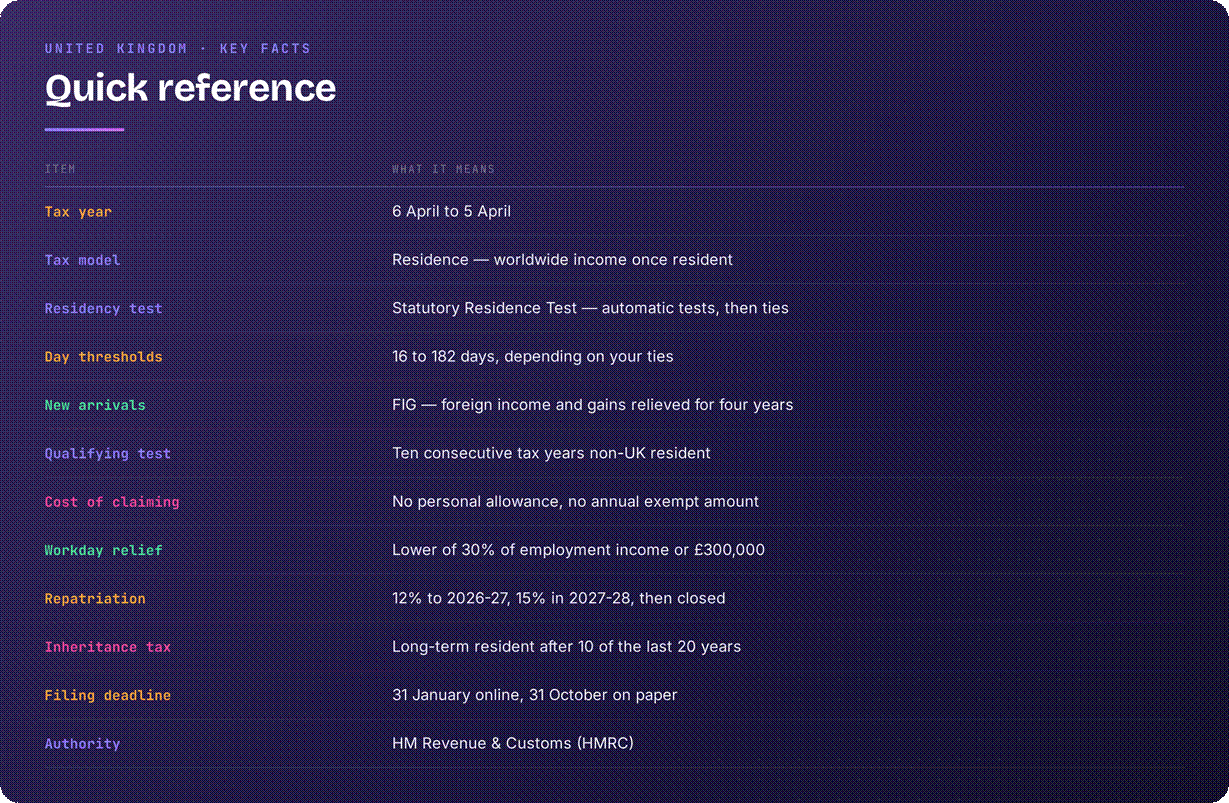
The UK position at a glance.
Your residency status is the first step
Establish your position before assessing how your income is treated. UK residence is determined by the Statutory Residence Test, which works in a fixed order: the automatic overseas tests first, then the automatic UK tests, and only if neither settles the question, the sufficient ties test.
The ties test is where day counting stops being simple. It combines the number of days you spend in the UK with the number of connections you have to it, and the threshold moves accordingly — from as few as 16 days for someone with several ties who was recently resident, up to 182 days for someone with none.
Maintain accurate records of:
• Arrival and departure dates, including days of transit;
• Days spent in the UK in each tax year and the three preceding years;
• Workdays physically performed in the UK;
• Accommodation available to you in the UK, whether owned or rented;
• Where your spouse, partner and minor children are resident; and
• Any other country that may also treat you as resident.
The relevant ties include family, accommodation, work, days spent in the UK in previous years and — for leavers — whether the UK is the country where you spend most time. A midnight in the UK generally counts as a day, subject to specific exceptions for transit and exceptional circumstances.
The UK tax year also runs from 6 April to 5 April, not the calendar year. This misalignment with almost every other country is a persistent source of error for anyone keeping day counts on a calendar basis, and it matters because the SRT is applied tax year by tax year.
The first four years: no UK tax on foreign income
The main planning opportunity for new arrivals is the FIG regime. You qualify if you become UK tax resident having been non-UK resident for the ten consecutive tax years immediately before. The test is residence history alone — nationality is irrelevant, and a returning British citizen who has been away for a decade qualifies on exactly the same terms as someone who has never lived here.
During the four years, foreign income and foreign chargeable gains can be claimed free of UK tax entirely. Not taxed at a reduced rate, and not taxed on remittance. The money can be brought into the UK and spent freely, which is the substantive break from the old system and removes the mixed-fund tracing that consumed so much professional time under the remittance basis.
Income | Treatment during the four years |
UK employment income | UK-source — taxable |
UK rental income | UK-source — taxable |
Profits of a UK business | UK-source — taxable |
Foreign employment income | Relievable under a FIG claim |
Foreign dividends and interest | Relievable under a FIG claim |
Foreign rental income | Relievable under a FIG claim |
Gains on foreign assets | Relievable under a FIG claim |
A claim is not a formality. FIG relief is claimed on your Self Assessment return, and the foreign income and gains have to be identified and reported even though no tax is charged on them. Relief is not given automatically to anyone who happens to qualify.
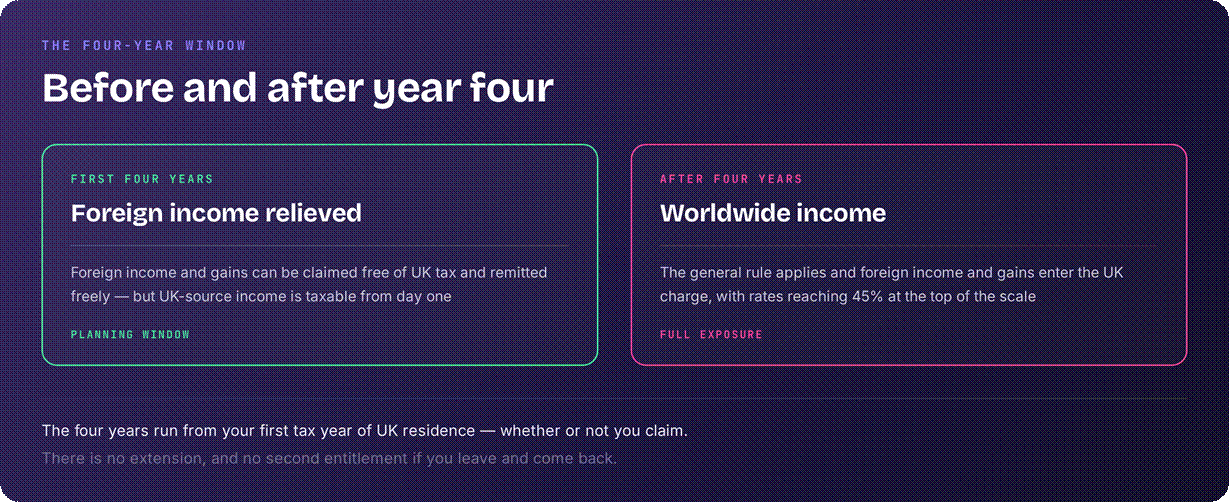
The four years run from your first year of UK residence, claimed or not.
What claiming costs you
For any tax year in which you claim FIG, you forfeit the personal allowance and the capital gains annual exempt amount. For someone with substantial foreign income the trade is obviously worth making. For someone with modest foreign income and significant UK earnings, the lost allowance can exceed the relief.
Because the claim is made year by year rather than once, this is a calculation to run every April rather than a decision taken on arrival. The four-year clock runs regardless, so there is no benefit in deferring a claim to preserve the window.
Overseas Workday Relief, rebuilt around FIG
Overseas Workday Relief still exists for employees whose duties are performed partly outside the UK, but it now sits inside FIG rather than alongside the remittance basis. It runs for the same four years, and it is capped at the lower of 30% of qualifying employment income or £300,000 a year.
The old requirement to receive and keep the relevant earnings in an offshore account has been removed, which eliminates a long-standing administrative trap. The cap is new, and it bites hardest on higher earners who previously sheltered a larger share of their package.
Case study: Daniel returns after eleven years
Daniel is a British citizen who has lived in Singapore since 2014. He returns to London in the 2026-27 tax year to take a role with a UK employer, keeping a rental apartment in Singapore and a portfolio of foreign dividend-paying shares.
Because he has been non-UK resident for more than ten consecutive tax years, he qualifies for FIG. His UK salary is taxable from the outset. His Singapore rent and foreign dividends can be relieved under a FIG claim for four years, and he can remit that money to the UK freely.
What Daniel needs to decide each year is whether the relief exceeds his personal allowance and annual exempt amount. And he needs a plan for the fifth year, when his worldwide income enters the UK charge in full.
The Temporary Repatriation Facility, and the date it closes
Anyone who used the remittance basis before April 2025 is likely holding foreign income and gains that were never taxed because they were never brought to the UK. Remitting them under the old rules would have triggered tax at full rates. The Temporary Repatriation Facility allows those amounts to be designated and charged at a reduced flat rate instead:
• 12% for 2025-26 and 2026-27;
• 15% for 2027-28; and
• Closed after that, with no announced successor.
Once an amount has been designated and the charge paid, it can be brought into the UK at any time with no further UK tax. The facility is open to former remittance basis users whether or not they now qualify for FIG, and designation is made through Self Assessment.
The practical point is the calendar rather than the rate. Someone weighing whether to bring offshore funds onshore has two tax years at 12%, one at 15%, and then the door closes.
Filing and the compliance calendar
The UK tax year ends on 5 April. The Self Assessment return for that year is due by 31 October on paper or 31 January online, with the balancing payment due on 31 January and payments on account, where required, on 31 January and 31 July.
Relief is not relief from filing. A FIG claim is made on a return, so claiming it requires you to file. The same applies to a TRF designation. Prepare in good time:
• UK employment and PAYE records;
• Foreign income statements by country and category;
• Foreign capital gains computations in sterling;
• Evidence of foreign tax paid;
• Travel and day-count records supporting your SRT position;
• Records identifying pre-April 2025 foreign income and gains; and
• Documentation of the ten-year non-residence period.
Timing matters more than the headline relief
Four years is a planning period, not a permanent arrangement. Model your position before you move, considering:
• Whether you will become UK resident early or late in a tax year;
• Whether split-year treatment applies to your year of arrival;
• Whether to realise foreign gains inside the window rather than after it;
• Whether the personal allowance is worth more than the relief in any given year;
• Whether Overseas Workday Relief applies and where the cap bites;
• Whether offshore funds should be designated before the 12% rate ends; and
• What your inheritance tax exposure looks like as the ten-year mark approaches.
Case study: Priya weighs the repatriation window
Priya claimed the remittance basis for several years before April 2025 and holds around £400,000 of unremitted foreign income in an offshore account. She now lives in the UK permanently and has no intention of leaving.
She does not qualify for FIG, because she has been UK resident throughout. But the Temporary Repatriation Facility is available to her regardless. Designating the funds in 2026-27 costs 12%; waiting until 2027-28 costs 15%; leaving it beyond that means any future remittance is charged at her marginal rate.
Her decision is not about whether she needs the money now. It is about whether she is prepared to leave a permanent restriction on funds she may want in ten years.
Your UK checklist
1. Work through the Statutory Residence Test in order, not by day count alone;
2. Record every arrival and departure, including days of transit;
3. Confirm whether you were non-UK resident for the full ten preceding tax years;
4. Identify the first tax year of UK residence, because the four years run from it;
5. Classify each income stream as UK-source or foreign-source;
6. Compare the value of a FIG claim against your personal allowance each year;
7. Check whether split-year treatment applies to your year of arrival;
8. Quantify any pre-April 2025 unremitted foreign income and gains;
9. Diarise the 12% repatriation rate ending after 2026-27; and
10. Review your inheritance tax position well before the ten-year mark.
Frequently asked questions
Can I still use the remittance basis?
No. The remittance basis is unavailable for tax years from 6 April 2025 onwards. FIG is a different relief with different conditions, and many former remittance basis users do not qualify for it at all.
Who qualifies for the four-year FIG regime?
Anyone who becomes UK tax resident having been non-UK resident for the ten consecutive tax years immediately before. Nationality and domicile are irrelevant — a returning British citizen qualifies on the same terms as a first-time arrival.
Does the four-year clock pause if I do not claim?
No. The period runs from your first tax year of UK residence regardless of whether you claim in each year. A year in which you decide the personal allowance is worth more is still one of your four.
What does a FIG claim actually cost me?
The personal allowance and the capital gains annual exempt amount for that tax year. Whether that is worth paying depends on the size of your foreign income relative to your UK income, so it is a year-by-year calculation.
Do I have to keep foreign earnings offshore for Overseas Workday Relief?
Not any more. The requirement to receive and keep the earnings in an offshore account has been removed. In exchange, the relief is capped at the lower of 30% of qualifying employment income or £300,000 per tax year.
Is the Temporary Repatriation Facility only for people who qualify for FIG?
No, and this is a common confusion. The facility is aimed at people who used the remittance basis before April 2025 and hold untaxed foreign income offshore, whether or not they meet the ten-year non-residence condition.
When exactly does the repatriation facility close?
The reduced rate is 12% for 2025-26 and 2026-27 and 15% for 2027-28. After 2027-28 the facility closes, and no successor has been announced.
Official sources and further reading
• GOV.UK guidance on tax on foreign income
• RDR3: Statutory Residence Test guidance
Important information
This article is general information and does not constitute tax, legal, immigration or financial advice, and does not create a client relationship. Tax outcomes depend on travel history, income sources, treaty status and the law applying to the relevant year. Rates, thresholds and regimes change, and some measures described may be proposed rather than enacted; this article reflects our understanding as at the date of publication. Obtain advice from a suitably qualified professional before acting or refraining from action.
