
Türkiye has introduced the most generous new-resident tax regime in its history. Under Law No. 7582, published in the Official Gazette on 4 June 2026, qualifying individuals who become Turkish tax residents from 1 January 2026 may be exempt from Turkish income tax on foreign-source income and gains for twenty years.
The implementing rules followed in Income Tax General Communiqué Series No. 333, published on 4 July 2026. Because the regime applies from the start of 2026, people who relocated earlier in that year can fall within it.
What the regime provides
The law inserted a new provision, commonly referred to as Article 20/D, into the Turkish Income Tax Law. In substance it gives a twenty-year exemption from Turkish income tax on income and gains obtained outside Türkiye, for qualifying resident individuals.
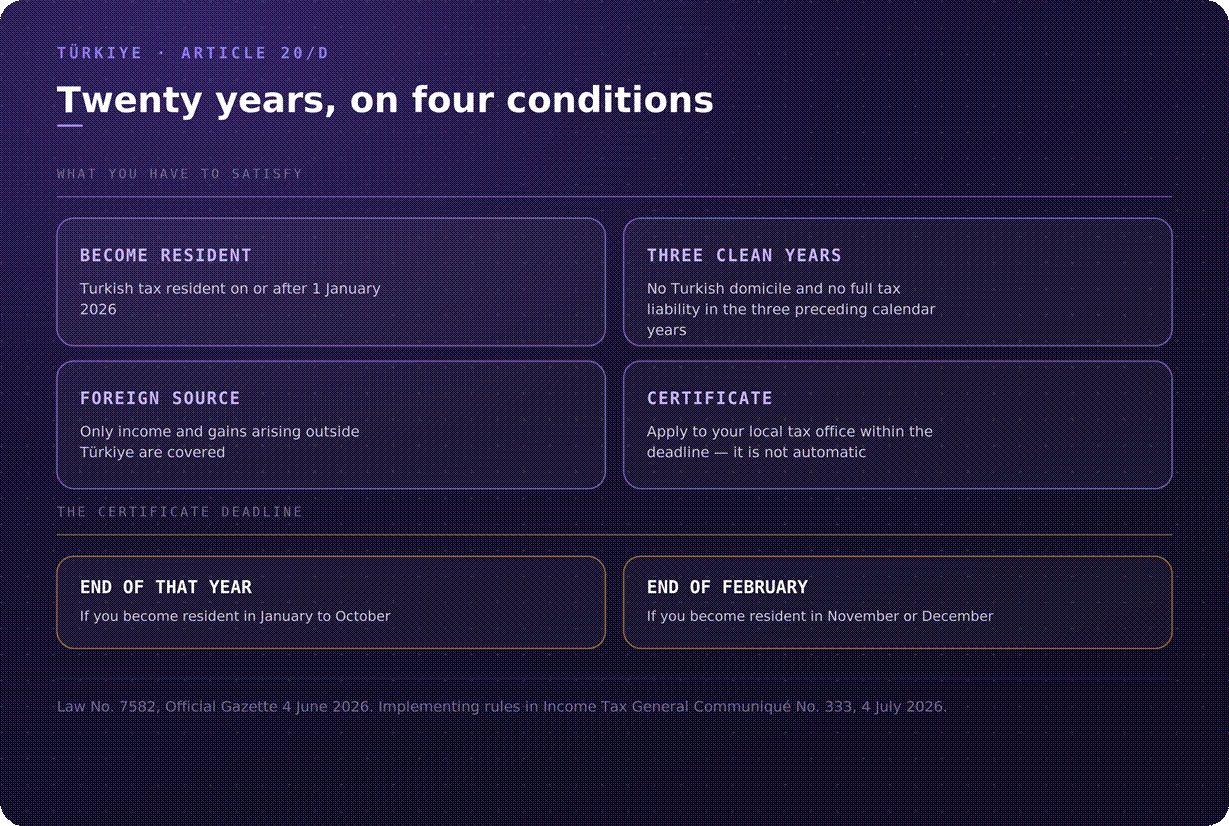
Four conditions, and a deadline that depends on when you arrive.
The three-year look-back
Your previous connection with Türkiye is the first eligibility question. To qualify you must become Turkish tax resident on or after 1 January 2026, and must not have had either a domicile in Türkiye or full Turkish tax liability during the three calendar years immediately preceding the year you become resident.
The test runs on calendar years rather than a rolling 36 months, so the year in which you become resident determines which three years are examined.
An important nuance. Having previously been taxed in Türkiye on a limited basis — for example on rental income, capital gains or securities income — does not by itself disqualify you. What the test looks for is Turkish domicile or full tax liability. That distinction matters for anyone who has owned Turkish property while living abroad.
Citizenship is not the decisive factor. A returning Turkish citizen can qualify if the residency and look-back conditions are satisfied. Equally, immigration status and tax residence are separate matters — a residence permit supports your right to live in Türkiye but does not determine whether the exemption applies.
Case study: Mark returns to Türkiye
Mark lived in Germany from 2021 through 2025 and had no Turkish domicile or full Turkish tax liability during 2023, 2024 or 2025. He returns and becomes Turkish tax resident in 2026.
If he satisfies the other conditions, his look-back period is clean and his twenty-year exemption may run from 2026 through 2045.
Case study: Felicity has a recent connection
Felicity spent part of 2025 living in Türkiye and was treated as having Turkish tax liability that year. She intends to become resident again in 2026.
The 2025 connection may prevent her satisfying the three-calendar-year condition for a 2026 start. Because an incorrect assumption here affects the entire twenty-year period, this is the point at which advice is worth most — and the answer may simply be to wait.
Foreign-source and Turkish-source
The exemption reaches only income and gains derived outside Türkiye. Turkish-source income remains taxable under the ordinary rules, at progressive rates that reach 40% at the top of the scale.
Income | Position under Article 20/D |
Dividends from foreign companies | Within the exemption, where genuinely foreign-source |
Interest from foreign institutions | Within the exemption |
Rent from property outside Türkiye | Within the exemption |
Gains on foreign assets | Within the exemption |
Turkish-source income of any kind | Outside the exemption, taxed as normal |
Services physically performed in Türkiye | May be Turkish-source despite a foreign client |
Foreign tax paid on exempt income | Cannot be credited against Turkish income tax |
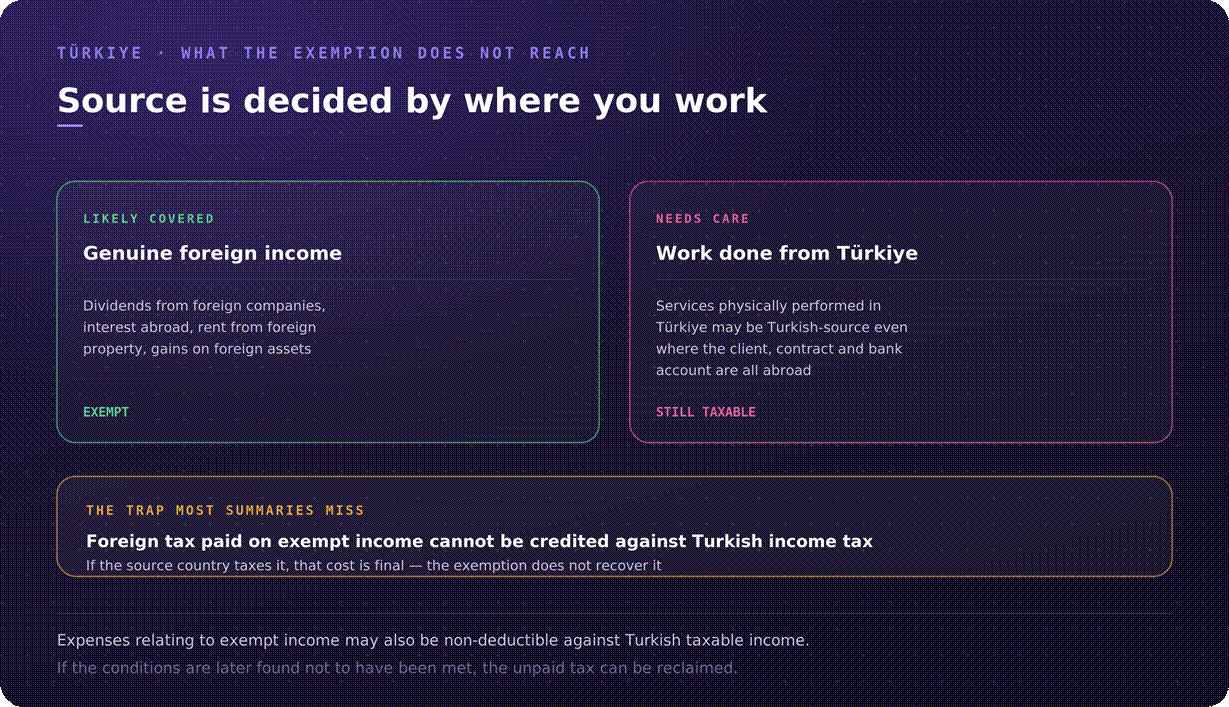
Where the line falls, and the credit rule that follows from it.
Remote-service income needs the most care
This is the live practical issue for digital nomads. If you work from a home office in Istanbul for clients in the United States, the United Kingdom or Germany, you may assume your income is foreign-source. Tax authorities look at where the services are physically performed.
The position taken by the implementing guidance. Communiqué No. 333 indicates that income from services performed inside Türkiye may be treated as Turkish-source, even where the client is foreign. A foreign client, a foreign contract and a foreign bank account do not establish foreign sourcing on their own.
The analysis can turn on where you physically perform the work, whether you are an employee, freelancer or business owner, where the business activity is managed, whether the work relates to Turkish customers or assets, and whether a foreign company is being used to receive income from activity carried out in Türkiye.
Case study: Sarah works for foreign clients
Sarah is a freelance designer. She moves to Istanbul, signs contracts with clients in Canada and France, and performs all the work from her apartment in Türkiye.
She may satisfy the residency and look-back conditions, but the source of her service income requires separate analysis. Under the approach reflected in the Communiqué, work physically performed in Türkiye may remain taxable there. She should not assume Article 20/D delivers a 0% rate on her freelance income, and should model the conservative outcome before relocating.
The regime works most cleanly where income is genuinely passive or genuinely generated abroad — foreign dividends, interest, rent and investment gains. It works least cleanly for someone earning service income from a desk in Türkiye.
The trap most summaries miss
Foreign tax on exempt income cannot be credited. Taxes paid abroad on income within the scope of the exemption cannot be offset against Turkish income tax. If the source country taxes the income, that cost is final — the Turkish exemption does not recover it. For income streams already suffering meaningful foreign withholding, the regime may be worth less than it appears.
Expenses relating to exempt income may also be non-deductible against Turkish taxable income, which matters if you have a mixed income profile with both exempt foreign income and taxable Turkish income.
There is also a clawback dimension. Where it is later determined that the conditions were not met, the unpaid tax is treated as lost revenue and can be recovered. That places a premium on documentation maintained across the full exemption period rather than just at the application stage.
Applying for the certificate
The exemption is not automatic. You must apply to the relevant local tax office for an exemption certificate under the Communiqué.
The deadline is generally the end of the calendar year in which you become Turkish tax resident. If you become resident during November or December, the deadline extends to the end of February of the following year. Become resident in April 2026, for example, and you should apply by the end of December 2026.
Your application may require evidence of the date you became tax resident, your previous domicile history, your Turkish tax status during the three look-back years, the nature and source of your income, and your identity and tax registration details.
Keep the evidence for twenty years, not one. Travel records, former lease agreements, foreign tax returns, employment documents and evidence of your previous residence position should be preserved for the full duration of the exemption, because the conditions can be revisited.
Related measures in the same law
Two further elements of Law No. 7582 matter for internationally mobile families.
Inheritance and gift transfers
Individuals benefiting from the Article 20/D exemption may receive preferential treatment for certain inheritance and gift transfers during the twenty-year exemption period, with a 1% rate applying in place of the ordinary progressive rates where the statutory conditions are met. This is not a standalone inheritance planning regime — you have to qualify for the income exemption first, and the transfer has to fall within the Turkish inheritance and transfer tax rules.
Asset repatriation
The law also created a repatriation measure for assets held abroad, including cash, gold, foreign currency, securities and capital market instruments, with certain unrecorded domestic assets also within scope. The declaration window runs to 31 July 2027, assets generally have to be brought to Türkiye or deposited with eligible Turkish banks or intermediaries within the prescribed period, and special rates of between 0% and 5% can apply depending on how the assets are handled.
The two regimes are independent. Repatriation concerns existing assets; Article 20/D concerns qualifying income and gains received during the exemption period. Analyse them separately.
A structured decision process
1. Establish your likely tax-residency year, considering domicile, physical presence and when your life genuinely moves;
2. Review the three preceding calendar years for Turkish domicile or full tax liability;
3. Classify each income stream — dividends, interest, rent, investment gains, salary and service income;
4. Assess where work is physically performed, not where clients or bank accounts sit;
5. Calculate foreign taxes and withholding, remembering they cannot be credited against Turkish tax;
6. Diarise the certificate deadline for your residency year;
7. Assemble the evidence, and plan to keep it for twenty years;
8. Consider the inheritance and repatriation measures separately; and
9. Take Turkish advice before becoming resident, restructuring work or moving assets.
Frequently asked questions
Does the regime mean digital nomads pay no Turkish tax?
No. It applies only to qualifying foreign-source income. Turkish-source income remains taxable, and income from services physically performed in Türkiye may be treated as Turkish-source even where the client is abroad.
Can a Turkish citizen qualify?
Yes, potentially. Citizenship is not the test. A returning Turkish citizen can qualify if they meet the residency requirement and the three-calendar-year look-back condition.
Is it automatic once I become resident?
No. You must apply to the relevant local tax office and obtain an exemption certificate, by the end of the year you become resident — or by the end of February where you become resident in November or December.
I owned Turkish property and paid rental tax. Am I disqualified?
Not necessarily. The look-back test is concerned with Turkish domicile and full tax liability. Prior taxation on a limited basis, such as rental income or capital gains, does not by itself prevent eligibility — but confirm your own history with an adviser.
Can I claim credit for foreign tax on exempt income?
No. Foreign taxes paid on income within the exemption cannot be offset against Turkish income tax. Where a source country withholds meaningfully, that cost is final.
Does the regime apply to companies?
No. Article 20/D is for qualifying individuals. Corporate structures fall under separate rules and need to be analysed on their own terms.
What if my circumstances are later found not to qualify?
The unpaid tax can be recovered as lost revenue. That is why the residency position, income classification and supporting documentation need monitoring across the whole period, not just at the outset.
Do other countries still tax my income?
They may. The Turkish exemption does not stop another country taxing income under its own law. Review source-country rules and any applicable treaty, particularly given the absence of Turkish credit relief.
Official sources and further reading
• Turkish Revenue Administration (Gelir İdaresi Başkanlığı)
Important information
This article is general information and does not constitute tax, legal, immigration or financial advice, and does not create a client relationship. Tax outcomes depend on travel history, income sources, treaty status and the law applying to the relevant year. Rates, thresholds and regimes change, and some measures described may be proposed rather than enacted; this article reflects our understanding as at the date of publication. Obtain advice from a suitably qualified professional before acting or refraining from action.
