
Australia announced a simpler residency test at the 2021 Budget. Five years on it still has not been legislated, and the old four-test framework — with all its case law — remains the law you have to work with.
Australian tax residency is decided by four tests, any one of which is enough. They have been criticised as unworkable for the better part of a decade, a replacement has been designed and announced, and none of it has been enacted. Anyone planning a move in or out of Australia is working with the old framework.
Residents are taxed on worldwide income. Non-residents are taxed on Australian-source income, with no tax-free threshold and a first marginal rate of 30% applying from the first dollar. The gap between the two positions is wide enough that residency is usually the whole question.
The tax year is also unusual: 1 July to 30 June, which misaligns with almost everywhere else and quietly breaks day counts and income matching kept on a calendar basis.
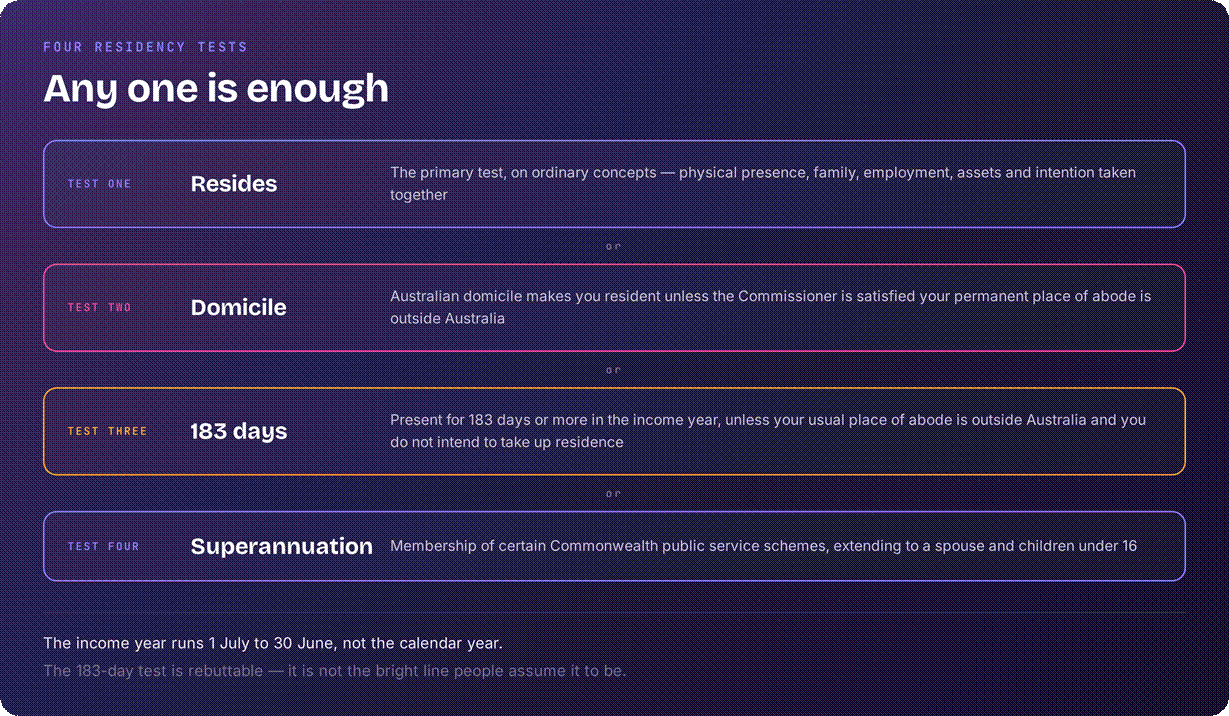
Four tests, and satisfying any one of them is enough.
Your residency status is the first step
The resides test is the primary one and works on ordinary concepts — whether you actually reside in Australia, weighing physical presence, family, employment, assets and intention. If it is satisfied, the other three do not matter.
The domicile test treats you as resident if your domicile is in Australia unless the Commissioner is satisfied your permanent place of abode is outside Australia. This is where most departing Australians are decided, and recent case law has moved in the taxpayer’s favour: a permanent place of abode outside Australia does not require a single fixed dwelling, and a town or country can suffice.
The 183-day test applies where you are present for 183 days or more in the income year, unless your usual place of abode is outside Australia and you do not intend to take up residence. The superannuation test covers members of certain Commonwealth public service schemes, and extends to their spouse and children under 16.
Maintain accurate records of:
• Arrival and departure dates by income year, running July to June;
• Where your permanent place of abode is, and the evidence for it;
• Housing arrangements in Australia and abroad, including leases;
• Where your family lives and where your employment is based;
• Australian assets, bank accounts and economic connections; and
• Any other country that may also treat you as resident.
The reform that keeps not arriving
At the 2021-22 Budget the government announced it would replace the four tests with a modernised framework built on the Board of Taxation’s model. Under it, a primary bright-line test would make you resident on 183 days or more in an income year, full stop, with no usual-place-of-abode escape.
Individuals below that would face a secondary factor test. Someone previously a foreign resident would become resident by spending more than 45 days in Australia and satisfying two or more of four factors: a right to reside permanently, Australian accommodation, Australian family, and Australian economic interests.
Forty-five days is the number expats should watch. Many Australians working abroad return home for six or eight weeks a year to see family, and many of them would meet two of the four factors without difficulty. Under the proposed model that pattern becomes residence.
The measure has not been legislated. If enacted as announced, it would apply from 1 July following enactment. Until then the four tests continue, and any guidance describing the bright-line model as current is describing something that does not exist.
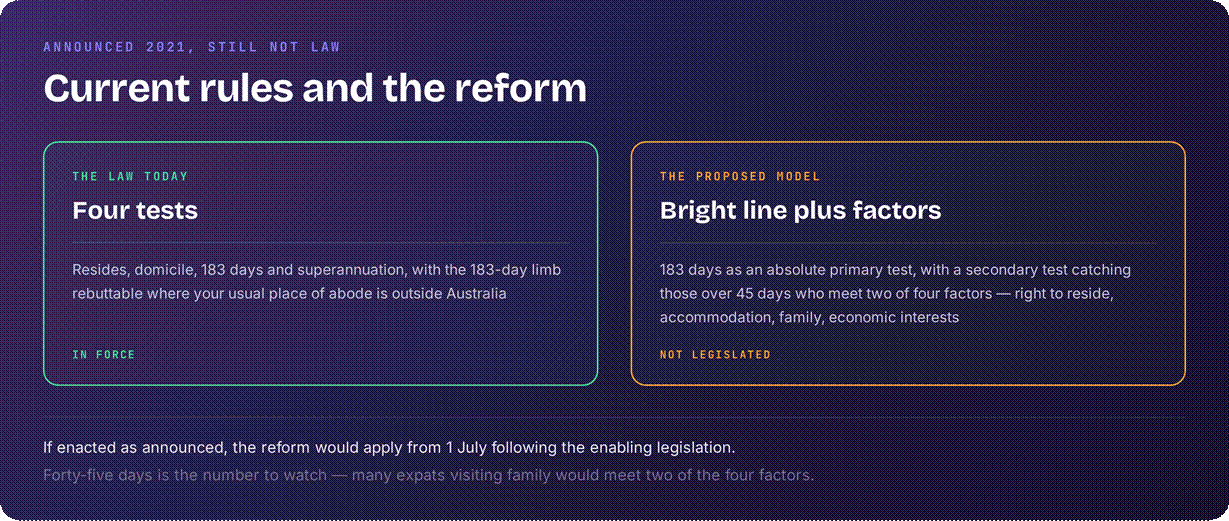
The law as it stands, against the model announced in 2021.
Ceasing residence, and the deemed disposal
When you stop being an Australian resident, CGT event I1 treats you as having disposed of your assets that are not taxable Australian property. Accrued gains become taxable even though nothing has been sold.
There is an election to defer: you can choose to treat those assets as taxable Australian property instead, so no charge arises until you actually dispose of them or resume Australian residence. The election is not automatic and has to be made.
Item | Position on ceasing residence |
Non-taxable Australian property | Deemed disposal under CGT event I1 |
Taxable Australian property | Remains in the Australian net |
The deferral election | Treat assets as TAP until actual disposal |
CGT discount | Not available to foreign residents |
Main residence exemption | Denied if you are a foreign resident when you sell |
Non-resident rates | No tax-free threshold, 30% from the first dollar |
The main residence point is the harsh one. A foreign resident at the time of disposal loses the exemption on the whole gain, not merely the period spent abroad. Selling before departure, or returning to residence before selling, can produce a completely different result on the same property.
Case study: Grant sells from Singapore
Grant moved to Singapore and kept the Sydney house he had lived in for fifteen years, renting it out. Four years later he sells it while still a Singapore resident.
Because he is a foreign resident at the time of disposal, the main residence exemption is unavailable — and not merely for the four years he was away. The entire gain, including the fifteen years he lived there, falls into the Australian charge, and as a foreign resident he gets no CGT discount either.
Had he sold before leaving, or re-established residence before selling, the outcome would have been materially different. Nobody raised it with him, because his move and his sale were four years apart.
Why Australians cannot become residents of nowhere
This is the single most consequential point for any Australian planning to work remotely from abroad, and it is the one most often got wrong. Leaving Australia does not, by itself, end Australian tax residency.
The definition in subsection 6(1) of the Income Tax Assessment Act 1936 contains four alternative tests, and the one that catches Australians abroad is the domicile test. A resident includes a person whose domicile is in Australia, unless the Commissioner is satisfied that the person’s permanent place of abode is outside Australia.
Read the structure of that provision carefully. Australian domicile makes you resident by default. The only way out is to satisfy the Commissioner of something positive — that your permanent place of abode is outside Australia. It is not enough to show that you have left.
Domicile is sticky by design
Domicile is a common law concept, modified in Australia by the Domicile Act 1982. An Australian citizen will generally have an Australian domicile of origin, and it persists until a domicile of choice is acquired somewhere else.
Acquiring one requires an intention to make your home indefinitely in another country, supported by the lawful right to live there permanently. If you do not consciously relinquish your Australian domicile, or if there is simply no new country to which you intend to commit, you keep the Australian one.
That is precisely the position of someone moving between countries on tourist entries and short-stay visas. They have not formed an intention to make a home indefinitely anywhere, and they usually have no right to reside permanently anywhere either. Their Australian domicile survives intact.
What Harding actually decided
The leading authority is Harding v Federal Commissioner of Taxation [2019] FCAFC 29, and it is widely misread as a general win for expatriates.
Mr Harding departed Australia in 2009, lived in serviced apartments in Bahrain — moving between them rather than settling in one — and commuted to a permanent position in Saudi Arabia. At first instance the Federal Court held he had no permanent place of abode outside Australia, because each apartment was temporary accommodation.
The Full Federal Court overturned that. It held that permanent place of abode does not refer to a specific house, flat or dwelling. It requires the identification of a country in which the taxpayer is permanently living. Because Mr Harding was permanently based in Bahrain and had abandoned his residence in Australia, his permanent place of abode was outside Australia.
The Commissioner sought special leave to appeal to the High Court and was refused on 13 September 2019, Justice Gordon observing that requiring a specific permanent dwelling seems impractical given the way we currently live. The ATO has no further avenue of appeal.
And why that is bad news for nomads
Harding replaced a dwelling requirement with a country requirement. For an expatriate settled in one place it is a considerable relief. For someone deliberately settled in no place, it is the opposite.
The test now asks you to identify the country in which you are permanently living. A nomad rotating through Bali, Lisbon and Mexico City cannot answer that question. The same difficulty has been flagged for Australians working on yachts, who may be unable to point to any particular country where they permanently live.
Fail to identify one and the domicile test is not displaced. You retain Australian domicile, you have no permanent place of abode outside Australia, and you remain an Australian tax resident assessable on worldwide income — while quite possibly paying tax nowhere else.
Two further points from Taxation Ruling TR 2023/1, issued on 7 June 2023 and legally binding, sharpen the position. It is only possible to have one permanent place of abode at any point in time. And where a person is living both in Australia and overseas, it is unlikely their permanent place of abode could be said to be overseas.
What the Commissioner actually looks at
TR 2023/1 sets out the factors relevant to the domicile test. They are worth knowing because they tell you what evidence to build.
• The length of the overseas stay, with an intention to remain for two years or more treated as a rule of thumb rather than a rule;
• The nature of the accommodation occupied abroad;
• The durability of association with the particular place;
• Whether a residence in Australia has genuinely been abandoned; and
• Objectively observable connections, since intention alone carries little weight.
The Ruling consolidated and replaced IT 2650, IT 2681 and TR 98/17, and is informed by Harding alongside Pike and Addy. It made no change to the legislation — residency remains a question of fact with no hard and fast rules, decided holistically, with no single factor determinative.
Case study: two Australians who both left
Cameron leaves Sydney and takes a two-year contract in Singapore. He rents an apartment, his family joins him, he holds an employment pass giving him the right to live there, and he sells the Australian house. He can identify a country in which he is permanently living, and the domicile test is displaced.
Meg leaves Sydney with no fixed destination. Over the following two years she spends four months in Thailand, five in Portugal, three in Colombia and the rest moving. Every stay is on a tourist entry. She has no right of permanent residence anywhere and no intention to commit to a country.
Meg has not acquired a domicile of choice, and she cannot identify a country in which she is permanently living. Her Australian domicile stands, her permanent place of abode is not outside Australia, and she remains assessable in Australia on her worldwide income. She has changed her life considerably and her tax position not at all.
Rates and the compliance calendar
Resident rates begin with a tax-free threshold of A$18,200 and climb to 45%, with the Medicare levy applying on top for most residents. Foreign residents receive no tax-free threshold and pay 30% from the first dollar, rising to 45% at the top.
The income year ends 30 June. Returns lodged by the taxpayer are generally due by 31 October, with considerably later deadlines available through a registered tax agent, provided you are on their books before that date.
Prepare in good time:
• A tax file number and myGov access;
• Records supporting your residency position under all four tests;
• Travel records by income year, not calendar year;
• Cost bases and market values for assets held at departure;
• Documentation of any CGT event I1 deferral election; and
• Details of Australian-source income received after departure.
Timing matters more than the rate
Model your position before you move, considering:
• Which of the four tests your circumstances actually engage;
• Whether you can evidence a permanent place of abode outside Australia;
• Whether the July-to-June year splits your move awkwardly;
• Whether to realise gains before ceasing residence or make the deferral election;
• What the main residence exemption is worth, and when to sell;
• Whether a 45-day return pattern would catch you if the reform passes; and
• Whether your destination has a treaty with Australia.
Your Australia checklist
1. Identify the single country in which you are permanently living;
2. Do not assume leaving Australia ends Australian tax residency;
3. Establish a lawful right to reside permanently somewhere, if you can;
4. Build objectively observable connections, not just intention;
5. Work all four residency tests, not just the day count;
6. Gather evidence of a permanent place of abode outside Australia;
7. Count days by income year, running July to June;
8. Value all non-TAP assets as at the date residence ceases;
9. Decide whether to make the CGT event I1 deferral election;
10. Establish what the main residence exemption is worth before selling;
11. Remember foreign residents get no CGT discount;
12. Model a 45-day annual return pattern against the proposed factor test;
13. Register with a tax agent before 31 October if you want the later deadline; and
14. Check the treaty position with your destination country.
Frequently asked questions
Can an Australian nomad escape Australian tax by leaving?
Generally not. The domicile test in subsection 6(1) makes a person with an Australian domicile a resident unless the Commissioner is satisfied their permanent place of abode is outside Australia. Leaving is not enough — you must establish something positive somewhere else.
Why does domicile matter so much?
Because an Australian citizen generally has an Australian domicile of origin that persists until a domicile of choice is acquired elsewhere. That requires an intention to make your home indefinitely in another country, supported by a lawful right to live there permanently.
What did Harding decide?
The Full Federal Court held in 2019 that permanent place of abode does not refer to a specific dwelling but requires identifying a country in which the taxpayer is permanently living. Mr Harding, based in Bahrain in serviced apartments, was held to have a permanent place of abode outside Australia.
Doesn’t Harding help nomads?
No — it does the opposite. It replaced a dwelling requirement with a country requirement, which helps someone settled in one place and hurts someone deliberately settled in none. A nomad rotating between countries cannot identify the country in which they are permanently living.
Can I have a permanent place of abode in more than one country?
No. TR 2023/1 states it is only possible to have one permanent place of abode at any point in time, and that where a person lives both in Australia and overseas it is unlikely their permanent place of abode is overseas.
What evidence does the ATO look for?
Under TR 2023/1, the length of the overseas stay, the nature of the accommodation, the durability of association with the place, and whether the Australian residence was genuinely abandoned. Intention must be supported by objectively observable connections.
Has Australia changed its residency tests?
No. A modernised framework was announced at the 2021-22 Budget and designed by the Board of Taxation, but it has not been legislated. The four existing tests remain the law.
Does spending 183 days in Australia make me resident?
Not necessarily. The 183-day test is rebuttable — it does not apply where your usual place of abode is outside Australia and you do not intend to take up residence here. Under the proposed reform it would become an absolute test, which is a significant change.
What is the 45-day rule people mention?
It belongs to the proposed reform, not current law. Under the model, someone previously a foreign resident would become resident by spending more than 45 days in Australia and meeting two of four factors — right to reside, accommodation, family and economic interests.
What happens to my assets when I stop being a resident?
CGT event I1 treats non-taxable Australian property as disposed of at market value, so accrued gains become taxable. You can elect instead to treat those assets as taxable Australian property, deferring the charge until actual disposal or resumption of residence.
Can I still claim the main residence exemption from abroad?
Generally not. A foreign resident at the time of disposal is denied the exemption on the entire gain, not merely the period spent overseas. Timing the sale around your residence position matters enormously.
What rates apply to non-residents?
There is no tax-free threshold and the first marginal rate of 30% applies from the first dollar, rising to 45%. Foreign residents also cannot access the CGT discount.
When does the Australian tax year run?
1 July to 30 June. The misalignment with the calendar year is a persistent source of error for people tracking days or matching foreign income on a January-to-December basis.
When is the return due?
Generally 31 October where you lodge yourself. Registered tax agents have considerably later deadlines, but you usually need to be on their books before 31 October to use them.
Official sources and further reading
Important information
This article is general information and does not constitute tax, legal, immigration or financial advice, and does not create a client relationship. Tax outcomes depend on travel history, income sources, treaty status and the law applying to the relevant year. Rates, thresholds and regimes change, and some measures described may be proposed rather than enacted; this article reflects our understanding as at the date of publication. Obtain advice from a suitably qualified professional before acting or refraining from action.
