
Peru decides your status at the start of the fiscal year, not when you cross the day count. Someone arriving in July is taxed as a non-domiciled individual for eighteen months or more.
Peru taxes by domicile rather than by residence in the ordinary sense, and the rule that matters most is about timing rather than about days. A foreign individual becomes domiciled by being present in Peru for more than 183 calendar days within a twelve-month period — but the change of status takes effect only from 1 January of the following fiscal year.
The condition is determined at the beginning of the fiscal year. A change during the year does not take effect until the next one. In practice that means a non-domiciled individual who crosses the threshold after 30 June waits until the year after next before domiciled treatment applies to them.
Until that point they are taxed as non-domiciled — that is, on Peruvian-source income only, with foreign income entirely outside the Peruvian charge.
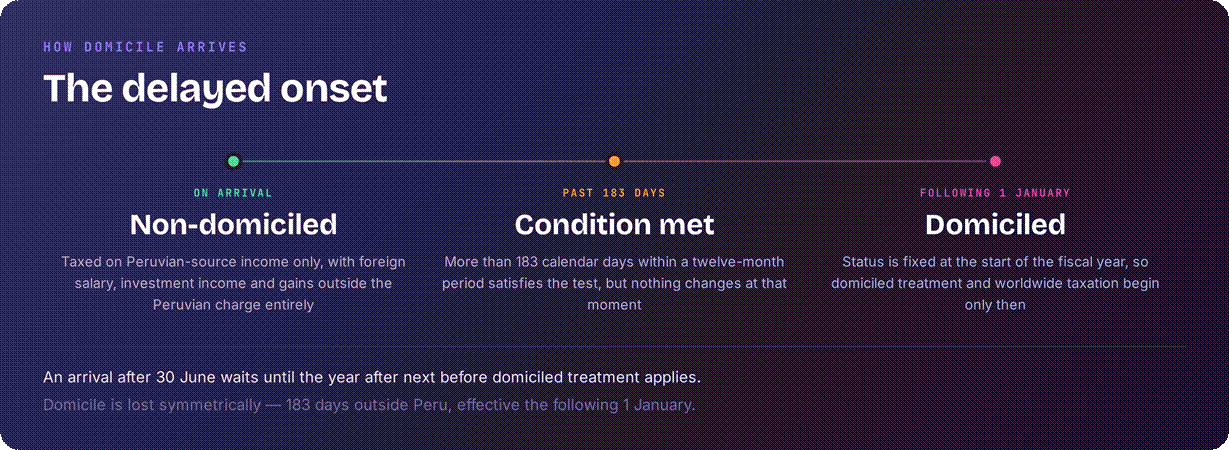
The window between crossing the threshold and the charge applying.
Your residency status is the first step
Foreign individuals are deemed domiciled in Peru if they have resided or been present in Peru for more than 183 calendar days within a twelve-month period. Temporary absences of up to 183 days within a twelve-month period do not interrupt the continuity of that status.
The timing rule is the substantive one. Because the condition is fixed at the start of the fiscal year and changes take effect on the following 1 January, an arrival in the second half of a year has a materially longer non-domiciled window than an arrival in January.
Losing domicile works symmetrically: a Peruvian or foreign individual who stays outside Peru for more than 183 days in a twelve-month period loses domiciled status, again effective from 1 January of the following year. A Peruvian who obtains a foreign domicile with the corresponding visa, or a foreign employment contract of at least a year, loses it once they leave.
Maintain accurate records of:
• Days present in Peru across rolling twelve-month periods;
• The date the 183-day threshold is crossed, and which fiscal year follows;
• Temporary absences, and whether any exceeds 183 days;
• Income by source, Peruvian and foreign;
• Whether income is labour income or capital income; and
• Any other country that may also treat you as resident.
The tax rates
Income | Domiciled individual |
Labour income | Progressive at 8%, 14%, 17%, 20% and 30% |
Foreign-source income | Progressive at the same rates |
Peruvian dividends | 5% |
Peruvian interest | 5% |
Peruvian royalties | 5% |
Peruvian rental income | 5% |
Local capital gains | 5% |
Individual business income | Corporate treatment, with dividends tax on distribution |
The split between labour income and capital income is the whole structure. Peru operates a schedular system: employment and foreign-source income run through progressive rates reaching 30%, while Peruvian-source investment income sits at a flat 5%. The first seven tax units of labour income are also exempt, which removes lower earners from the charge.
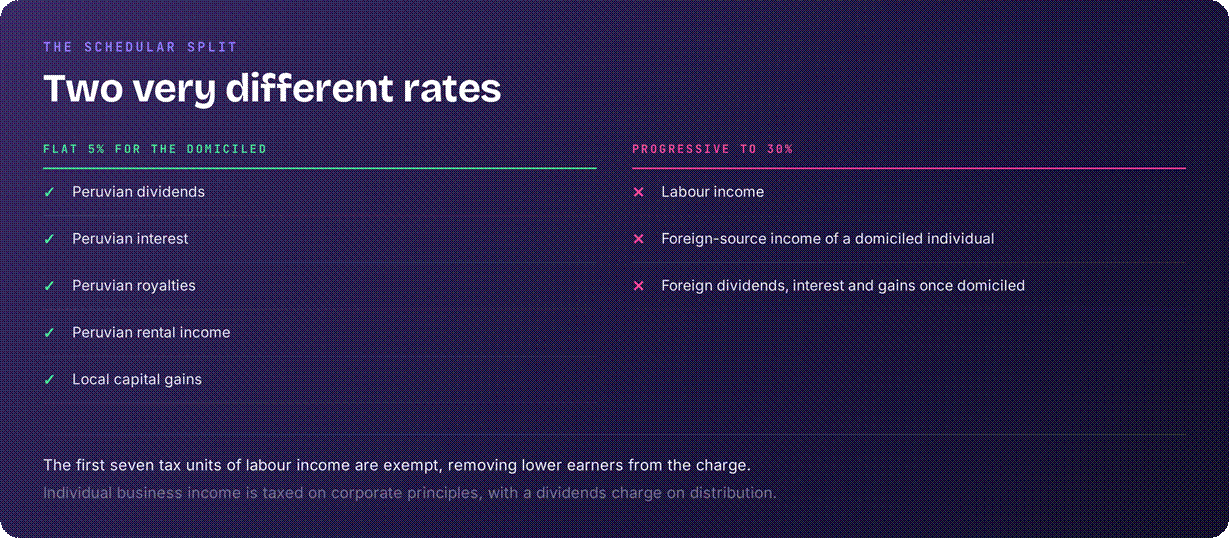
Two schedules, and the gap between them.
What the non-domiciled window means
A non-domiciled individual is taxed only on Peruvian-source income. Foreign salary, foreign investment income and foreign gains are outside the Peruvian system altogether during that period.
Non-domiciled rates are less favourable on Peruvian income — generally 30% on most categories, with 5% on dividends, on capital gains from securities disposed of within the Lima Stock Exchange, and on capital gains or lease income from Peruvian real estate, and 4.99% on certain interest. No deductions or credits apply.
So the window is a genuine benefit for someone whose income is largely foreign, and a disadvantage for someone earning mainly in Peru. Which of those you are determines whether the delayed onset of domicile helps or hurts.
What makes Peru attractive
For an arrival with foreign income the case is stronger than a 30% top rate suggests:
• A delayed onset of domicile that can leave foreign income outside the charge for eighteen months or more;
• A flat 5% on Peruvian dividends, interest, royalties, rental income and local capital gains for domiciled individuals;
• The first seven tax units of labour income exempt, which removes lower earners entirely;
• A schedular system that keeps investment income out of the progressive scale;
• A foreign tax credit for taxes paid on foreign income taxable in Peru, limited to the average Peruvian rate applied to that income; and
• Symmetrical exit rules, so losing domicile is as mechanical as gaining it.
The qualification is the mirror image: once domiciled, worldwide income enters the charge at progressive rates reaching 30%, and the transition happens in a single step on 1 January rather than tapering.
Case study: Daniel arrives in July
Daniel moves to Lima in July and stays. By January he has been in Peru for around six months — not yet past 183 days. He crosses the threshold in the spring of the following year.
Because status is fixed at the start of the fiscal year and changes take effect the following 1 January, he is non-domiciled for the remainder of his arrival year and for the whole of the next one. Domiciled treatment begins on 1 January of the year after that.
Throughout that period his foreign income is outside the Peruvian charge entirely. Had he arrived in January instead, the window would have been considerably shorter — which makes the month of arrival a genuine planning variable.
Filing and the compliance calendar
The Peruvian fiscal year begins on 1 January, and thresholds are expressed in tax units — the UIT — which is revalued annually, so figures quoted in soles date quickly. Domiciled individuals file an annual return; non-domiciled individuals with income not subject to withholding pay directly.
A non-domiciled individual leaving Peru submits a form declaring that they have complied with and paid all taxes for which they are liable. Prepare in good time:
• A tax registration and filing access;
• Day-count records on a rolling twelve-month basis;
• The date the 183-day threshold was crossed;
• Income separated by source and by schedule;
• The UIT figure for the year being computed; and
• Evidence of foreign tax paid, for the credit.
Arrival timing is the planning
Consider:
• Which month you arrive, since it decides the length of the window;
• When your rolling 183rd day will fall;
• Which fiscal year domiciled treatment will begin in;
• Whether your income is mainly foreign or mainly Peruvian;
• That non-domiciled treatment is favourable for one and not the other;
• Whether investment income can be characterised as Peruvian-source at 5%; and
• That thresholds move with the tax unit each year.
Your Peru checklist
1. Choose your arrival month deliberately — it decides the window;
2. Track days on a rolling twelve-month basis;
3. Identify the date the 183-day threshold is crossed;
4. Work out which fiscal year domiciled treatment begins in;
5. Check whether temporary absences exceed 183 days;
6. Separate labour income from capital income;
7. Identify Peruvian-source investment income eligible for 5%;
8. Use the UIT figure for the year being computed;
9. Keep evidence of foreign tax paid for the credit; and
10. Submit the departure form if leaving as non-domiciled.
Frequently asked questions
When do I become tax resident in Peru?
You become domiciled by being present for more than 183 calendar days within a twelve-month period, but the change takes effect only from 1 January of the following fiscal year. The condition is determined at the start of the year.
Why does my arrival month matter?
Because status is fixed at the start of each fiscal year. Someone who crosses the threshold after 30 June waits until the year after next for domiciled treatment, which can leave foreign income outside the Peruvian charge for eighteen months or more.
What does non-domiciled treatment mean?
Tax on Peruvian-source income only. Foreign salary, foreign investment income and foreign gains are outside the Peruvian system entirely during that period, though Peruvian income is taxed less favourably and without deductions.
How is investment income taxed?
For a domiciled individual, Peruvian dividends, interest, royalties, rental income and local capital gains are taxed at a flat 5%. Labour income and foreign-source income run through progressive rates of 8%, 14%, 17%, 20% and 30%.
What rates apply to non-domiciled individuals?
Generally 30% on most Peruvian-source income, with 5% on dividends, on capital gains from securities within the Lima Stock Exchange, and on gains or lease income from Peruvian real estate, and 4.99% on certain interest. No deductions or credits apply.
How do I lose domicile?
By staying outside Peru for more than 183 days in a twelve-month period, effective from 1 January of the following year. A Peruvian who obtains a foreign domicile with a visa, or a foreign employment contract of at least a year, loses it on leaving.
Is there a foreign tax credit?
Yes. A credit is available for taxes paid on foreign income taxable in Peru, determined by the average Peruvian rate applied to that foreign income, capped at the amount of tax actually paid abroad.
What is the tax unit?
The UIT, a reference unit used for thresholds and penalties across the Peruvian system. It is revalued annually, so any threshold quoted in soles dates quickly and should be recalculated for the year being computed.
Official sources and further reading
• SUNAT — Peruvian tax administration
Important information
This article is general information and does not constitute tax, legal, immigration or financial advice, and does not create a client relationship. Tax outcomes depend on travel history, income sources, treaty status and the law applying to the relevant year. Rates, thresholds and regimes change, and some measures described may be proposed rather than enacted; this article reflects our understanding as at the date of publication. Obtain advice from a suitably qualified professional before acting or refraining from action.
