
If you live, work or travel regularly in Norway, understand how residency is determined before you plan your compliance. Norway follows a residence taxation model: once you become tax resident you are generally taxed on worldwide income, while non-residents are taxed on certain Norwegian-source income only.
The key question is not where you are registered, but how many days you spend in Norway and how that presence is distributed over time.

Two alternative tests. You only need to fail one of them.
The two tests
You become tax resident in Norway if either applies: you are present for more than 183 days during any 12-month period, or more than 270 days during any 36-month period. These are alternatives — you do not need to exceed both.
These are rolling periods, not calendar years. Review your travel history across rolling 12-month and 36-month windows rather than totting up days between 1 January and 31 December. Whole and partial days may count, and the reason for your presence generally does not change the analysis.
Do not overlook the 270-day test
The 183-day rule attracts the attention, but the longer test is the one that catches people who divide their time between countries. Spend 80 days in year one, 95 in year two and 100 in year three and you have 275 days across 36 months — resident, without ever approaching 183 in any single year.
Case study: Mark, the long-term nomad
Mark works remotely for clients in several countries. He spends around three months each summer in Norway and returns for shorter winter visits, never exceeding 183 days in a year.
After three years his total presence exceeds 270 days, so he may become tax resident regardless. He should review his days over each 36-month window rather than his annual totals, and consider where his work is performed, where his clients are, and whether another country claims him.
When residency begins
The start date matters, because it determines what has to be reported.
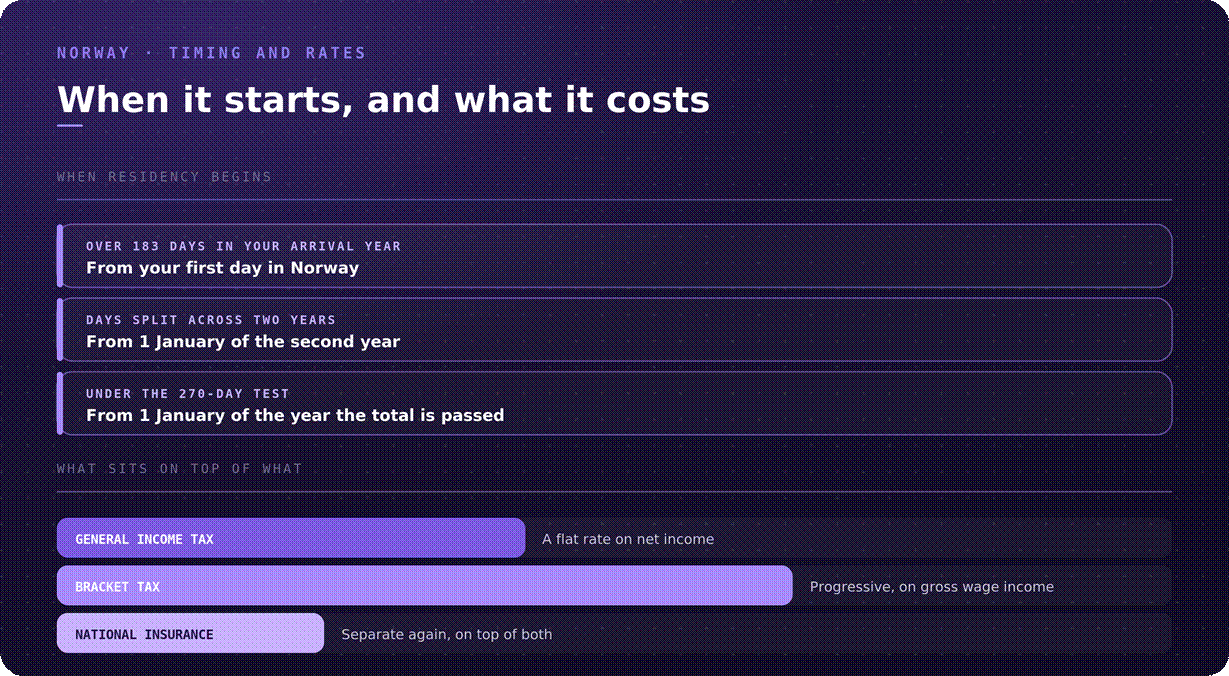
When it starts, and the layers that make up the bill.
If you spend more than 183 days in Norway during the year you move there, you may be resident from your first day. If your days straddle two income years, residency may begin from 1 January of the second. If you become resident under the 270-day test, it may apply from 1 January of the year in which the total is passed.
Arriving late in the year does not protect you. A move in the second half of a year can still produce worldwide reporting obligations from the following January. Assess your expected travel pattern before relocating, particularly if you will arrive near the year end.
What residents are taxed on
Once resident, you are generally taxed on worldwide income — employment, self-employment and business income, foreign dividends and interest, capital gains, pensions, rental income and other income earned outside Norway.
Your position | What Norway taxes |
Tax resident | Worldwide income |
Not resident | Certain Norwegian-source income only |
Work performed in Norway | Within limited liability even if you are non-resident |
Norwegian property | Within limited liability |
Dividends from Norwegian companies | Within limited liability |
Treat any single headline rate with caution. Norwegian income tax on wages is built in layers: a flat general income tax on net income, and a progressive bracket tax on gross wage income on top of it, with separate contributions charged alongside. Quoting one percentage understates what employment income actually costs.
Your actual liability depends on the nature and amount of your income, available deductions and the applicable rules.
If you are not resident
Not being tax resident does not mean no Norwegian tax. Limited liability can apply to certain Norwegian-source income — work performed in Norway, Norwegian property, dividends from Norwegian companies and other locally connected income.
Distinguish between residence taxation, covering worldwide income, and limited taxation, covering specified Norwegian-source income. Where the same income is taxable in Norway and elsewhere, relief may be available under domestic foreign tax credit rules or a treaty. Norway has 84 double taxation agreements, though the result depends on the treaty and the income type.
Treaty residence
You can be resident under Norwegian domestic law while another country also treats you as resident. Where that happens, the applicable treaty may apply tie-breaker tests — permanent home, centre of vital interests, habitual abode and nationality — to decide which country has the stronger claim. Your domestic Norwegian status and your treaty status are different questions, and Norway’s taxing rights may be limited by the treaty result.
Filing
Norway uses the calendar year, and most people receive a pre-completed tax return to check and supplement. Deadlines differ depending on whether you are an employee or self-employed, and self-employed individuals generally have a later date. Advance tax may also be payable during the year where income is not collected through withholding.
Work from the dates published for your own return rather than a date you have read elsewhere, and prepare records through the year rather than reconstructing them afterwards.
Your checklist
1. Maintain a reliable travel calendar with every arrival and departure;
2. Check both the rolling 12-month and rolling 36-month totals;
3. Identify the date your residency would begin under each test;
4. Establish where your work is physically performed;
5. Separate Norwegian-source from foreign income;
6. Check whether another country also treats you as resident;
7. Review the applicable treaty and its tie-breakers;
8. Confirm the filing deadline that applies to your situation; and
9. Budget for advance tax where income is not withheld at source.
Frequently asked questions
Is it 183 days in a calendar year?
No — 183 days in any rolling 12-month period. Planning around the calendar year is one of the more common mistakes, because a stay straddling New Year can pass the threshold without either calendar year looking problematic.
What is the 270-day test?
More than 270 days across any rolling 36-month period. It works out at roughly 90 days a year, so a regular seasonal pattern can make you resident even though you never come close to 183 days in one year.
When does residency actually start?
It depends which test you meet. Over 183 days in your arrival year can make you resident from your first day; days split across two years can push it to 1 January of the second year; the 270-day test generally applies from 1 January of the year the total is passed.
If I am not resident, do I pay nothing?
Not necessarily. Limited liability applies to certain Norwegian-source income, including work performed in Norway, Norwegian property and dividends from Norwegian companies.
What is the top rate?
There is no single figure. A flat general income tax applies to net income, and a progressive bracket tax applies to gross wage income on top, with separate contributions charged alongside. The combined marginal cost on employment income is materially higher than the income tax element alone.
Does a treaty override Norwegian residency?
It can limit Norway’s taxing rights where another country also treats you as resident, using tie-breaker tests. It does not change your domestic Norwegian status, and it does not remove filing obligations.
Do partial days count?
They can. Arriving in the morning and leaving later the same day may still be relevant to the calculation, so do not assume short trips are free.
When do I file?
Norway uses the calendar year, with deadlines differing between employees and the self-employed. Use the date on your own pre-completed return.
Official sources and further reading
Important information
This article is general information and does not constitute tax, legal, immigration or financial advice, and does not create a client relationship. Tax outcomes depend on travel history, income sources, treaty status and the law applying to the relevant year. Rates, thresholds and regimes change, and some measures described may be proposed rather than enacted; this article reflects our understanding as at the date of publication. Obtain advice from a suitably qualified professional before acting or refraining from action.
