
Austria is among the heaviest-taxed countries in the EU for mid-to-high earners, with seven bands topping out at 55%. It also has a narrow relocation relief that very few arrivals qualify for.
Austrian income tax runs through seven bands, from nil to 55%. The top rate applies above EUR 1,000,000 and was introduced as a temporary measure that has been repeatedly extended. For most working people the relevant rates are the 40% and 48% bands, which begin at levels that would be considered mid-range in much of Europe.
Since 2023 the brackets have been indexed annually to offset inflation, ending the cold progression that had quietly raised effective rates for years. The 2026 brackets were adjusted upward by around 1.73%, though the rate architecture itself is unchanged.
Investment income is treated separately and far more favourably. Capital gains and dividends attract a flat 27.5% — the Kapitalertragsteuer — with 25% on certain bank interest, and real estate gains at 30%.
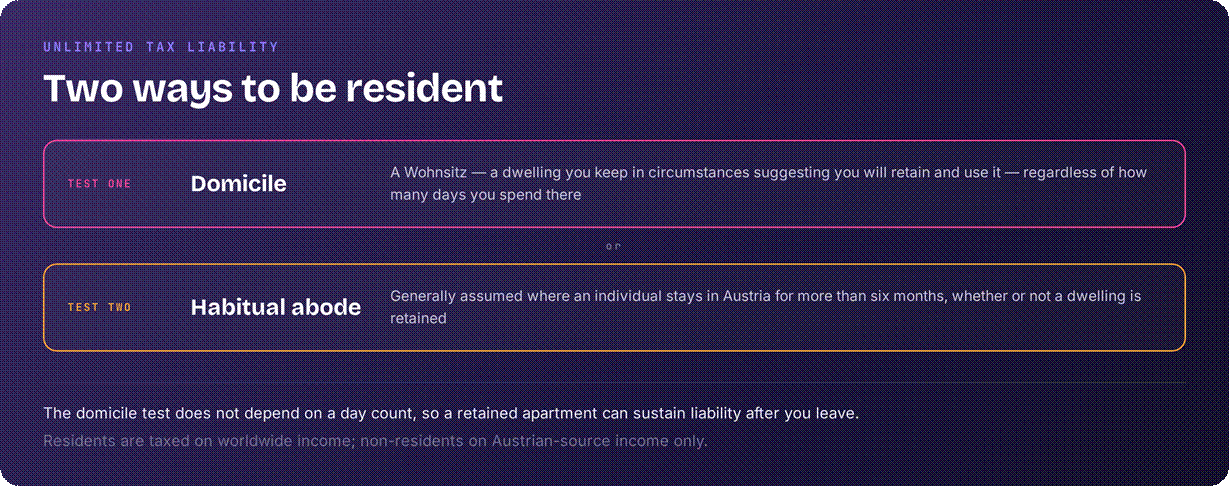
Two residence tests, and only one involves counting days.
Your residency status is the first step
You are Austrian tax resident if you have a domicile — a Wohnsitz, meaning a dwelling you keep in circumstances suggesting you will retain and use it — or a habitual abode, generally assumed after a stay of more than six months. Residents are taxed on worldwide income; non-residents on Austrian-source income.
The Wohnsitz test does not depend on the number of days you spend in the dwelling, which makes it the same structural trap found in Germany and Kenya. Retaining an Austrian apartment while living elsewhere can sustain unlimited liability regardless of your travel pattern.
Maintain accurate records of:
• Whether any Austrian dwelling remains available to you, and from when;
• Days present in Austria across rolling periods;
• The date of any deregistration and what happened to the property;
• Where your centre of interests lies;
• Investment holdings, for the separate 27.5% treatment; and
• Any other country that may also treat you as resident.
The 2026 tax rates
Taxable income (EUR) | Rate |
Up to 13,539 | 0% |
13,540 to 21,992 | 20% |
21,993 to 36,458 | 30% |
36,459 to 70,365 | 40% |
70,366 to 104,859 | 48% |
104,860 to 1,000,000 | 50% |
Over 1,000,000 | 55% |
Investment income and capital gains | 27.5%, or 30% on real estate |
The 13th and 14th salary payments are the distinctive feature. Austrian employees customarily receive holiday and Christmas payments amounting to two additional months of salary, and these are taxed at a flat 6% rather than at progressive rates, with an initial amount exempt. That reduces the effective annual rate meaningfully and is often missing from cross-country comparisons.
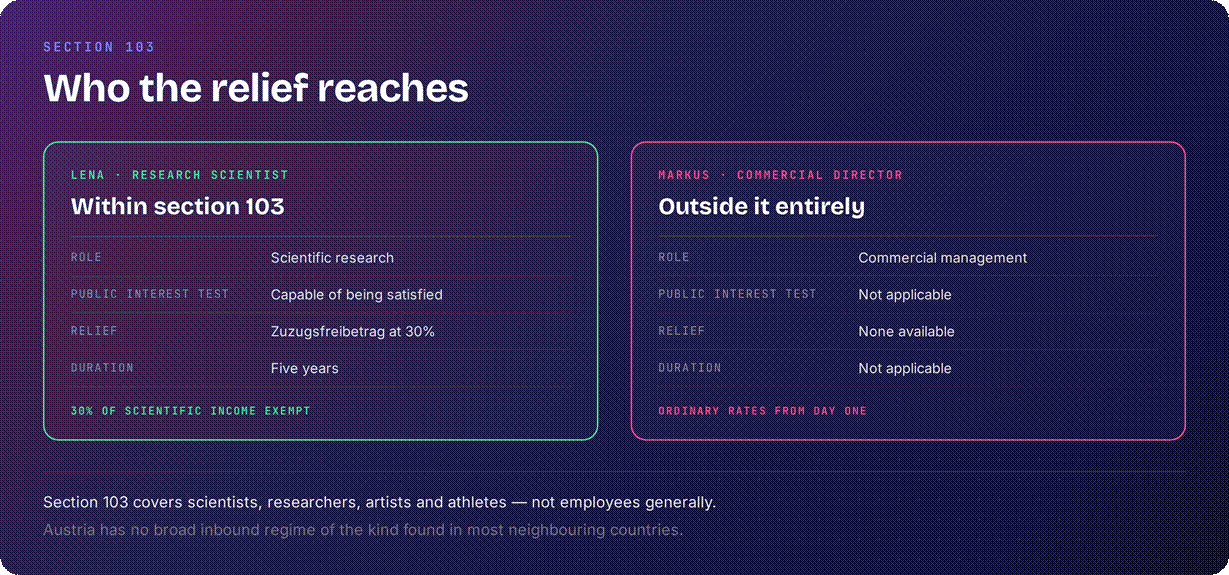
The relief reaches a narrow group, and misses everyone else.
The relocation relief
Section 103 of the Income Tax Act provides two distinct advantages for people relocating to Austria, and both are narrower than the phrase "expatriate regime" suggests.
The first, under section 103(1), allows the previous foreign tax burden to be retained on foreign income at a minimum of 15%. It is available to scientists and researchers, and also to artists and athletes moving to Austria.
The second, under section 103(1a), is the Zuzugsfreibetrag — a relocation allowance of 30% of income from scientific activity taxed at the progressive rate, granted for five years. In practice this is by far the more commonly applied of the two.
Both require that the relocation is in Austria’s public interest, which is assessed rather than assumed. Where the allowance is granted, no other operating expenses, income-related expenses or exceptional charges connected with the relocation can be claimed. For an ordinary employee moving to Vienna for a commercial role, neither applies.
Case study: Lena qualifies and Markus does not
Lena is a materials scientist recruited to a Vienna research institute. Her relocation can be assessed as being in Austria’s public interest, and the Zuzugsfreibetrag exempts 30% of her income from scientific activity for five years.
Markus moves to Vienna the same month as a commercial director on a similar salary. Section 103 does not reach him — he is neither a scientist, researcher, artist nor athlete, and there is no general inbound regime to fall back on. He is taxed on the ordinary scale from the first day.
Austria is unusual among its neighbours in having no broad expatriate regime. Germany has none either; the Netherlands, Belgium, France, Italy, Luxembourg, Greece and Poland all do. Anyone comparing options across the region should treat that absence as a material difference.
Leaving Austria
Austria applies an exit tax — the Wegzugsbesteuerung — on unrealised gains when an individual ceases to be resident, with instalment arrangements available in defined circumstances. The rules are close in structure to the German provision and should be modelled before departure rather than at the point of leaving.
Because the Wohnsitz test can sustain residence on a retained dwelling, genuinely ceasing Austrian residence requires dealing with the property as well as the day count.
Filing and the compliance calendar
The Austrian tax year follows the calendar year. Employment income is taxed through payroll withholding, and an annual assessment can be requested or may be required where there is other income. Returns are generally due by 30 April on paper or 30 June electronically, with later deadlines available through a registered adviser.
Model the whole package
Consider:
• Where your income falls against the 40% and 48% bands;
• What the 6% rate on 13th and 14th salaries is worth to you;
• Whether any investment income benefits from the 27.5% treatment;
• Whether section 103 could realistically apply to your role;
• That there is no general inbound regime to fall back on;
• Whether an Austrian dwelling would sustain residence after you leave; and
• What the exit tax would cost if you later depart.
Your Austria checklist
1. Check whether a retained Austrian dwelling would sustain residence;
2. Model your income against the 40% and 48% bands specifically;
3. Value the 6% treatment of 13th and 14th salary payments;
4. Separate investment income for the 27.5% treatment;
5. Establish whether section 103 could apply to your role;
6. Do not assume a general expatriate regime exists, because it does not;
7. Note that claiming the allowance excludes other relocation deductions;
8. Model the exit tax before any future departure;
9. Deal with property as well as days when ceasing residence; and
10. Diarise the filing deadline for your filing method.
Frequently asked questions
What are the Austrian income tax rates for 2026?
Seven bands: nil up to EUR 13,539, then 20%, 30%, 40%, 48% and 50%, with 55% above EUR 1,000,000. The brackets are indexed annually to offset inflation.
Does Austria have an expatriate regime?
Not a general one. Section 103 of the Income Tax Act provides relief for scientists, researchers, artists and athletes whose relocation is in Austria’s public interest, but there is nothing comparable to the inbound regimes in the Netherlands, Belgium, France or Italy.
What is the Zuzugsfreibetrag?
A relocation allowance under section 103(1a) exempting 30% of income from scientific activity taxed at the progressive rate, granted for five years. Where it is claimed, other relocation-related deductions cannot be.
How is investment income taxed?
At a flat 27.5% for capital gains and dividends, with 25% on certain bank interest and 30% on real estate gains. That treatment sits outside the progressive scale entirely.
What is the 6% rate on bonuses?
Austrian employees customarily receive 13th and 14th salary payments — holiday and Christmas money — which are taxed at a flat 6% rather than at progressive rates, with an initial amount exempt. It reduces the effective annual rate meaningfully.
When am I Austrian tax resident?
If you have a domicile in Austria — a dwelling kept in circumstances suggesting you will retain and use it — or a habitual abode, generally assumed after more than six months. The domicile test does not depend on a day count.
Is there an exit tax?
Yes. Austria charges unrealised gains on ceasing residence, with instalment arrangements available in defined circumstances. It should be modelled before departure rather than discovered at the point of leaving.
When is the return due?
Generally 30 April on paper or 30 June electronically, following the calendar tax year, with later deadlines available where a registered adviser files on your behalf.
Official sources and further reading
Important information
This article is general information and does not constitute tax, legal, immigration or financial advice, and does not create a client relationship. Tax outcomes depend on travel history, income sources, treaty status and the law applying to the relevant year. Rates, thresholds and regimes change, and some measures described may be proposed rather than enacted; this article reflects our understanding as at the date of publication. Obtain advice from a suitably qualified professional before acting or refraining from action.
