
Bahrain charges individuals nothing, on salary or on self-employment. That makes the certificate of residence the only document that evidences where you are — and foreign authorities ask for it.
Bahrain operates the simplest personal position in the Gulf. There is no personal income tax, no capital gains tax on individuals, no wealth tax, no inheritance tax and no withholding tax.
The absence extends to self-employment. Unlike Saudi Arabia, which taxes a non-Saudi resident carrying on business at 20%, and Qatar, which taxes activity carried on in the State at 10%, Bahrain does not charge business or professional income of individuals at all.
That is worth stating plainly, because the Gulf is often treated as a single tax proposition and it is not. On self-employment income, Bahrain and Kuwait charge nothing while Saudi Arabia and Qatar both charge. For a freelancer or consultant, that distinction is the most consequential fact about choosing between them.
There is no statute imposing a charge on individual income, which means no domestic residency test, no annual return and no source analysis. The origin of your income makes no difference.
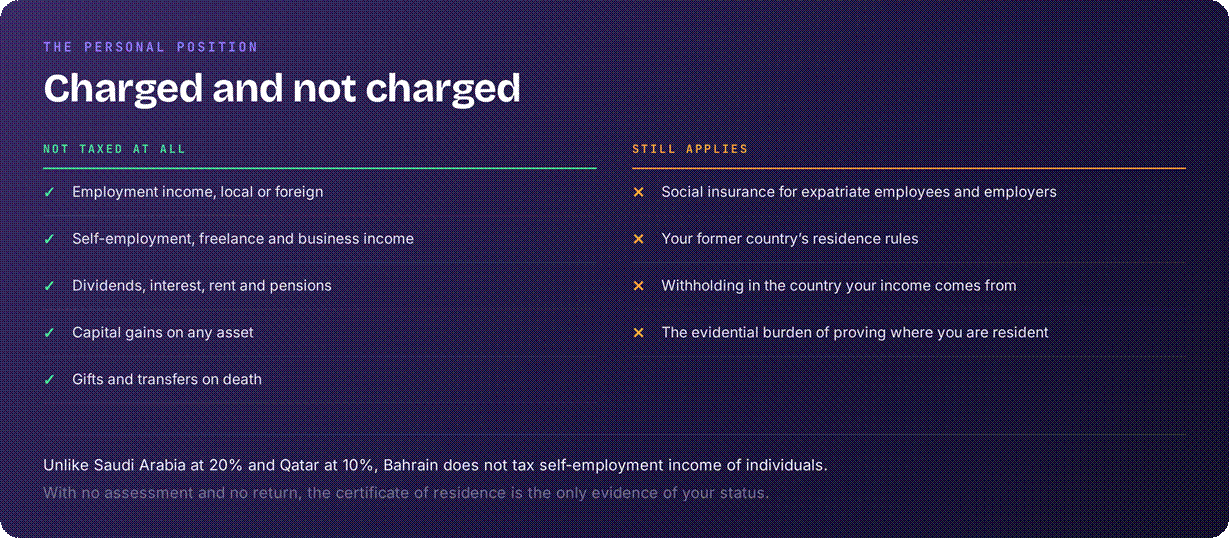
What Bahrain charges, and what it does not.
What the absence covers
Every category of personal income sits outside the charge:
• Employment income, whether paid locally or from abroad;
• Self-employment, freelance and professional earnings;
• Business profits of an individual;
• Dividends, interest and investment distributions;
• Rental and pension income;
• Capital gains on any asset; and
• Foreign-source income of any kind.
There is also no gift tax and no estate duty. Social insurance contributions apply to expatriate employees and their employers, and those belong in a net-pay calculation, but they are not an income tax.
The certificate of residence
Because Bahrain charges no income tax, there is no assessment and no return to evidence where you are resident. The certificate of residence therefore does all the work, and for anyone with a continuing connection to another country it is the document that matters most.
Revenue authorities routinely single out zero-tax jurisdictions for special certification on a double taxation claim. A claim will typically require the certificate itself, together with a reasoned explanation of why you consider yourself resident in Bahrain — usually addressing your permanent home and your personal and economic relations, since those are the factors Bahrain’s treaties turn on.
The provision to read is Article 4 of the specific agreement between Bahrain and the other country, which defines who counts as a resident of each state and therefore what you need to demonstrate.
Note that this differs from Kuwait, where the equivalent enquiry tends to focus on nationality status and total days of presence. Bahrain’s agreements lean instead on permanent home and personal and economic relations — the classic treaty tie-breaker factors. The evidence you need to assemble is different in each case, which is why the relevant article should be read rather than assumed.
Applications for a certificate are made to the Bahraini authorities. Because procedures change, confirm the current route and document requirements with the Ministry of Finance and National Economy or the National Bureau for Revenue before applying, and do so while you are still resident in Bahrain.
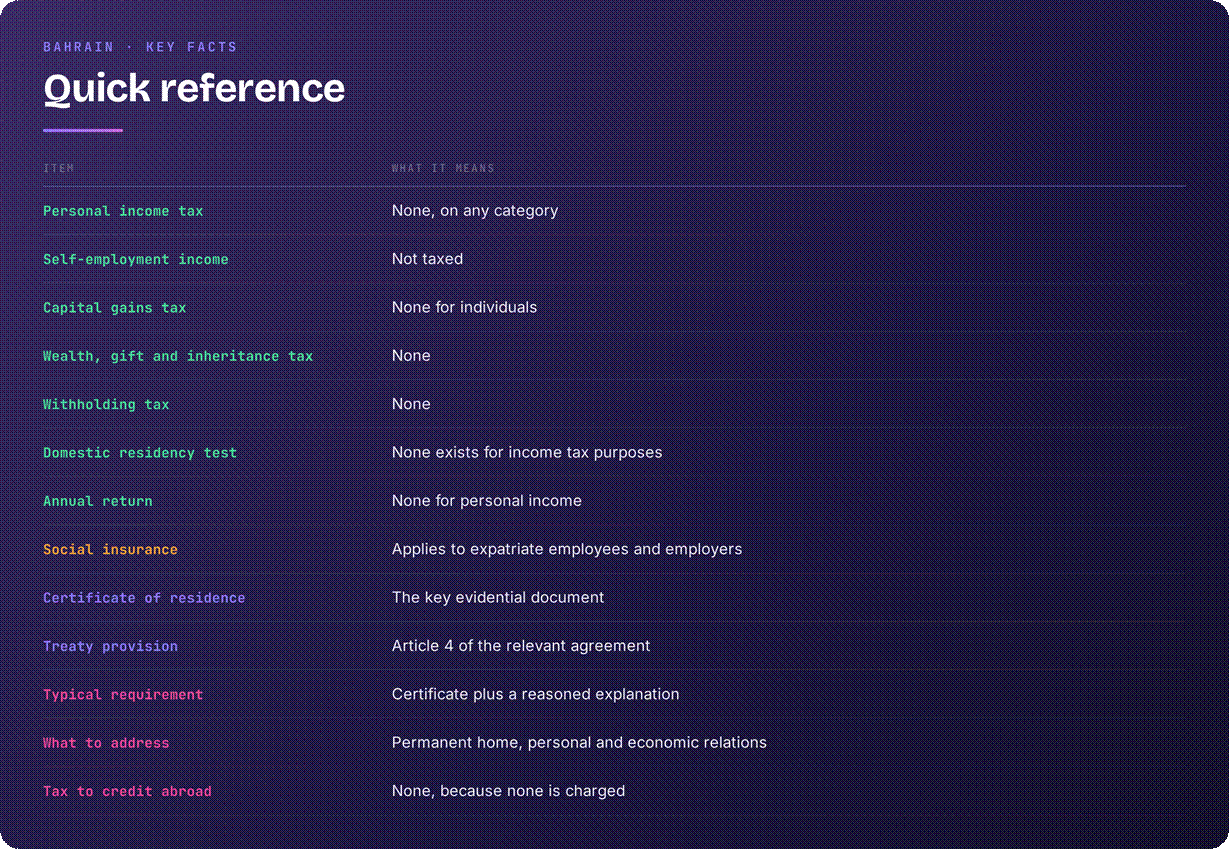
The Bahraini position at a glance.
Why the treaty position carries the weight
In a country that taxes income, a treaty does two things: it allocates taxing rights, and it allows tax paid in one state to be credited against tax due in the other.
Bahrain can only ever benefit from the first. Because it charges no personal income tax, there is never any Bahraini tax to credit. If a former country continues to treat you as resident and taxes your worldwide income, relief has to come from the treaty tie-breaker, not from a credit.
A tie-breaker turns on facts: where your permanent home is, where your personal and economic relations are closer, where you habitually reside. Those are exactly the matters a foreign authority will ask a Bahrain claimant to address, and they are considerably easier to evidence while you are living there than afterwards.
Case study: Yusuf and the claim he made too late
Yusuf moves to Manama from a country that taxes worldwide income and works for a Bahraini employer. His Bahraini tax is nil and he files nothing locally.
His former country continues to treat him as resident for the year of departure, and he wants to claim under the treaty. He assumes his employment contract and residence permit will suffice.
They do not. The authority requires a copy of his Bahrain certificate of residence and an explanation addressing his permanent home and his personal and economic relations. By the time he discovers this he has left Bahrain, and obtaining the certificate and assembling the supporting evidence is substantially harder than it would have been while he was there.
What makes Bahrain attractive
For a self-employed individual in particular, Bahrain is among the strongest propositions in the region:
• No personal income tax on any category of income, local or foreign;
• No tax on self-employment, freelance or business income of an individual, unlike Saudi Arabia and Qatar;
• No capital gains tax, wealth tax, inheritance tax or gift tax;
• No withholding tax;
• No domestic residency test to manage and no annual return to file;
• A long history of open foreign ownership and diversification away from oil; and
• A treaty network giving access to tie-breaker relief where another country also claims you.
The honest qualifications are that social insurance applies, that there is no Bahraini tax to credit abroad, and that relief from a competing claim depends entirely on the treaty tie-breaker and the evidence you can produce for it.
Filing and the compliance calendar
For personal income there is nothing to file. What replaces filing is evidence, and the sensible approach is to assemble it while it is easy to obtain.
Keep in good order:
• A current certificate of residence;
• Evidence of your permanent home in Bahrain, such as a tenancy contract;
• Records bearing on your personal and economic relations;
• Day-count records for each year;
• Your employment contract and social insurance records; and
• The text of the treaty between Bahrain and your former country.
Evidence, not assessment
Consider:
• That no statute charges individual income in Bahrain;
• That self-employment income is untaxed, unlike in Saudi Arabia and Qatar;
• That there is no domestic residency test or annual return;
• That the certificate of residence is your only evidence of status;
• That a foreign authority will want it plus a reasoned explanation;
• That the explanation must address permanent home and economic relations; and
• That obtaining it is far easier before you leave.
Your Bahrain checklist
1. Note that no statute charges individual income;
2. Note that self-employment income is untaxed here;
3. Compare against Saudi Arabia at 20% and Qatar at 10%;
4. Obtain a certificate of residence while still in Bahrain;
5. Confirm the current application route with the authorities;
6. Keep evidence of your permanent home in Bahrain;
7. Document your personal and economic relations;
8. Read Article 4(1) of the relevant treaty;
9. Expect to explain your position, not just produce a document; and
10. Budget social insurance in your net-pay figure.
Frequently asked questions
Does Bahrain tax personal income?
No. There is no personal income tax, no capital gains tax on individuals, no wealth tax, no inheritance tax and no withholding tax. No statute imposes a charge on individual income.
Is self-employment income taxed?
No. Unlike Saudi Arabia, which taxes a non-Saudi resident carrying on business at 20%, and Qatar, which taxes activity carried on in the State at 10%, Bahrain does not charge business or professional income of individuals at all.
Is there a residency test?
Not for income tax purposes. Because there is no charge on individual income, there is no domestic residency test, no annual return and no source analysis to perform.
Why do I need a certificate of residence?
Because there is no assessment or return to evidence where you are resident. The certificate is the only document that does, and foreign revenue authorities require it before allowing a treaty claim.
What will a foreign authority require?
Typically a copy of your Bahrain certificate of residence, plus a reasoned explanation of why you consider yourself resident in Bahrain — usually addressing your permanent home and your personal and economic relations.
Which part of the treaty matters?
Article 4, which defines who counts as a resident of each state. It is the provision a claim turns on, and it should be read in the specific agreement between Bahrain and the country concerned.
How does that differ from Kuwait?
Enquiries about Kuwait tend to focus on nationality status and total days of presence, while Bahrain’s agreements lean on permanent home and personal and economic relations. The evidence required is different, so read the relevant article rather than assuming they are interchangeable.
When should I apply for the certificate?
While you are still resident in Bahrain. Confirm the current route and document requirements with the Ministry of Finance and National Economy or the National Bureau for Revenue, since procedures change.
Official sources and further reading
• Ministry of Finance and National Economy, Bahrain
Important information
This article is general information and does not constitute tax, legal, immigration or financial advice, and does not create a client relationship. Tax outcomes depend on travel history, income sources, treaty status and the law applying to the relevant year. Rates, thresholds and regimes change, and some measures described may be proposed rather than enacted; this article reflects our understanding as at the date of publication. Obtain advice from a suitably qualified professional before acting or refraining from action.
