
The UAE gained a statutory tax residency definition in 2023 and a corporate tax that reaches self-employed individuals above AED 1 million of turnover. Both change how the zero rate should be read.
The UAE levies no personal income tax on employment or other personal income. That has not changed. What has changed is everything around it: there is now a statutory definition of tax residency, a formal certificate procedure, and a tax that reaches business income of individuals above a turnover threshold.
Cabinet Decision No. 85 of 2022 was issued on 9 September 2022 and came into force on 1 March 2023. It provides, for the first time, a domestic definition of when a natural person is a tax resident of the UAE for the purposes of any UAE tax law or double tax treaty.
That matters more than it sounds. Many of the bilateral agreements the UAE has entered into refer back to UAE domestic law to determine whether a person is a resident for treaty purposes. Before 2023 there was no such law to refer to. The Decision fills that gap and, in doing so, makes treaty claims considerably easier to evidence.
Ministerial Decision No. 27 of 2023 supplies the definitions used in the tests, and Ministerial Decision No. 247 of 2023 governs the treaty certificate track.
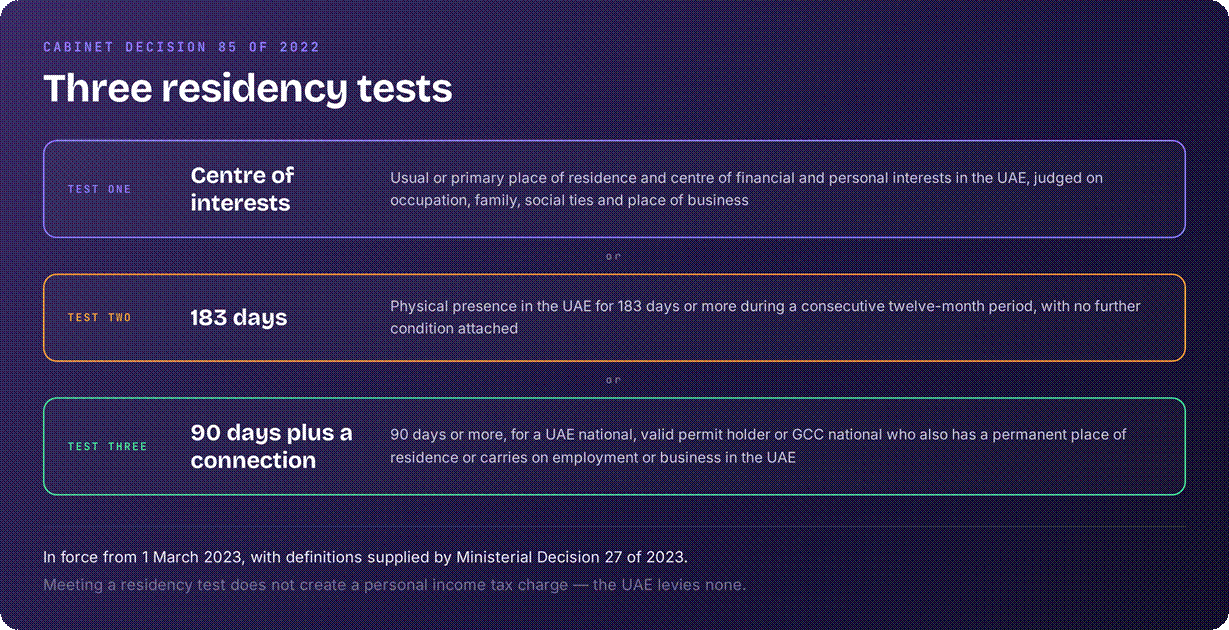
Three routes into UAE tax residency.
The three residency tests
A natural person is a UAE tax resident if any one of three conditions is met.
The first is the centre of interests test. The individual has their usual or primary place of residence and their centre of financial and personal interests in the UAE. Ministerial Decision 27 of 2023 defines the primary place of residence as the jurisdiction where the person spends most of their time with a settled routine that is more than transient, and the centre of financial and personal interests by reference to occupation, family, social ties, political and cultural activities, place of business and the place from which property is administered.
The second is presence. The individual was physically present in the UAE for 183 days or more during a consecutive twelve-month period. No other condition attaches.
The third is a shorter presence with a connection. The individual was physically present for 90 days or more in a consecutive twelve-month period and is a UAE national, holds a valid UAE residence permit, or holds the nationality of any GCC member state, and either has a permanent place of residence in the UAE or carries on employment or a business in the UAE.
Note what the Decision does not do. The Federal Tax Authority was explicit at the time that the introduction of residency criteria does not mean individuals become subject to personal income tax. The UAE does not levy any personal income tax on the employment or other personal income of individuals.
The Tax Residency Certificate
The certificate is the document that converts your residency position into something a foreign revenue authority will accept. It is issued by the Federal Tax Authority and applied for through the EmaraTax portal.
There are two distinct tracks, and applicants routinely confuse them. The domestic track certifies residency under Cabinet Decision 85 of 2022. The treaty track, governed by Ministerial Decision 247 of 2023, produces a certificate for the purposes of a specific double taxation agreement, naming the treaty partner state.
If your purpose is to make a claim under a particular treaty, apply on the treaty track and name the country. A domestic certificate may not be accepted for that purpose.
Have ready:
• Passport and Emirates ID;
• A valid UAE residence permit;
• Proof of a permanent place of residence, such as an Ejari tenancy contract or title deed;
• An entry and exit report evidencing days of presence;
• Employment contract, trade licence or other evidence of economic activity; and
• Bank statements covering the period claimed.

What the certificate application requires.
Self-employment income and the AED 1 million line
This is the part most affected by recent change, and the part most often described incorrectly.
UAE corporate tax at 9% took effect from 1 June 2023. It is not confined to companies. A natural person conducting a business or business activity in the UAE falls within it where their total turnover from that activity exceeds AED 1 million in a calendar year.
Below that threshold, a self-employed individual is outside the charge. Above it, they are required to register and account for corporate tax on the taxable income of the business, at 9% on the portion above the small business threshold.
Three categories are specifically excluded from the calculation for a natural person, and they matter:
• Wage income, which is outside the charge entirely;
• Personal investment income, being investment activity conducted in a personal capacity that does not require a licence; and
• Real estate investment income, from investment in UAE real property that does not require a licence.
The practical consequence for a freelancer or consultant holding a trade licence is that the AED 1 million figure is a turnover test, not a profit test. A consultant billing AED 1.2 million with modest expenses is within the regime even though the tax is computed on profit.
Case study: Priya crosses the threshold
Priya holds a freelance permit in Dubai and consults for clients in Europe and Asia. In her first two years she bills around AED 700,000 and sits below the threshold, with no corporate tax registration required.
In her third year she bills AED 1.3 million. Her turnover from business activity now exceeds AED 1 million in the calendar year, so she falls within the corporate tax regime and must register and file.
Her salary from a part-time employed role is excluded from that calculation, as is the rental income from an apartment she owns personally. It is the licensed consulting activity alone that crosses the line.
What makes the UAE attractive
The case remains strong, and the new framework arguably strengthens it:
• No personal income tax on employment or other personal income;
• No capital gains tax for individuals, and no wealth, inheritance or gift tax at federal level;
• A statutory residency definition, which makes treaty claims far easier to evidence than before 2023;
• A formal Tax Residency Certificate procedure with a dedicated treaty track;
• An extensive double taxation treaty network;
• A 90-day residency route for permit holders and GCC nationals with a permanent home or economic activity; and
• Self-employment income outside the corporate tax charge entirely below AED 1 million of turnover.
The honest qualifications are that the residency tests require real substance rather than a permit alone, that the 90-day route carries additional conditions, and that a self-employed individual above the turnover threshold has genuine registration and filing obligations.
Filing and the compliance calendar
There is no personal income tax return. A natural person within the corporate tax regime registers with the Federal Tax Authority and files on the corporate tax cycle. Tax Residency Certificate applications are made through EmaraTax and are typically valid for one year.
Keep in good order:
• Entry and exit records supporting your day count;
• Your Ejari or title deed as evidence of a permanent place of residence;
• Turnover records by activity, measured against AED 1 million;
• A clear split between wage income, personal investment income and licensed business income;
• Your trade or freelance licence; and
• Certificates obtained, noting whether domestic or treaty track.
Substance, then the certificate
Consider:
• Which of the three residency tests you actually satisfy;
• That a residence permit alone does not establish tax residency;
• That the 90-day route requires a permanent home or economic activity as well;
• Whether you need a domestic or a treaty-track certificate;
• That the treaty track requires naming the partner state;
• Whether your business turnover exceeds AED 1 million in the calendar year; and
• That wage, personal investment and real estate investment income are excluded from that test.
Your UAE checklist
1. Identify which of the three residency tests you meet;
2. Do not rely on a residence permit alone;
3. Check the extra conditions if using the 90-day route;
4. Keep entry and exit records supporting your day count;
5. Hold an Ejari or title deed as evidence of a permanent home;
6. Choose the domestic or treaty certificate track deliberately;
7. Name the partner state on a treaty-track application;
8. Measure business turnover against AED 1 million each calendar year;
9. Exclude wage, personal investment and real estate investment income; and
10. Register for corporate tax if the threshold is crossed.
Frequently asked questions
Does the UAE tax personal income?
No. The UAE levies no personal income tax on employment or other personal income of individuals. The residency criteria introduced in 2023 do not change that — the Federal Tax Authority was explicit on the point.
How do I become a UAE tax resident?
Through any one of three tests under Cabinet Decision 85 of 2022: having your usual place of residence and centre of financial and personal interests in the UAE; 183 days or more in a consecutive twelve-month period; or 90 days or more as a UAE national, permit holder or GCC national with a permanent home or economic activity in the UAE.
Why did the UAE introduce residency criteria?
Because many of its bilateral tax agreements refer back to UAE domestic law to determine residency for treaty purposes, and before 2023 there was no such law. The Decision fills that gap and makes treaty claims easier to evidence.
How do I get a Tax Residency Certificate?
Through the EmaraTax portal, from the Federal Tax Authority. There are two tracks — a domestic certificate under Cabinet Decision 85 of 2022, and a treaty certificate under Ministerial Decision 247 of 2023 naming a specific partner state.
Which certificate track do I need?
If your purpose is a claim under a particular double taxation agreement, apply on the treaty track and name the country. A domestic certificate may not be accepted for that purpose.
Is self-employment income taxed?
Only above a threshold. A natural person conducting business in the UAE falls within corporate tax at 9% where total turnover from that activity exceeds AED 1 million in a calendar year. Below that, they are outside the charge.
What is excluded from the AED 1 million test?
Wage income, personal investment income from activity that does not require a licence, and real estate investment income from UAE property that does not require a licence. Only licensed business activity counts toward the threshold.
Is the threshold based on turnover or profit?
Turnover. The AED 1 million test is measured on total turnover from the business activity, even though the tax itself is computed on taxable income. A consultant billing above that figure is within the regime regardless of margin.
Official sources and further reading
Important information
This article is general information and does not constitute tax, legal, immigration or financial advice, and does not create a client relationship. Tax outcomes depend on travel history, income sources, treaty status and the law applying to the relevant year. Rates, thresholds and regimes change, and some measures described may be proposed rather than enacted; this article reflects our understanding as at the date of publication. Obtain advice from a suitably qualified professional before acting or refraining from action.
