
Próspera is widely promoted as a low-tax jurisdiction inside Honduras. The law it rests on was repealed in 2022, and the dispute has not been resolved. That has to shape any planning.
Honduras appears on low-tax lists almost entirely because of Próspera, a Zone for Employment and Economic Development — a ZEDE — on Roatán in the Bay Islands, which operates its own regulatory and fiscal framework.
The essential fact for anyone considering it: the law that ZEDEs rest on was repealed. The Honduran Congress passed the repeal of the Organic Law of the Zones for Employment and Economic Development on 21 April 2022, and President Xiomara Castro signed it on 25 April 2022, with a ratifying vote following at the start of the next legislative period.
The constitutional permission for such zones remains in place, but the enabling law was struck. President Castro described the repeal as Honduras "recovering its sovereignty", and she had campaigned in the November 2021 election on shutting the zones down.
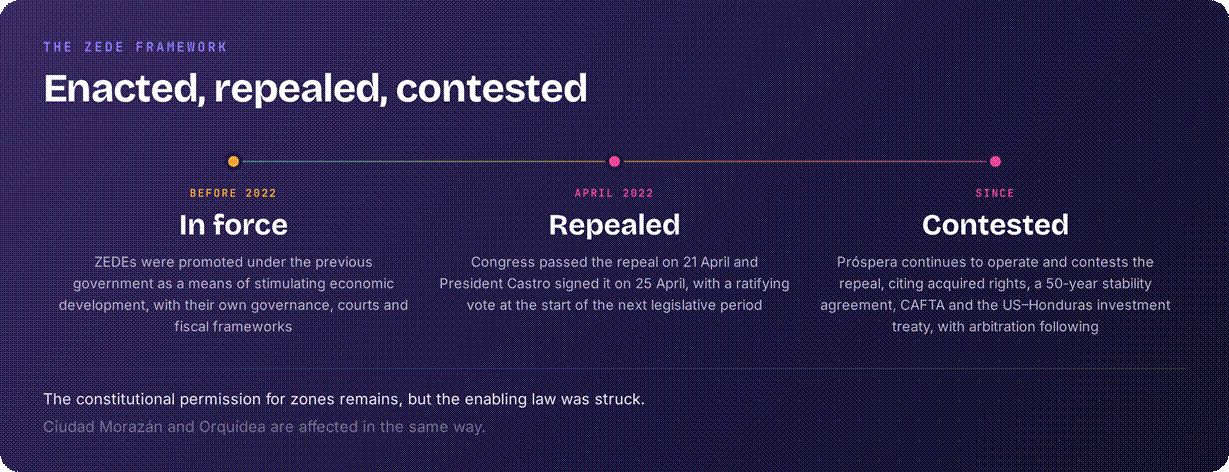
How the legal position developed.
Why this matters for planning
Próspera’s position is that it is protected by several overlapping legal frameworks agreed with the previous government:
• Constitutionally-protected acquired rights of ZEDE investors;
• A 50-year legal stability agreement guaranteeing the rights and privileges of investors;
• Protection under international investment law, including the Central America Free Trade Agreement; and
• The United States–Honduras Bilateral Investment Treaty.
The company has stated that for Honduras to deny those rights would violate its obligations under international and domestic law, and signalled that the government could face damages exceeding USD 1.3 billion. International arbitration followed.
That is a live dispute between an investor and a sovereign state, not a settled tax regime. Whatever the eventual outcome, the position today is contested and unresolved, and no individual should treat the ZEDE framework as a dependable basis for a personal tax plan.
The ordinary Honduran position
Outside the zones, Honduras operates a conventional progressive personal income tax reaching 25%, with an exempt threshold below which no charge arises. There is no low flat national rate, despite the impression created by ZEDE marketing.
Anyone modelling a move should work from the ordinary national rules and confirm the current bands, thresholds and residency test with the Servicio de Administración de Rentas directly, then treat any ZEDE position as a separate question requiring its own legal advice.
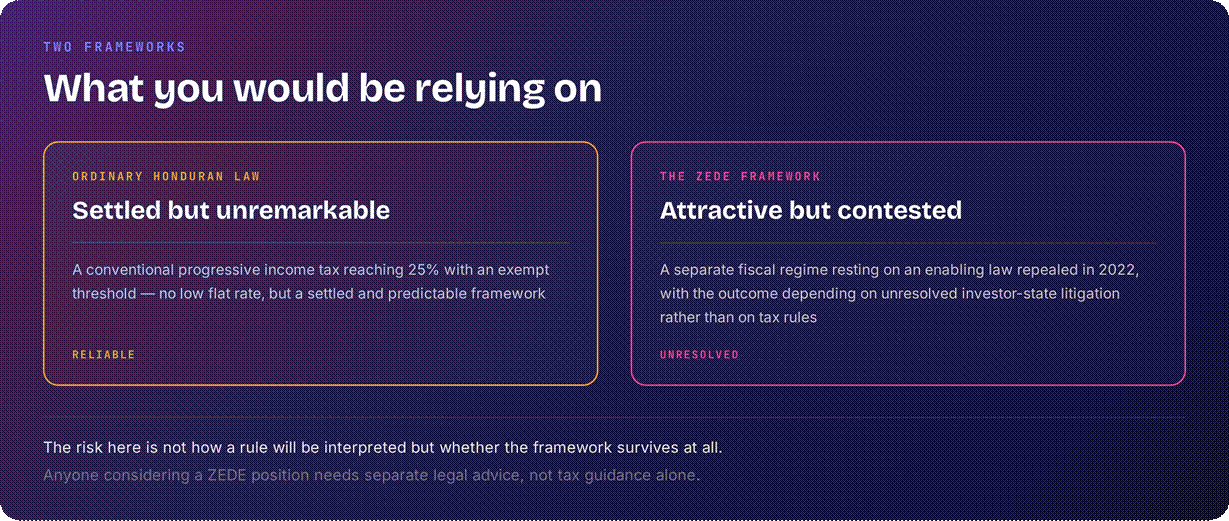
Two frameworks, two very different risk profiles.
What to ask before relying on a ZEDE
If you are nonetheless considering it, these are the questions that decide whether it is viable:
• What is the current status of the repeal and of the arbitration?
• Does the 50-year stability agreement cover individuals, or only the corporate investors who signed it?
• What happens to an individual’s acquired rights if the dispute resolves against the zone?
• Would your home country recognise a ZEDE tax residence certificate, if one is issued?
• What is your position under ordinary Honduran law if the zone framework falls away?
• What banking and payment infrastructure would you be relying on? And
• What is your exit route if the position changes?
The last of those is the one most often skipped. A tax plan that cannot be unwound is not a plan.
Case study: the question behind the brochure
A remote worker reads that Próspera offers a low personal tax rate under its own framework, obtains e-residency and structures on that basis.
The framework they are relying on sits on an enabling law that was repealed in 2022 and is the subject of an unresolved investor-state dispute. Their position depends not on a tax rule but on the outcome of that litigation.
This is a different kind of risk from the ordinary uncertainty of tax planning. It is not about how a rule will be interpreted; it is about whether the framework survives at all. That belongs in the analysis explicitly, not as a footnote.
What makes Honduras workable
Setting the ZEDE question aside, the ordinary position has some merit:
• A top rate of 25%, moderate by regional standards;
• An exempt threshold before any charge arises;
• A low cost of living, particularly outside Tegucigalpa and San Pedro Sula;
• Proximity and connectivity to North America; and
• The Bay Islands as a genuinely attractive place to live, independent of any tax framework.
The honest qualification is that none of that constitutes a tax advantage. Honduras is a reasonable place to live with an ordinary tax system, and readers are better served by that framing than by a low-tax claim resting on contested foundations.
Filing and the compliance calendar
The system is administered by the Servicio de Administración de Rentas. The current bands, thresholds, residency test and filing timetable should be confirmed directly, as published secondary guidance on Honduras is thin and inconsistent.
Prepare in good time:
• Registration with the tax administration;
• Confirmation of the current bands and exempt threshold;
• Clarity on the residency test that applies to you;
• Separate legal advice on any ZEDE position;
• Records of income by source; and
• An understanding of your position if the zone framework falls away.
Separate the two questions
Consider:
• That the ZEDE enabling law was repealed in 2022;
• That the dispute is unresolved and in arbitration;
• That Próspera continues to operate while contesting it;
• That ordinary Honduran tax reaches 25% with no low flat rate;
• Whether stability agreements reach individuals or only corporate investors;
• Whether your home country would recognise a ZEDE residence certificate; and
• What your exit route looks like if the framework changes.
Your Honduras checklist
1. Establish the current status of the repeal and the arbitration;
2. Treat the ZEDE framework as contested, not settled;
3. Work from ordinary Honduran law as your base case;
4. Confirm the current bands and exempt threshold with the SAR;
5. Confirm which residency test applies to you;
6. Ask whether stability agreements reach individuals at all;
7. Check whether your home country would recognise a ZEDE certificate;
8. Take separate legal advice on any zone position;
9. Plan your exit route before entering; and
10. Do not rely on marketing material for the legal position.
Frequently asked questions
Is Próspera a low-tax jurisdiction?
It operates its own fiscal framework, but the enabling law that ZEDEs rest on was repealed by the Honduran Congress on 21 April 2022 and signed into repeal on 25 April 2022. The position is contested and unresolved, so it is not a settled basis for personal tax planning.
Has Próspera closed?
No. It continues to operate and contests the repeal, relying on constitutionally-protected acquired rights, a 50-year legal stability agreement, the Central America Free Trade Agreement and the United States–Honduras Bilateral Investment Treaty.
What is the dispute about?
Whether Honduras can repeal the ZEDE framework without breaching obligations owed to investors. Próspera has signalled that damages could exceed USD 1.3 billion, and international arbitration followed the repeal.
What are ordinary Honduran tax rates?
A conventional progressive personal income tax reaching 25%, with an exempt threshold. There is no low flat national rate, despite the impression created by ZEDE marketing.
Do other ZEDEs exist?
Yes. Ciudad Morazán and Orquídea are two further zones affected by the same repeal and in the same contested position.
Should I plan around a ZEDE?
Not without separate legal advice. The risk is not the ordinary uncertainty of how a tax rule will be interpreted — it is whether the framework survives the litigation at all, which is a different kind of question.
Would my home country recognise a ZEDE tax residence?
That needs establishing before you rely on it. A certificate issued under a contested framework may not be accepted by another revenue authority, which would leave you claiming a residence neither country recognises.
Where should I confirm the ordinary rules?
With the Servicio de Administración de Rentas directly. Published secondary guidance on Honduras is thin and inconsistent, so the bands, thresholds, residency test and filing timetable are worth confirming at source.
Official sources and further reading
Important information
This article is general information and does not constitute tax, legal, immigration or financial advice, and does not create a client relationship. Tax outcomes depend on travel history, income sources, treaty status and the law applying to the relevant year. Rates, thresholds and regimes change, and some measures described may be proposed rather than enacted; this article reflects our understanding as at the date of publication. Obtain advice from a suitably qualified professional before acting or refraining from action.
