
Most digital nomad visas are immigration permissions with a tax hope attached. The Barbados Welcome Stamp is different a statute deems qualifying holders non-resident, whatever the day count says.
Barbados launched the Welcome Stamp in 2020 as a twelve-month, renewable permission for remote workers. Dozens of countries have since launched something similar. What makes the Barbadian version worth studying is not the visa it is the statute sitting behind it.
Under the Remote Employment Act 2020, a qualifying remote worker is deemed not resident in Barbados for income tax purposes even where they are physically present for more than 182 days in the year.
That is a structural override, not a concession. It sits in statute rather than in administrative practice, and it displaces the day count rather than adjusting it. Where it applies, foreign-source income is simply not assessable in Barbados, however long you have been on the island.
Two limits define it. The relief is built around income arising outside Barbados, so any Barbadian-source engagement moves you back into the ordinary system. And it is time-limited by its own terms, which means most people who settle permanently eventually fall to be assessed under the general rules.
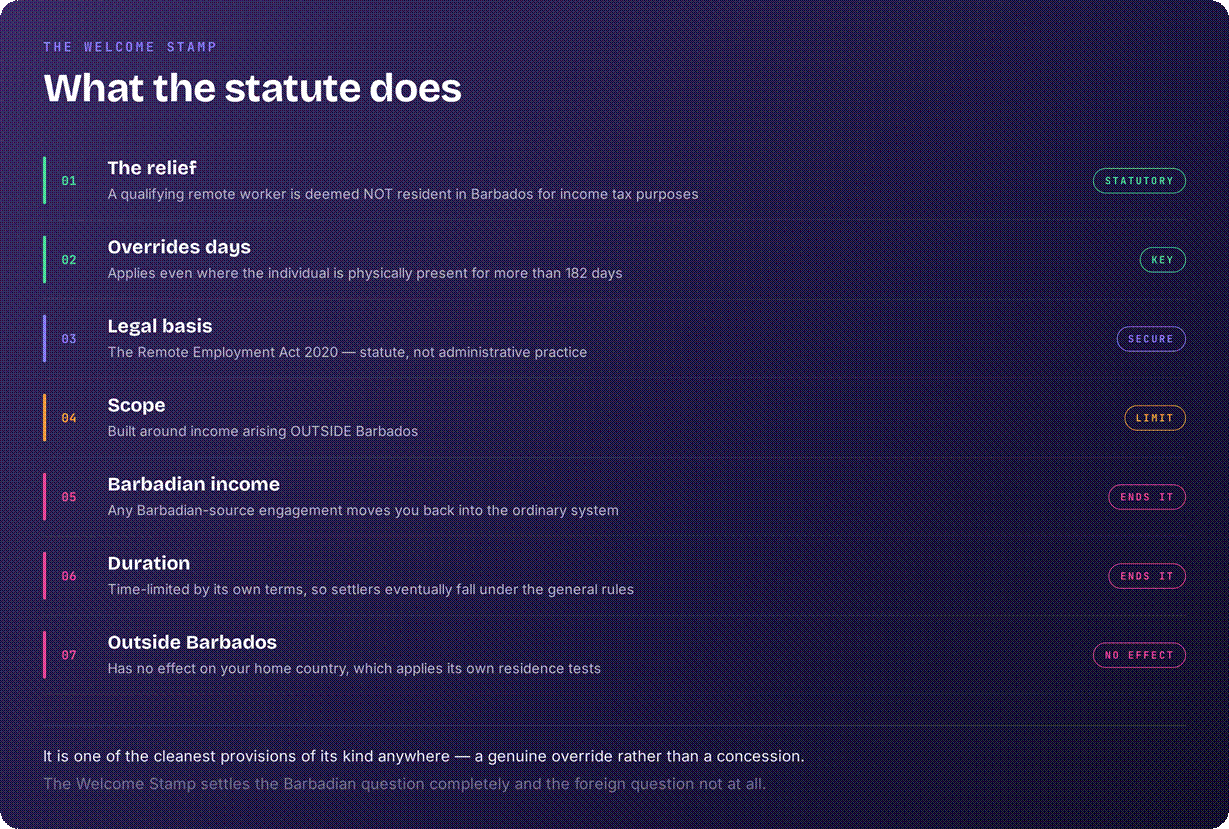
Every condition attaching to the statutory relief.
What the deeming rule does not do
It does nothing outside Barbados. Being deemed non-resident here does not make you non-resident anywhere else. Your home country applies its own tests — day counts, available accommodation, family location, centre of vital interests — and the Barbadian deeming provision has no effect on any of them.
That is the single most common misunderstanding about remote worker visas generally, and it applies with full force here. The Welcome Stamp settles the Barbadian question completely and the foreign question not at all.
Maintain accurate records of:
• Your Welcome Stamp permission and its expiry date;
• Confirmation that your employment or engagement qualifies;
• The source of every item of income, Barbadian or foreign;
• Any Barbadian-source engagement, which ends the relief;
• Days present, for your home country’s test rather than Barbados’s; and
• Your position in your home country during the same period.
When the Welcome Stamp runs out
Because the deeming rule is time-limited, anyone staying longer needs to understand the ordinary system it gives way to. Barbados uses two separate tests, and only one of them counts days.
The day count is more than 182 days in Barbados, in aggregate, in the calendar year. Both the day of arrival and the day of departure are included, which quietly costs two days on every trip.
Ordinary residence is the second route, and it involves no counting at all. You are ordinarily resident if you have permanent accommodation available for your personal use in Barbados and give notice to the Revenue Commissioner of an intention to reside for at least two consecutive income years.
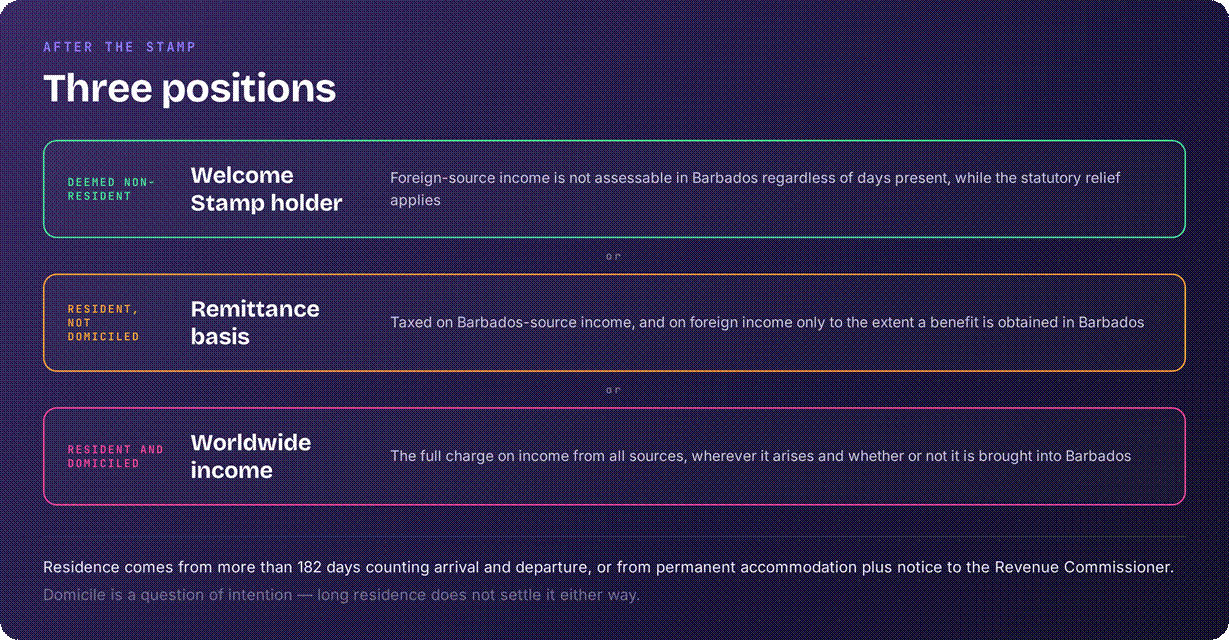
Three positions, three different charges.
Then domicile decides the scope
Once you are resident, domicile determines what Barbados actually taxes. A resident who is also domiciled in Barbados is taxed on worldwide income. A resident who is not domiciled is taxed on Barbados-source income, and on foreign income only to the extent that a benefit is obtained in Barbados.
In practice that is a remittance basis. Foreign salary from working abroad, where it is not derived from an office in Barbados and is not brought in, sits outside assessable income. Foreign investment income is assessed when remitted. Capital gains do not arise at all, because Barbados has no capital gains tax.
Domicile is a question of intention, and long residence does not settle it. You do not acquire a Barbadian domicile simply by living there for many years, and you cannot assume you have kept your old one if you have severed your ties to it.
The tax rates, once you are inside the system
Item | Position |
Welcome Stamp holders | Deemed non-resident by statute |
Resident and domiciled | Worldwide income |
Resident, not domiciled | Barbados-source plus foreign income remitted |
Top rate of income tax | 28.5% |
Capital gains tax | None |
Inheritance and gift tax | None |
Local dividends to residents | 15% withholding, representing full liability |
Residential property income | 15% |
Half of royalty income is exempt. And the absence of capital gains, inheritance and gift tax is a significant part of the case for Barbados — a 28.5% top rate on a narrow base can produce a smaller bill than a 0% rate applied to a wider one.
Case study: Aisha stays a second year
Aisha arrives on a Welcome Stamp and works remotely for a foreign employer. She spends 250 days in Barbados in her first year. The day count would ordinarily make her resident; the Remote Employment Act deems her not resident, so her foreign salary is not assessable.
She renews and stays a second year, then decides to settle. Once the permission runs its course, the deeming rule falls away and she is assessed under the ordinary rules. She is clearly resident on days — but if she is not domiciled in Barbados, she moves onto the remittance basis rather than into a worldwide charge.
The transition is the moment to plan for. It is also the moment at which separating pre-arrival capital from post-arrival foreign income stops being tidy bookkeeping and starts mattering.
Treaties and filing
Barbados has a respectable treaty network, including agreements with the United Kingdom, Canada and the United States, alongside CARICOM arrangements. That is a genuine point of difference from Caribbean jurisdictions with no income tax and therefore little to negotiate with — a treaty gives you a tie-breaker and a credit mechanism when two countries both claim you.
Returns are filed for the calendar year, generally by the end of April following it. A resident individual whose total income from sources in and out of Barbados exceeds BBD 25,000 is required to file. Spouses file separately.
Plan for the transition, not just the stamp
Consider:
• Whether the Remote Employment Act applies to your engagement;
• That it overrides the day count entirely while it lasts;
• That it falls away the moment Barbadian-source income arises;
• That it is time-limited and the ordinary rules follow;
• That it has no effect on your home country’s treatment of you;
• Your domicile position, which decides the scope afterwards; and
• Keeping pre-arrival capital separate from post-arrival foreign income.
Your Barbados checklist
1. Confirm your engagement qualifies under the Remote Employment Act;
2. Note the relief overrides the day count entirely;
3. Avoid Barbadian-source engagements while relying on it;
4. Diarise when the permission expires;
5. Plan for the ordinary rules that follow;
6. Do not assume it affects your home country position;
7. Take advice on your domicile rather than assuming it;
8. Separate pre-arrival capital from post-arrival foreign income;
9. Record every remittance and what it represents; and
10. Check the treaty between Barbados and your home country.
Frequently asked questions
What is the Barbados Welcome Stamp?
A twelve-month renewable permission for remote workers launched in 2020. What distinguishes it from most equivalents is the statute behind it — the Remote Employment Act 2020 deems a qualifying holder not resident in Barbados for income tax purposes.
Can I be present over 182 days and still not be resident?
Yes, where the Remote Employment Act applies. It deems a qualifying remote worker not resident for income tax purposes regardless of days spent on the island, which is an override rather than an adjustment.
Does the Welcome Stamp make me non-resident everywhere?
No. It has no effect outside Barbados. Your home country applies its own tests — day counts, available accommodation, family location — and the Barbadian deeming provision does not touch them.
What ends the relief?
Two things. Any Barbadian-source engagement moves you back into the ordinary system, because the relief is built around income arising outside Barbados. And it is time-limited by its own terms.
What happens when it runs out?
You are assessed under the ordinary rules — resident if present more than 182 days counting arrival and departure, or if you have permanent accommodation and have given notice of intent to reside for two consecutive income years.
What is the non-dom remittance basis?
A resident who is not domiciled in Barbados is taxed on Barbados-source income, and on foreign income only to the extent a benefit is obtained in Barbados. A resident who is also domiciled is taxed on worldwide income.
What are the rates?
A personal allowance and two bands with a top rate of 28.5%. There is no capital gains tax, no inheritance tax and no gift tax. Local dividends to residents carry 15% withholding representing the full liability, and residential property income is taxed at 15%.
When do I file?
For the calendar year, generally by the end of April following it, where total income from sources in and out of Barbados exceeds BBD 25,000. Spouses file separately.
Official sources and further reading
Important information
This article is general information and does not constitute tax, legal, immigration or financial advice, and does not create a client relationship. Tax outcomes depend on travel history, income sources, treaty status and the law applying to the relevant year. Rates, thresholds and regimes change, and some measures described may be proposed rather than enacted; this article reflects our understanding as at the date of publication. Obtain advice from a suitably qualified professional before acting or refraining from action.
