
Belgium raised its inbound allowance from 30% to 35% and abolished the EUR 90,000 ceiling, backdated to January 2025. Anyone working from the old figures is working from a regime that no longer exists.
Belgium had an expatriate tax concession from 1983 until it was abolished in 2022. What replaced it — the special tax regime for inbound taxpayers, and a parallel regime for inbound researchers — was codified in law rather than resting on an administrative circular, which made it more predictable but initially less generous.
At the end of 2025 that changed. The law of 18 December 2025, aligned with the federal coalition agreement, substantially improved the regime and did so retroactively to 1 January 2025. A circular published on 1 April 2026 confirmed the practical detail.
Belgium otherwise taxes residents on worldwide income at progressive rates reaching 50%, with communal surcharges on top, which is among the heaviest burdens in Europe. Against that backdrop the inbound regime is not a marginal saving.

How the regime changed, and from when.
What the regime now gives
A qualifying inbound taxpayer can receive costs proper to the employer free of income tax, up to 35% of gross remuneration, with no annual cap. That allowance sits on top of gross salary rather than being carved out of it.
Certain additional costs can be reimbursed tax free beyond that 35%, subject to their own limits such as moving and relocation costs, the cost of furnishing accommodation in Belgium, and certain school fees.
One caveat worth stating plainly: the increase from 30% to 35% was accepted for income tax purposes but the position for social security contributions has not moved in step. The treatment of the additional five percentage points therefore differs between the two systems, and the contribution side is outside the scope of this article.
Your residency status is the first step
Belgian tax residence turns on having your domicile or your seat of wealth in Belgium. Registration in the population register creates a rebuttable presumption, and for married taxpayers residence generally follows where the household is established.
An individual treated as a non-resident taxpayer must supply an annual residency certificate from the state where they are resident. Maintain accurate records of:
• The start date of your Belgian employment;
• Where you lived in the period before taking up the role;
• Your gross annual remuneration against the threshold, throughout the year;
• Where your household is established;
• Any residency certificate obtained from another state; and
• Previous periods of Belgian employment or residence.
The conditions, and the two routes
Condition | Inbound taxpayer route |
Minimum salary | More than EUR 70,000 gross annually, reduced from EUR 75,000 |
Qualification | No degree requirement |
Recruitment | Direct hire from abroad, or secondment within a group |
Prior connection | Must not have been a Belgian resident or taxed in Belgium beforehand |
Allowance | 35% of gross remuneration, no annual cap |
Additional costs | Moving, furnishing and school fees, within their own limits |
Duration | Five years, extendable by three — eight in total |
Portability | Transfers to a new Belgian employer if conditions continue to be met |
The researcher route has no salary threshold at all. The special regime for inbound researchers requires instead a doctorate or master’s degree in a specified STEM discipline, or equivalent professional experience. For a postdoctoral hire or a specialist engineer below EUR 70,000, that is the route to examine.
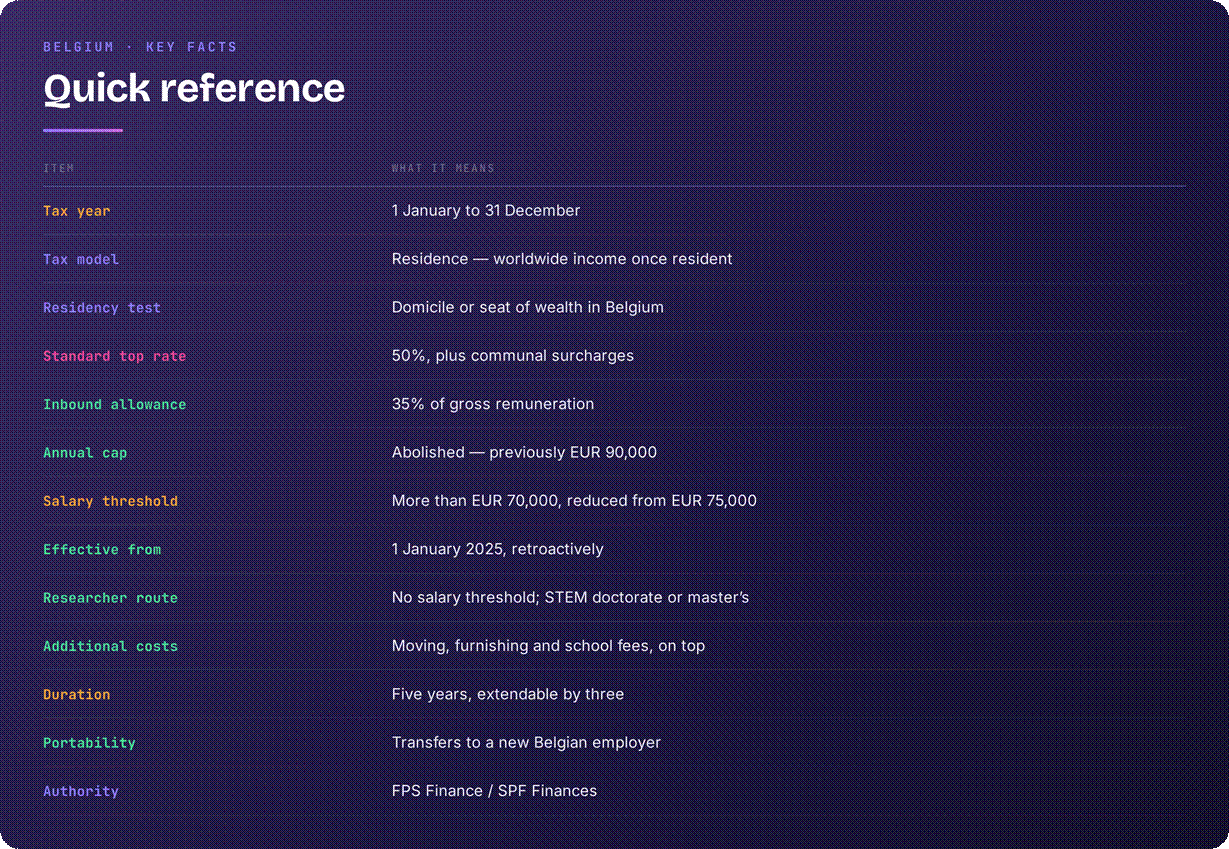
The Belgian position at a glance.
The retroactive window
Because the law applies from 1 January 2025, employees already in the regime before that date can benefit from the improved terms too. The circular confirmed that contracts could be amended to implement the changes retroactively, and that applications could be made for eligible employees who had not previously applied.
What matters is whether the conditions — including the lower EUR 70,000 threshold — were in fact met when the Belgian employment began, rather than whether an application happened to be submitted at the time. Anyone who assumed they fell below the old EUR 75,000 threshold should have that assumption re-tested.
Case study: Hanne assumed she did not qualify
Hanne moved from Copenhagen to Ghent in early 2025 on a gross package of EUR 72,000. Her employer’s adviser looked at the then-current EUR 75,000 threshold, concluded she fell short, and did not apply.
The December 2025 law cut the threshold to EUR 70,000 with effect from 1 January 2025 which is the month she started. She qualified all along under the amended rules, and the retroactive mechanism existed precisely for her situation.
The cost of not revisiting it is 35% of her gross remuneration, free of income tax, for up to eight years. Anyone who was assessed against the old threshold in 2025 is worth re-checking.
Filing and the compliance calendar
The Belgian tax year follows the calendar year, and the annual return is filed in the year following, with deadlines varying by filing method and by whether an accountant submits on your behalf. Employers operate withholding on salary throughout the year.
Prepare in good time:
• The application for the regime and its approval;
• Employment contract terms, including any amendment implementing the allowance;
• Payroll records evidencing the 35% allowance;
• Documentation of additional reimbursed costs;
• Evidence of your position before taking up Belgian employment; and
• A residency certificate, if filing as a non-resident taxpayer.
Timing matters more than the headline percentage
Model your position before accepting an offer, considering:
• Whether your gross package clears EUR 70,000 with headroom;
• Whether the researcher route suits you better, given it has no threshold;
• Whether you were assessed against the old figures during 2025;
• How the eight-year maximum fits your intended stay;
• Whether a later change of Belgian employer would preserve the regime;
• What the ordinary rates would cost you without it; and
• How the position differs for contributions, which have not followed the tax change.
Your Belgium checklist
1. Check your gross package against the EUR 70,000 threshold, not EUR 75,000;
2. Re-test any 2025 assessment made against the old figures;
3. Consider the researcher route if you are below the threshold;
4. Confirm you were not previously Belgian resident or taxed in Belgium;
5. Ensure the employment contract reflects the 35% allowance;
6. Track gross remuneration through the year, since the test is continuous;
7. Keep documentation for additional reimbursed costs separately;
8. Note the eight-year maximum from the start of the regime;
9. Check portability before changing Belgian employer; and
10. Take separate advice on the contribution position.
Frequently asked questions
Is the Belgian inbound allowance still 30%?
No. The law of 18 December 2025 raised it to 35% of gross remuneration, with effect from 1 January 2025. Guidance quoting 30% describes the position before that reform.
Is there still a EUR 90,000 cap?
No. The annual ceiling on the allowance was abolished rather than increased, so the 35% applies without a monetary limit for income tax purposes.
What is the salary threshold now?
More than EUR 70,000 gross annually for the inbound taxpayer regime, reduced from EUR 75,000. The inbound researcher regime has no salary threshold at all.
Can the changes apply to me if I started in 2025?
Yes. The law applies retroactively to 1 January 2025, and the April 2026 circular confirmed that contracts could be amended and applications made for employees who had not previously applied. What matters is whether the conditions were met when the employment began.
What is the difference between the two regimes?
The inbound taxpayer regime requires a minimum salary but no degree. The inbound researcher regime requires a doctorate or master’s in a specified STEM discipline, or equivalent experience, but imposes no salary threshold.
How long does the regime last?
Five years, extendable by three, so eight years in total. It is individual-centric and can transfer to a new Belgian employer provided all conditions continue to be met.
Does the allowance come out of my salary?
No. Costs proper to the employer are paid in addition to gross remuneration rather than carved out of it, which is why the arithmetic differs from a regime that simply exempts part of the salary.
Do contributions follow the same 35%?
Not at present. The increase was accepted for income tax purposes, but the social security position has not moved in step, so the treatment of the additional five percentage points differs between the two systems. That side needs separate advice.
Official sources and further reading
• FPS Finance — Belgian federal tax administration
Important information
This article is general information and does not constitute tax, legal, immigration or financial advice, and does not create a client relationship. Tax outcomes depend on travel history, income sources, treaty status and the law applying to the relevant year. Rates, thresholds and regimes change, and some measures described may be proposed rather than enacted; this article reflects our understanding as at the date of publication. Obtain advice from a suitably qualified professional before acting or refraining from action.
