
Botswana taxes income only where the source is within Botswana. It abolished capital gains tax on share sales in 2024, and private sector employees pay no social security at all.
The Botswana tax system operates on a territorial basis, and income is taxable in Botswana if the source is within Botswana. A resident is taxable on all income from a Botswana source in accordance with the personal income tax rates.
That is worth stating plainly, because a number of secondary sources describe Botswana as taxing residents on worldwide income. It does not. The charge follows source, not the person.
In 2024 Botswana abolished capital gains tax on share sales entirely; the rate is now 0%. Capital gains on property remain chargeable at 5%.
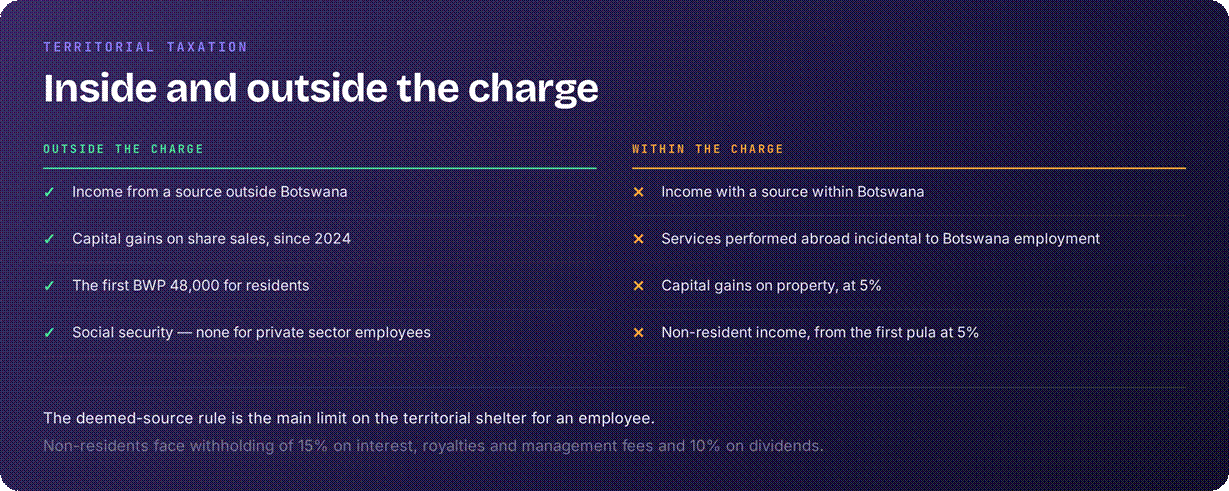
What the territorial rule covers, and its exception.
Your residency status is the first step
Residence is generally established by physical presence, which is more than 183 days in a tax year, or more than 120 days in the current year together with 183 days in the preceding year.
Because the system is territorial, residence does not widen the scope of the charge. What it changes is the rate structure: a resident gets a zero band covering the first BWP 48,000, while a non-resident starts at 5% from the first pula.
A non-resident is taxable on earned income at the personal rates, but pays withholding tax only — at 15% for interest, commercial royalties and management and consultancy fees, 10% for dividends, and 10% for entertainment fees — where such income is of Botswana origin.
Maintain accurate records of:
• Days present, against both the 183-day and the 120-plus-183 tests;
• The source of each item of income;
• Whether any services performed abroad are incidental to Botswana employment;
• Acquisition and disposal records, distinguishing shares from property;
• Income by category, for the non-resident withholding rates; and
• The tax year, which runs July to June rather than by calendar.
The tax rates
Taxable income (BWP) | Resident / Non-resident |
0 to 48,000 | Nil / 5% |
48,000 to 84,000 | 5% / 5% |
84,000 to 120,000 | 12.5% / 12.5% |
120,000 to 156,000 | 18.75% / 18.75% |
Above 156,000 | 25% / 25% |
Capital gains on shares | 0% since 2024 |
Capital gains on property | 5% |
Social security, private sector | None |
A 25% top rate is low by African standards, and it engages at BWP 156,000. Modest in absolute terms, but the bands beneath it are gentle, running 5%, 12.5% and 18.75% rather than jumping.
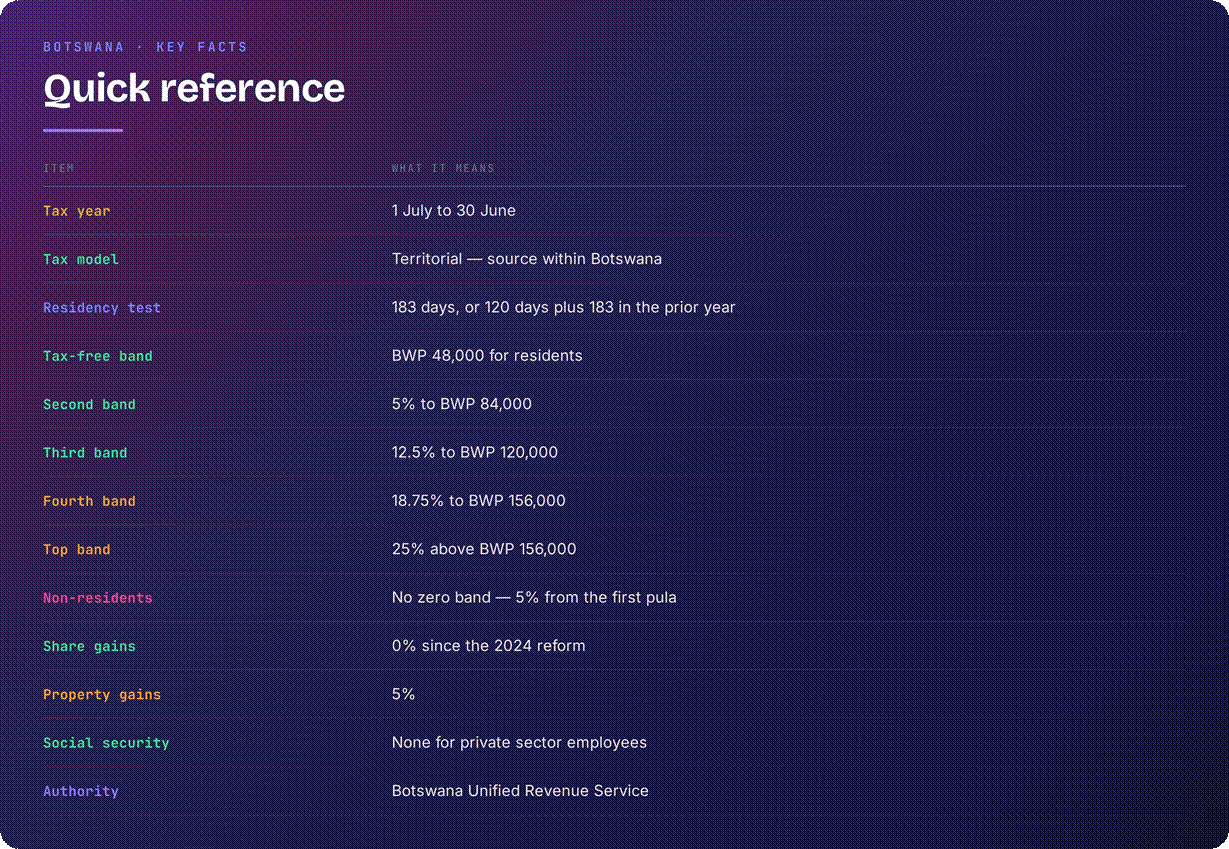
The Botswana position at a glance.
What makes Botswana attractive
The combination is one of the strongest on the continent:
• Territorial taxation, so income from a source outside Botswana is outside the charge;
• 0% capital gains tax on share sales since the 2024 reform;
• No national social security fund for private sector employees (PAYE is the only mandatory deduction);
• A BWP 48,000 tax-free band for residents;
• A 25% top rate, low by regional standards, with gentle bands beneath it;
• Corporate tax at 22%; and
• One of Africa’s most transparent and stable tax administrations.
The honest qualifications are that the deemed-source rule pulls back some of the territorial benefit for employees, that non-residents lose the zero band entirely, and that property gains remain chargeable at 5%.
Case study: Thabo and the deemed source rule
Thabo is employed in Gaborone and travels abroad for several weeks a year on assignments for the same employer. He assumes the territorial rule puts the income earned during those trips outside the Botswana charge.
It does not. Income for services performed outside Botswana is deemed to be from a Botswana source if the services are incidental to employment in Botswana, and travel for his Botswana employer is exactly that.
What genuinely sits outside the charge is income from a separate source abroad such as an overseas rental property, a foreign business, investments held offshore. The distinction is between income connected to his Botswana employment and income that is not.
Filing and the compliance calendar
The Botswana fiscal year runs from 1 July to 30 June. PAYE is withheld monthly by employers and remitted to the Botswana Unified Revenue Service by the 15th of the following month.
Prepare in good time:
• Registration with BURS;
• Day-count records across the July-to-June year;
• Documentation establishing the source of each receipt;
• Records separating share disposals from property disposals;
• Evidence of any withholding suffered as a non-resident; and
• Awareness that no social security deduction applies in the private sector.
Source, and the exception to it
Consider:
• That the system is territorial. Source governs, not residence;
• That services abroad incidental to Botswana employment are deemed local;
• That share gains have been untaxed since 2024;
• That property gains remain chargeable at 5%;
• That a resident gets BWP 48,000 free and a non-resident does not;
• That private sector employees pay no social security; and
• That the tax year runs July to June.
Your Botswana checklist
1. Establish the source of every item of income;
2. Check whether foreign services are incidental to Botswana employment;
3. Count days against both residence tests;
4. Separate share disposals from property disposals;
5. Note share gains have been untaxed since 2024;
6. Budget 5% on any property gain;
7. Claim the BWP 48,000 band if resident;
8. Expect no zero band as a non-resident;
9. Note there is no private sector social security; and
10. Work to the July-to-June tax year.
Frequently asked questions
Is Botswana territorial?
Yes. The system operates on a territorial basis and income is taxable in Botswana if the source is within Botswana. A resident is taxable on all income from a Botswana source, not on worldwide income, which several secondary sources get this wrong.
Is there capital gains tax?
Not on shares. Botswana abolished capital gains tax on share sales in 2024 and the rate is now 0%. Capital gains on property remain chargeable at 5%.
What is the deemed source rule?
Income for services performed outside Botswana is deemed to be from a Botswana source if the services are incidental to employment in Botswana. Travel abroad for a Botswana employer therefore stays within the charge.
What are the rates?
Nil on the first BWP 48,000 for residents, then 5% to BWP 84,000, 12.5% to BWP 120,000, 18.75% to BWP 156,000 and 25% above. Non-residents get no zero band and start at 5%.
Is there social security?
Not for private sector employees. There is no national social security fund covering them, so PAYE is the only mandatory payroll deduction — unusual in Africa. Civil servants have their own pension fund.
How do I become tax resident?
Generally by being present for more than 183 days in a tax year, or more than 120 days in the current year together with 183 days in the preceding year.
How are non-residents taxed?
On earned income at the personal rates without the zero band, and by withholding on Botswana-origin income; 15% for interest, commercial royalties and management and consultancy fees, 10% for dividends and 10% for entertainment fees.
When does the tax year run?
From 1 July to 30 June. PAYE is withheld monthly and remitted to BURS by the 15th of the following month.
Official sources and further reading
• Botswana Unified Revenue Service
Important information
This article is general information and does not constitute tax, legal, immigration or financial advice, and does not create a client relationship. Tax outcomes depend on travel history, income sources, treaty status and the law applying to the relevant year. Rates, thresholds and regimes change, and some measures described may be proposed rather than enacted; this article reflects our understanding as at the date of publication. Obtain advice from a suitably qualified professional before acting or refraining from action.
