
Panama taxes income produced within Panama and leaves the rest alone. The edge of that rule — work you physically perform while sitting in Panama City — is where the arguments happen.
Panama runs one of the purest territorial systems anywhere. Article 694 of the Código Fiscal charges income tax on income produced within Panamanian territory. Foreign-source income is not taxable in Panama even when received by a Panamanian resident, and there is no remittance question, because there is nothing to remit into.
For a retiree living on a foreign pension, or an investor living on foreign dividends, that is the end of the analysis. For someone working remotely from Panama City for clients abroad, it is the beginning of one.
Panama also uses the dollar, has no exchange controls and levies no personal wealth or inheritance tax. The combination is genuinely attractive, and it is why the country appears on every list of low-tax bases. The lists rarely mention where the territorial rule runs out.
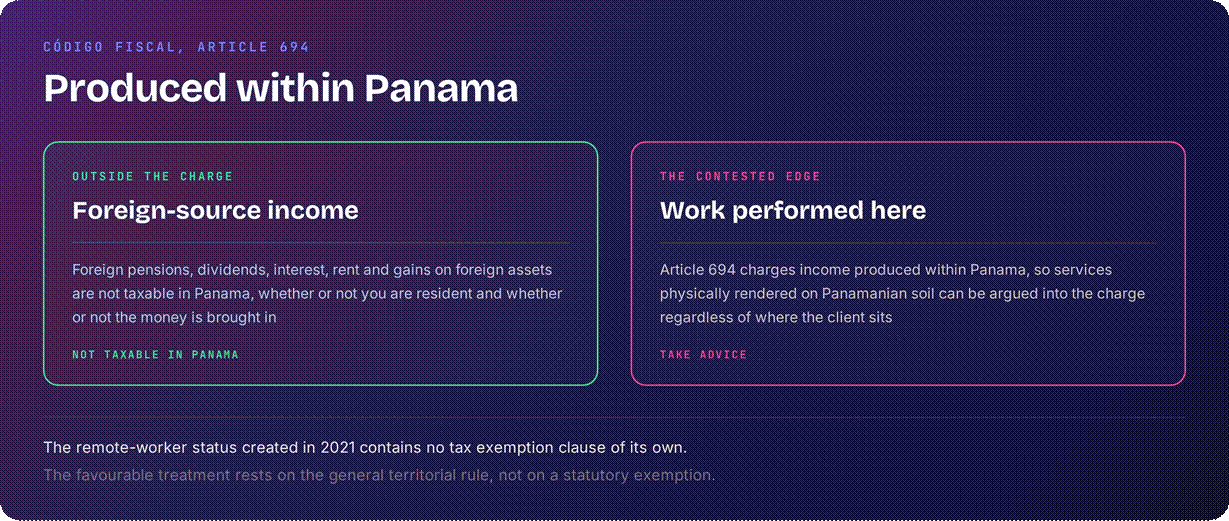
Foreign-source income is outside the charge — the edge is where you sit.
Your residency status is the first step
You generally become Panamanian tax resident by being present in Panama for more than 183 days in a fiscal year, whether continuously or in alternating periods, or by establishing a permanent home in Panama. A tax residency certificate can be obtained from the Dirección General de Ingresos, and it is the document a treaty partner will want to see.
As in every territorial system, residence does not extend the scope of the tax. Becoming Panamanian tax resident does not bring foreign income into charge. It affects filing, rates and the ability to claim a certificate.
Maintain accurate records of:
• Arrival and departure dates within each fiscal year;
• Workdays physically performed inside Panama;
• Where services were rendered, as distinct from where they were billed;
• Accommodation arrangements and whether a permanent home exists;
• Panamanian-source income of any kind; and
• Any other country that may also treat you as resident.
What Panama taxes, and what it does not
The charge follows the source of the income. Applied to a typical arrival:
Income | Panamanian treatment |
Foreign pensions and social security | Not taxable in Panama |
Dividends and interest from abroad | Not taxable in Panama |
Rent from property outside Panama | Not taxable in Panama |
Gains on foreign assets | Not taxable in Panama |
Salary from a Panamanian employer | Panamanian-source — taxable |
Income from a business operating in Panama | Panamanian-source — taxable |
Rent from Panamanian property | Panamanian-source — taxable |
Services performed while physically in Panama | The contested edge — take advice |
Where you sit matters more than where you invoice. Article 694 charges income produced within Panama, and there is a respectable argument that services physically performed on Panamanian soil are produced there regardless of who pays for them. Most practitioners treat foreign-employer income as outside the charge, but that is an interpretation of a general rule rather than a guarantee written into law.
The remote-worker status and what it does not include
Panama created a short-stay remote worker status by executive decree in 2021. It is frequently described as carrying a tax exemption. It does not. The decree contains no explicit tax-exemption clause, so the treatment of a holder’s foreign income rests entirely on the general territorial rule in Article 694.
Compare that with Costa Rica, where the equivalent exemption is written into the enabling statute and expressly provides that qualifying foreign income is not to be treated as locally sourced. The practical outcome is often the same; the legal footing is not.
Rates on Panamanian-source income
Individual income tax applies on a simple three-band scale: 0% on the first USD 11,000 of taxable income, 15% from USD 11,001 to USD 50,000, and 25% above USD 50,000. Business profits of individuals are taxed on the same scale.
Gains on Panamanian real property and on securities have their own regimes, generally operating through an advance withholding with an option to treat it as final. Gains on foreign assets remain outside the charge. ITBMS, Panama’s value added tax, applies at 7% to most goods and services.
Case study: Rafael bills abroad and works in Panama City
Rafael consults for clients in the United States and Spain. He invoices from a Panamanian company, the money lands in a Panamanian bank, and he performs every hour of the work from his apartment in Panama City.
His own view is that the income is foreign-source because the clients are abroad. The counter-argument is that the service was produced within Panamanian territory, which is exactly what Article 694 charges. Nothing about the invoice, the currency or the bank account resolves it.
What would resolve it is a properly reasoned position taken in advance, supported by contracts that describe where the work is performed. Rafael has none of that, and he is relying on nobody asking.
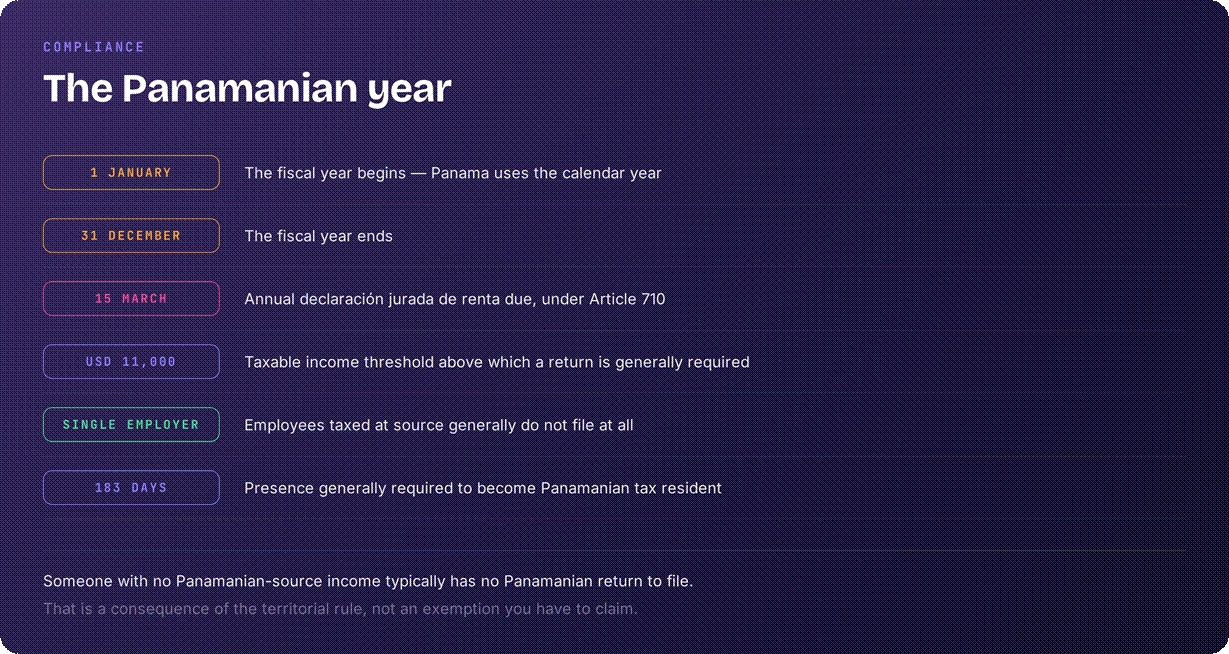
A short calendar, and a filing obligation many residents never have.
Filing and the compliance calendar
Panama’s fiscal year follows the calendar year. The annual return — the declaración jurada de renta — is due by 15 March of the following year and is filed through the tax authority’s online system. The obligation sits in Article 710 of the Código Fiscal.
Individuals with taxable Panamanian-source income above the USD 11,000 threshold are generally required to file. Employees with a single Panamanian employer are generally not, because the tax is withheld at source and there is nothing further to declare. Someone with no Panamanian-source income at all typically has no Panamanian return to file.
Prepare in good time:
• Registration with the tax authority and access to the filing system;
• Panamanian-source income records by category;
• Contracts and invoices evidencing where services were performed;
• Records of days spent in and out of Panama;
• Any tax residency certificate obtained; and
• Documentation supporting the foreign source of undeclared income.
Place matters more than timing
Model your position before you move, considering:
• Whether your income derives from foreign assets or from work you perform;
• How much of that work will be performed physically in Panama;
• Whether you want a reasoned source position documented in advance;
• Whether any Panamanian-source income creates a filing obligation;
• Whether a tax residency certificate would help with your former country;
• Whether a treaty exists, since Panama’s network is modest; and
• What your home country requires before it accepts that you have left.
Your Panama checklist
1. Separate income from foreign assets from income generated by your own work;
2. Quantify how much work you will perform physically inside Panama;
3. Document the place of performance in contracts and invoices;
4. Take a reasoned source position in advance rather than after a query;
5. Track days in and out of Panama across the calendar year;
6. Do not assume the remote-worker status carries its own exemption;
7. Identify any Panamanian-source income that triggers a filing obligation;
8. Consider whether a tax residency certificate would help with your former country;
9. Diarise 15 March if a return is required; and
10. Check what your home country needs before it accepts you have left.
Frequently asked questions
Does Panama tax foreign income?
No. Article 694 of the Código Fiscal charges income produced within Panamanian territory, so foreign-source income is not taxable in Panama even for residents. There is no remittance concept, because foreign income is outside the charge whether or not it is brought in.
I work remotely for foreign clients from Panama. Is that foreign income?
This is the contested edge. Most practitioners treat foreign-employer and foreign-client income as outside the charge, but the statute taxes income produced within Panama, and services physically performed here can be argued into it. A documented position taken in advance is worth having.
Does the remote-worker status give me a tax exemption?
No. The decree that created it contains no tax exemption clause. Any favourable treatment rests on the general territorial rule in Article 694, which is a weaker legal footing than a statutory exemption of the kind Costa Rica enacted.
What are the income tax rates?
Nil on the first USD 11,000 of taxable income, 15% from USD 11,001 to USD 50,000, and 25% above USD 50,000. The same scale applies to business profits of individuals.
Do I have to file a Panamanian tax return?
Only if you have Panamanian-source income above the threshold. Employees with a single Panamanian employer generally do not file, because tax is withheld at source, and someone with no Panamanian-source income typically has no return to file.
Is US Social Security taxed in Panama?
No. It is foreign-source income and falls outside the Panamanian charge. Whether it is taxable elsewhere depends on your other obligations — a US citizen, for example, remains within the US system regardless.
Does becoming resident change what Panama taxes?
No. In a territorial system, residence affects filing, rates and certificates rather than the scope of the charge. Crossing 183 days does not bring foreign income into the Panamanian base.
Is there a capital gains tax?
On Panamanian real property and securities there are specific regimes, generally operating through an advance withholding that can be treated as final. Gains on assets located outside Panama remain outside the charge.
Official sources and further reading
• Dirección General de Ingresos (DGI)
Important information
This article is general information and does not constitute tax, legal, immigration or financial advice, and does not create a client relationship. Tax outcomes depend on travel history, income sources, treaty status and the law applying to the relevant year. Rates, thresholds and regimes change, and some measures described may be proposed rather than enacted; this article reflects our understanding as at the date of publication. Obtain advice from a suitably qualified professional before acting or refraining from action.
