
The Philippines is one of the more misunderstood tax jurisdictions for remote workers, and the misunderstanding runs in both directions. Some guides warn that staying past 183 days makes you taxable on worldwide income. Others treat any foreign employer as putting the income beyond reach. Neither is right.
The structure is actually simple, and it starts with a distinction most systems do not make.
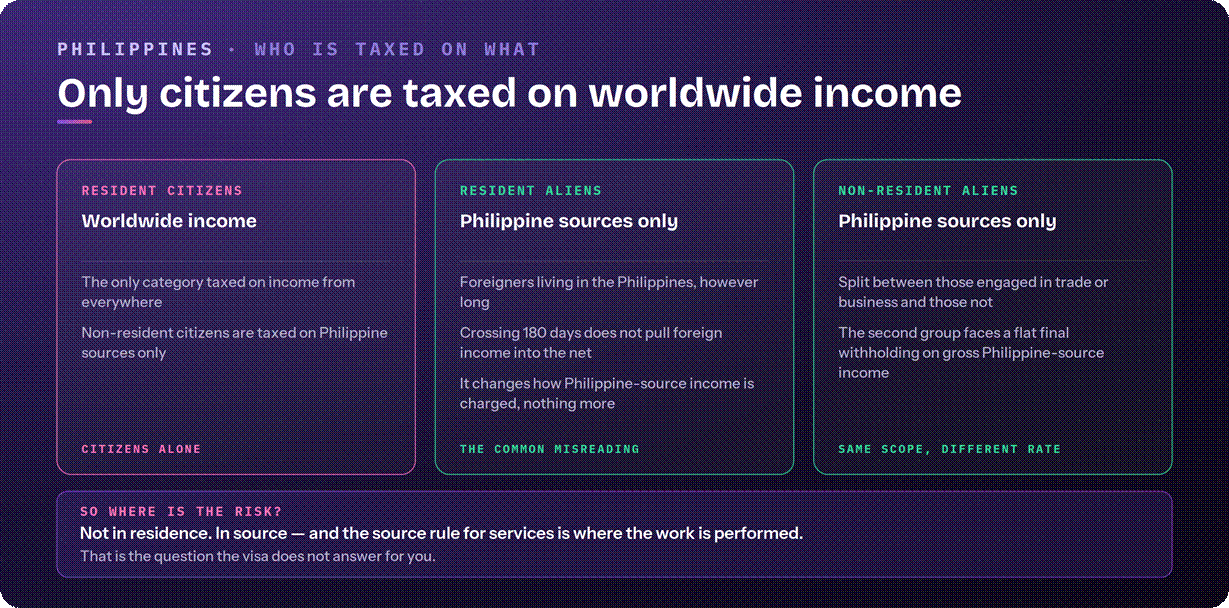
Only one category is taxed on worldwide income, and it is not a category a foreigner can fall into.
Only resident citizens are taxed on worldwide income. Every category of alien — resident alien, non-resident alien engaged in trade or business, non-resident alien not so engaged — is taxed only on income from sources within the Philippines. Crossing the 180-day threshold moves you between categories and changes how Philippine-source income is charged. It does not reach out and pull in your foreign income.
So the day count is not the risk. The source rule is.
Section 42, and where services are sourced
Under Section 42 of the National Internal Revenue Code, compensation for labour or personal services is treated as income from sources within the Philippines if the labour or services are performed in the Philippines. The provision is explicit that this holds regardless of the residence of the payer, the place where the contract was made, and the place of payment.
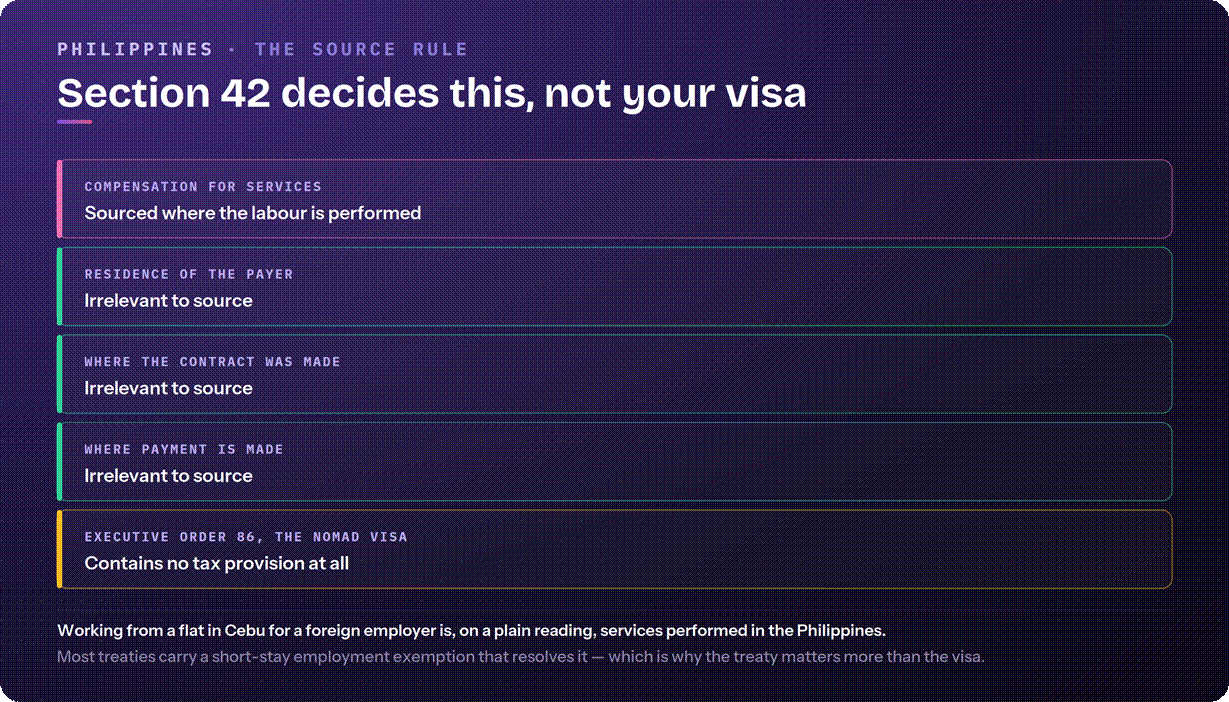
Three facts people rely on, none of which the source rule takes into account.
This is the gap between the popular account and the statute. The common claim is that a foreign employer paying into a foreign account produces foreign-source income. Section 42 says the opposite for services: what matters is where the work was done. On a plain reading, a salary earned while sitting in an apartment in Cebu is Philippine-source, and the fact that every dollar lands in a US bank is irrelevant.
Enforcement against short-stay remote workers has historically been close to non-existent, which is why the issue rarely surfaces. That changes once you register locally and the Bureau of Internal Revenue can see you. The risk profile of a six-week visit and a two-year stay are not the same, even though the legal analysis is identical.
What usually resolves it
The Philippines has an extensive treaty network, and most agreements contain an employment income article built on a familiar formula: a short stay, remuneration paid by an employer who is not a Philippine resident, and cost not borne by a Philippine permanent establishment. Where all three hold, the charge is relieved.
That formula does most of the practical work for short-stay remote workers from treaty countries. It becomes harder to satisfy as the stay lengthens, since the day threshold in the employment article is typically the first thing to fail.
The treaty is doing the work, not anything else. For most people the employment income article is what actually determines whether a charge arises. Nothing else in the picture affects it. If you are from a country with no Philippine treaty, there is no article to fall back on and the domestic source position stands on its own.
The exemption that does not exist
Executive Order No. 86 contains no tax provision. The Order signed on 24 April 2025 is widely described as creating a tax-free status for remote workers. Read against the primary text, that claim has nothing behind it: the Order does not grant an exemption, does not mention income tax and does not alter Section 42. The Bureau of Internal Revenue is among the implementing agencies, so guidance may follow — but guidance that has not been issued cannot be relied on.
This matters because it removes the only argument many people think they have. If your income is Philippine-source under Section 42, nothing in the 2025 Order takes it back out again. The relief, if there is any, comes from a treaty.
The tax rates
Where a charge does arise, individuals are taxed on a progressive scale. The first PHP 250,000 of annual taxable income is exempt, with rates then running from 15% to a top rate of 35% on income above PHP 8 million.
A non-resident alien not engaged in trade or business — broadly, someone staying 180 days or less without local business activity — faces a flat 25% final withholding on gross Philippine-source income instead. That is a gross basis with no deductions, so on some income profiles it is materially worse than the graduated table, which is the practical effect of the 180-day line.
Self-employed individuals and professionals whose gross receipts fall below the VAT registration threshold can elect a flat 8% on gross receipts in place of the graduated rates and percentage tax. VAT is 12%. Corporate income tax is generally 25%, with 20% for qualifying smaller domestic corporations.
Your Philippines checklist
• Stop worrying about 183 days pulling in worldwide income — it does not, for any foreigner;
• Work out instead whether your income is Philippine-source under Section 42;
• Assume services performed while physically in the Philippines are Philippine-source;
• Read the employment income article of your home country’s treaty with the Philippines;
• Check whether the short-stay day threshold in that article still holds for your stay;
• Do not treat the 2025 Executive Order as a tax exemption — it contains none;
• Watch for implementing guidance from the Bureau of Internal Revenue;
• Note the 180-day line changes the charge on Philippine-source income from 25% gross to graduated;
• If self-employed below the VAT threshold, compare the 8% gross election with the graduated rates; and
• Take local advice before formalising residence, not after.
Frequently asked questions
Does staying over 183 days make me taxable on worldwide income?
No. Only resident citizens of the Philippines are taxed on worldwide income. Every category of foreigner is taxed only on Philippine-source income, regardless of how long they stay.
What does the 180-day threshold actually do?
It moves a foreigner between categories for the purpose of charging Philippine-source income. Below it, a non-resident alien not engaged in trade or business faces a flat 25% final withholding on gross. Above it, the graduated rates apply.
Is my foreign salary Philippine-source if I work from here?
On a plain reading of Section 42, yes. Compensation for services is sourced where the labour is performed, regardless of the residence of the payer, where the contract was made or where payment is made. Treaty relief is what usually resolves it.
Is there a remote-worker tax exemption?
No. Executive Order No. 86 of April 2025 is often described as creating one, but it contains no tax provision at all. Any page describing it as a tax exemption is reading something into the text that is not there.
What are the income tax rates?
The first PHP 250,000 of annual taxable income is exempt, then rates run from 15% to a top rate of 35% above PHP 8 million. Self-employed individuals below the VAT threshold may elect a flat 8% on gross receipts.
Are pensions taxed differently?
Foreign pensions follow the same source analysis as any other foreign income and fall outside the Philippine charge for a foreigner. Certain retirement benefits recognised under Philippine law are specifically exempt.
What if my country has no treaty with the Philippines?
Then there is no employment income article to relieve a domestic charge on services performed here, and the source analysis stands on its own. That is the position most worth taking advice on.
Official sources and further reading
Important information
This article is general information and does not constitute tax, legal, immigration or financial advice, and does not create a client relationship. Tax outcomes depend on travel history, income sources, treaty status and the law applying to the relevant year. Rates, thresholds and regimes change, and some measures described may be proposed rather than enacted; this article reflects our understanding as at the date of publication. Obtain advice from a suitably qualified professional before acting or refraining from action.
