
Singapore taxes what is earned in Singapore, exempts almost all foreign income received by individuals, and does not tax capital gains at all. The complications are in the timing, not the scope.
Singapore’s personal tax system is among the simplest in the developed world, and the simplicity is genuine rather than a marketing claim. Income accruing in or derived from Singapore is taxable. Foreign-sourced income received in Singapore by a resident individual is exempt — with one narrow exception.
That exception is income received through a partnership in Singapore, which falls outside the exemption and is taxed. For the overwhelming majority of individuals — employees, investors, retirees — foreign income can be brought into Singapore freely with no Singapore tax on it.
There is also no capital gains tax, no inheritance tax and no gift duty. Gains on personal investments are simply outside the system, though gains from activity that amounts to trading can be taxed as income, which is a question of fact rather than a bright line.
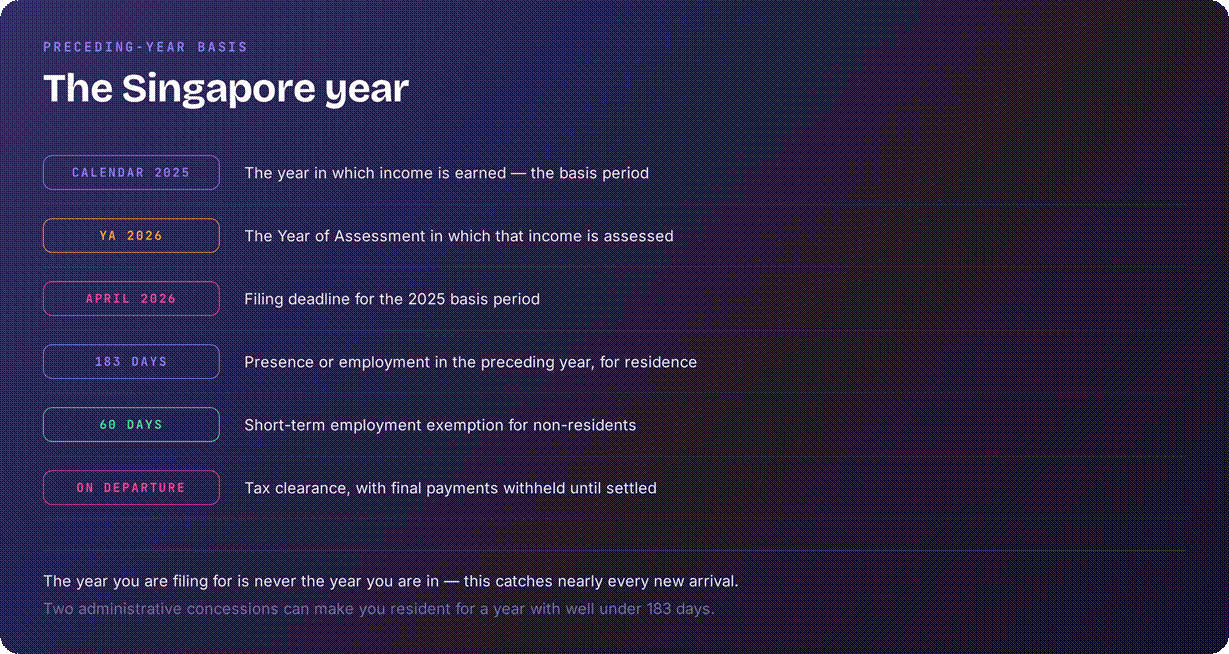
The Singapore position at a glance.
Your residency status is the first step
You are treated as tax resident for a Year of Assessment if, in the preceding calendar year, you resided in Singapore, or were physically present or exercised an employment there — other than as a company director — for 183 days or more.
Two administrative concessions extend that:
• The two-year concession: a foreign employee working in Singapore for a continuous period of 183 days or more straddling two calendar years is treated as resident for both years; and
• The three-year concession: where a stay straddles three consecutive years or more, residence can apply throughout, even if the 183-day test is not met in the first or final year of employment.
The difference matters because non-residents are taxed at a flat 15% on employment income or at resident rates, whichever is higher, and generally 24% on most other income, with no personal reliefs at all.
Maintain accurate records of:
• Arrival and departure dates by calendar year;
• The start and end dates of any Singapore employment;
• Whether any period of employment straddles a year end;
• Whether any income is received through a Singapore partnership;
• Foreign income received in Singapore, by source and category; and
• Any other country that may also treat you as resident.
What Singapore taxes
Income | Singapore treatment |
Employment income for work in Singapore | Taxable |
Trade or business income arising in Singapore | Taxable |
Rent from Singapore property | Taxable |
Foreign income received by a resident individual | Exempt |
Foreign income received through a Singapore partnership | Not exempt |
Capital gains on personal investments | Not taxed |
Inheritances and gifts | Not taxed |
Non-resident employment income | 15% or resident rates, whichever is higher |
Where the work is performed is what matters. Employment exercised in Singapore is Singapore-source even where the employer, the contract and the payment are all overseas. A remote worker sitting in Singapore for a foreign employer is earning Singapore-source income, not foreign income, and the exemption does not reach it.
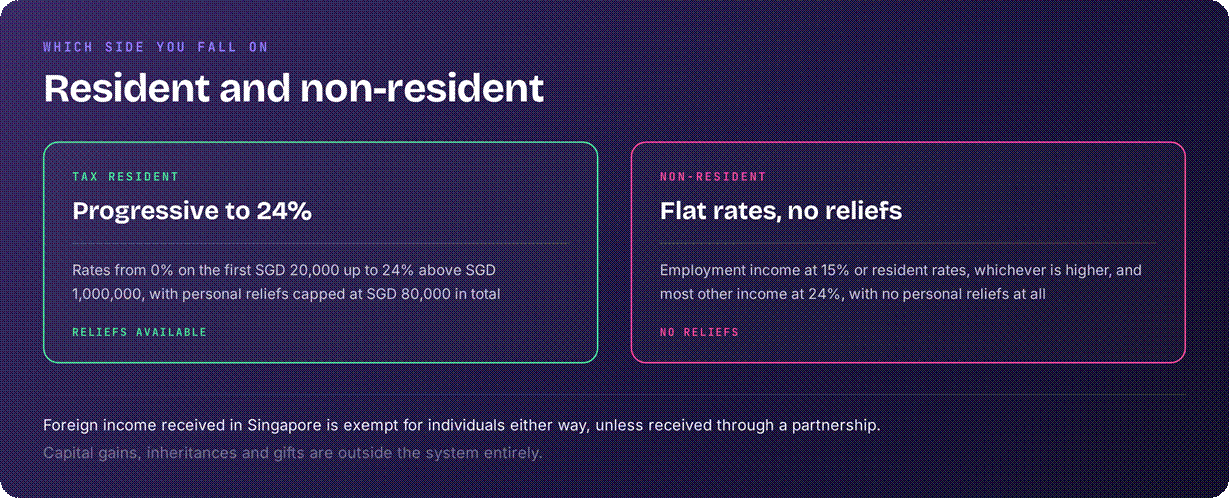
Resident and non-resident are taxed on very different terms.
Rates and reliefs
From Year of Assessment 2024, resident rates run from 0% to 24%, with the top rate applying to chargeable income above SGD 1,000,000. The first SGD 20,000 is untaxed, and the scale climbs gradually through a large number of narrow bands, which keeps effective rates low across most of the range.
Personal reliefs — earned income, spouse, child and others — are available to residents only and are subject to a combined cap of SGD 80,000. Non-residents receive none.
The 60-day exemption
Employment income of a non-resident who exercises employment in Singapore for not more than 60 days in a calendar year is exempt from tax. It does not extend to company directors, public entertainers or certain professionals.
For short-term regional roles this is a meaningful planning point, and it is straightforward to lose by a single extra trip.
Case study: Priya assumes her salary is foreign
Priya moves to Singapore and continues working for her Sydney employer, paid into an Australian account. She reads that foreign income received by residents is exempt and concludes her salary is outside the Singapore charge.
It is not. She exercises the employment in Singapore, which makes the income Singapore-source, and the exemption for foreign income has nothing to say about it. The Australian employer and the Australian bank account are irrelevant to the analysis.
What the exemption genuinely covers is her share portfolio in Australia, her rental property there, and any dividends or interest she brings across — all of which she can remit to Singapore freely without a Singapore charge.
The regime that no longer exists
Older guidance refers to the Not Ordinarily Resident scheme, which gave qualifying individuals time-apportionment of employment income. It was discontinued, with the last Year of Assessment for new entrants having passed some years ago. Anyone still planning around it is planning around a closed regime.
Filing and the compliance calendar
Singapore assesses on a preceding-year basis: income earned in calendar year 2025 is assessed in Year of Assessment 2026, with filing due in April 2026. The distinction between the calendar year and the Year of Assessment is the single most common source of confusion for new arrivals.
Employers participating in the Auto-Inclusion Scheme submit employment income directly, so many employees have little to add. Prepare in good time:
• A SingPass and access to the tax portal;
• Employment income records, where not auto-included;
• Details of any Singapore rental or business income;
• Reliefs you intend to claim, against the SGD 80,000 cap;
• Records of days present, if residence is marginal; and
• Tax clearance documentation if you are leaving Singapore.
Leaving requires clearance. Employers are generally obliged to notify the authority and withhold final payments pending tax clearance when a foreign employee ceases employment or leaves Singapore. It is not optional and it can hold up a final salary payment.
Timing matters more than structure
Model your position before you move, considering:
• Whether work performed in Singapore makes your salary Singapore-source;
• Whether your arrival date leaves you short of 183 days in year one;
• Whether either administrative concession would apply to you;
• Whether any income arrives through a Singapore partnership;
• Whether investment activity could be characterised as trading;
• How the preceding-year basis affects your first and last years; and
• What tax clearance will require when you eventually leave.
Your Singapore checklist
1. Establish whether work performed in Singapore makes your income Singapore-source;
2. Count days in the preceding calendar year, not the current one;
3. Check whether the two-year or three-year concession applies;
4. Identify any income received through a Singapore partnership;
5. Confirm no investment activity could be characterised as trading;
6. Separate the basis period from the Year of Assessment when planning;
7. Claim reliefs against the SGD 80,000 combined cap;
8. Disregard any guidance referring to the Not Ordinarily Resident scheme;
9. Diarise the April filing deadline; and
10. Plan for tax clearance before you leave, not after.
Frequently asked questions
Is Singapore a territorial tax system?
Substantially. Income accruing in or derived from Singapore is taxable, and foreign-sourced income received in Singapore by a resident individual is exempt — the one exception being income received through a partnership in Singapore.
I work remotely from Singapore for a foreign employer. Is that foreign income?
No. Employment exercised in Singapore is Singapore-source regardless of where the employer, the contract and the payment sit. The exemption for foreign income does not reach it, and this is the most common misreading of the rule.
Does Singapore tax capital gains?
There is no capital gains tax. Gains on personal investments fall outside the system, although gains from activity amounting to trading can be taxed as income — a question of fact rather than a fixed threshold.
How is residence decided?
By residing in Singapore, or being physically present or exercising employment there for 183 days or more in the calendar year preceding the Year of Assessment. Two administrative concessions extend residence where a stay straddles two or three consecutive years.
What is the preceding-year basis?
Income earned in one calendar year is assessed in the following Year of Assessment — income from 2025 is assessed in YA 2026 and filed in April 2026. The year you file for is never the year you are in.
What are the rates?
For residents, 0% to 24% from YA 2024, with the top rate on chargeable income above SGD 1,000,000 and personal reliefs capped at SGD 80,000. Non-residents pay 15% or resident rates on employment income, whichever is higher, and generally 24% on other income, with no reliefs.
Is short-term work in Singapore taxed?
Employment income of a non-resident exercising employment in Singapore for not more than 60 days in a calendar year is exempt. The exemption does not extend to company directors, public entertainers or certain professionals.
Can I still use the Not Ordinarily Resident scheme?
No. It has been discontinued and is closed to new entrants, though older guidance still refers to it. Any plan built around time-apportionment under that scheme needs revisiting.
Official sources and further reading
• Inland Revenue Authority of Singapore (IRAS)
Important information
This article is general information and does not constitute tax, legal, immigration or financial advice, and does not create a client relationship. Tax outcomes depend on travel history, income sources, treaty status and the law applying to the relevant year. Rates, thresholds and regimes change, and some measures described may be proposed rather than enacted; this article reflects our understanding as at the date of publication. Obtain advice from a suitably qualified professional before acting or refraining from action.
