
Bulgaria has the lowest headline income tax rate in the European Union, and a standard deduction that takes registered freelancers below it. It is also the figure most often quoted without the rest of the picture.
Bulgaria charges a flat 10% on personal income. Not 10% on a first band, not 10% after allowances phase out — a single rate across employment income, freelance income, rental income and capital gains alike. It is the lowest headline personal rate in the European Union.
For registered freelancers it is lower still. Bulgarian tax law grants a 25% normative expense deduction to individuals exercising a liberal profession, applied automatically with no receipts required and no calculation to perform. Tax at 10% on the remaining 75% gives an effective rate of 7.5%.
Two structural changes have improved the position further. Bulgaria joined Schengen on 1 January 2025 and adopted the euro on 1 January 2026, removing currency risk and making the country a more straightforward base for anyone billing in euros.
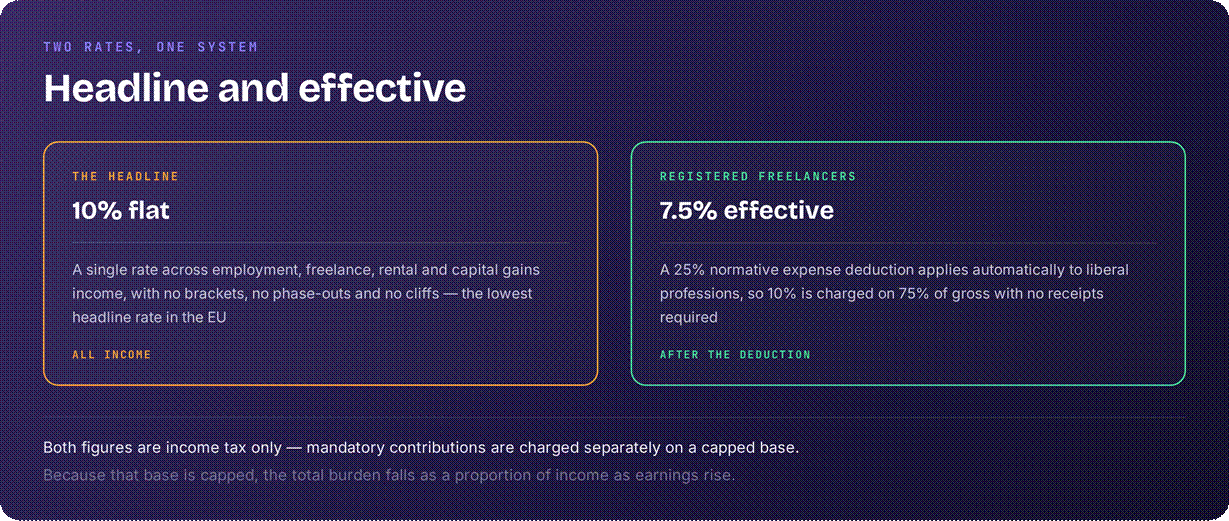
The headline rate, and the rate a freelancer actually pays.
Your residency status is the first step
You are Bulgarian tax resident if you spend more than 183 days in any twelve-month period in Bulgaria, or if you have a permanent address there, or if your centre of vital interests is in Bulgaria. Residents are taxed on worldwide income; non-residents on Bulgarian-source income.
The permanent address limb comes with an important qualification. Having a registered address in Bulgaria does not make you resident where your centre of vital interests — family, property, employment and the place from which you manage your affairs — lies in another country. That protects people with a Bulgarian address who genuinely live elsewhere, and it equally undermines anyone who registered an address hoping it would settle the question.
Maintain accurate records of:
• Days present across rolling twelve-month periods;
• Where your family lives and where your property is held;
• Where you manage your business and financial affairs;
• Registration with the National Revenue Agency;
• Any tax residency certificate obtained; and
• Any other country that may also treat you as resident.
The tax rates
Income | Bulgarian treatment |
Employment income | 10% flat |
Freelance income, liberal profession | 10% on 75% of gross — effective 7.5% |
Sole trader business income | 15% on net profit |
Rental income | 10%, after a statutory deduction |
Dividends | 5% final withholding |
Capital gains | 10%, with exemptions for EU regulated market disposals |
Corporate income tax | 10% |
VAT | 20% standard |
The 25% deduction is a standard entitlement, not a concession. It applies automatically to every registered freelancer in a liberal profession, which is why Bulgaria produces a lower effective rate than jurisdictions with a nominally similar flat charge.
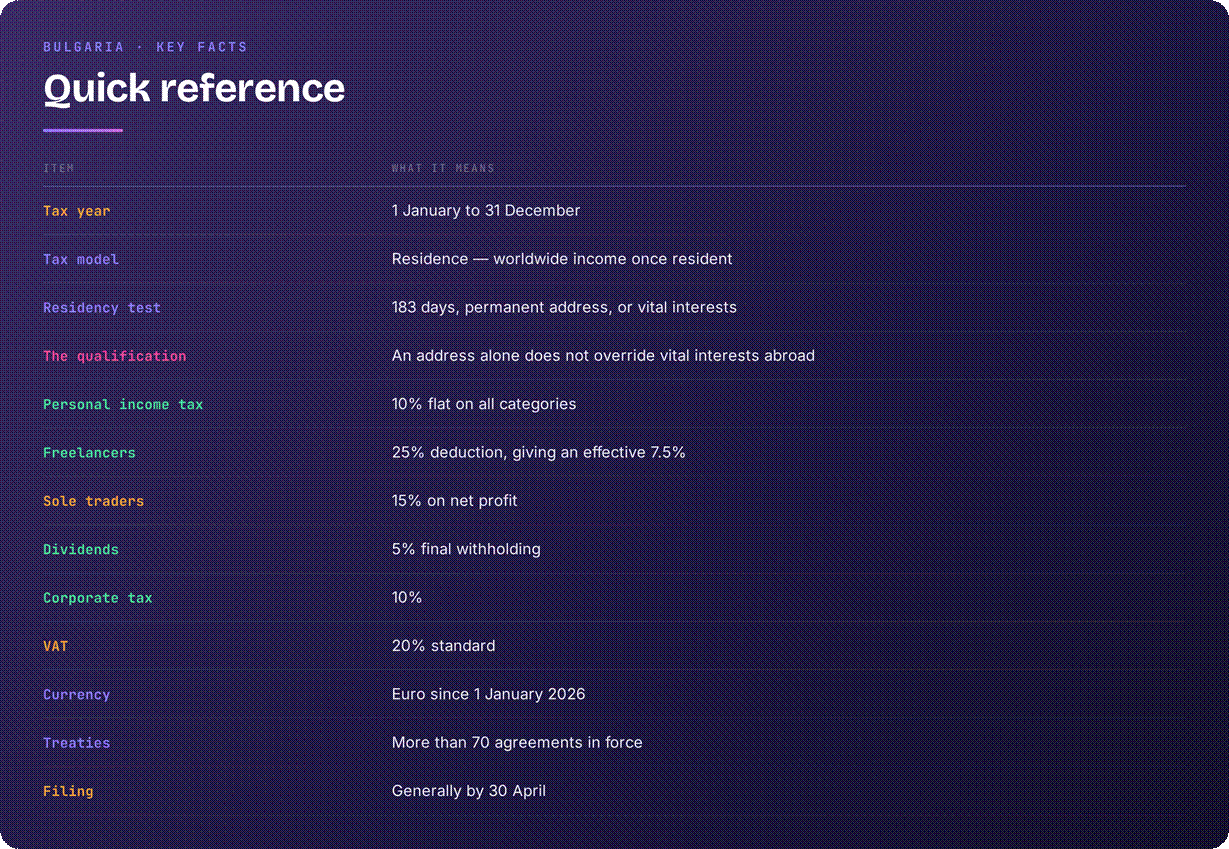
The Bulgarian position at a glance.
What the 7.5% figure leaves out
The effective 7.5% is an income tax figure. A self-insured person in Bulgaria also pays mandatory pension and health contributions, charged on a chosen insurable income between a statutory minimum and maximum rather than on actual earnings.
Because the base is capped, the contribution burden does not scale with income — which means the total burden falls as a proportion as earnings rise. For a modest freelance income the all-in rate is considerably above 7.5%; for a high one it converges toward it. The contribution side follows its own rules and is outside the scope of this article, but no honest comparison should omit that it exists.
The lesson is not that Bulgaria is expensive. It is genuinely among the lowest-tax jurisdictions in the EU, particularly for higher earners. The lesson is that "10%" and "7.5%" are income tax figures being quoted as though they were the whole cost.
Case study: Elena compares two structures
Elena earns the equivalent of EUR 90,000 a year from foreign clients. Registered as a freelancer in a liberal profession, her income tax is 10% on 75% of gross — an effective 7.5% — with contributions charged on the capped base rather than her actual income.
Through an EOOD, a single-owner limited company, the arithmetic is different: corporate tax at 10% on profit, then 5% on distributions, with the owner still inside the contribution system if they genuinely run the company.
Neither route is universally better. The freelance route is simpler and produces the lower income tax figure; the company route can suit a business with substantial deductible costs or one that retains profit. What decides it is the shape of the business, not the headline rate.
Filing and the compliance calendar
The Bulgarian tax year follows the calendar year. The annual return is generally due by 30 April of the following year, filed with the National Revenue Agency, with advance payments required during the year for freelance and business income.
Bulgaria has a treaty network of more than 70 agreements, including with most major economies, and a tax residency certificate is available from the NRA for treaty purposes. Prepare in good time:
• NRA registration as a self-insured person, if freelancing;
• Records of gross income, since the deduction is applied to it;
• Advance payment records through the year;
• A tax residency certificate for treaty purposes;
• Evidence supporting your centre of vital interests; and
• Documentation of your prior country’s deregistration.
Model the whole burden, not the headline
Consider:
• Whether your activity qualifies as a liberal profession for the 25% deduction;
• Whether the freelance route or a company suits your cost structure;
• That the 7.5% figure is income tax only;
• Where your centre of vital interests genuinely lies;
• Whether a Bulgarian address alone would achieve anything;
• Whether your former country will release you under a treaty; and
• That euro adoption from 2026 removes the currency question entirely.
Your Bulgaria checklist
1. Check whether your activity qualifies as a liberal profession;
2. Register with the National Revenue Agency before invoicing;
3. Apply the 25% deduction to gross, not to income after costs;
4. Remember the 7.5% is income tax only;
5. Establish where your centre of vital interests genuinely lies;
6. Do not rely on a permanent address alone to fix residence;
7. Compare the freelance route against an EOOD for your cost structure;
8. Make advance payments during the year;
9. Obtain a tax residency certificate for treaty purposes; and
10. Diarise the 30 April filing deadline.
Frequently asked questions
Is Bulgaria really 10%?
Yes, as a headline income tax rate — a single flat charge across employment, freelance, rental and capital gains income, with no brackets. It is the lowest headline personal rate in the European Union.
How do freelancers get to 7.5%?
Bulgarian law grants individuals exercising a liberal profession an automatic 25% normative expense deduction, with no receipts required. Tax at 10% on the remaining 75% of gross produces an effective 7.5%.
Is 7.5% the whole cost?
No. It is income tax only. Mandatory pension and health contributions are charged separately on a chosen insurable income between statutory minimum and maximum levels, so the realistic all-in burden is higher — particularly at modest income levels.
Does a Bulgarian address make me resident?
Not by itself. A permanent address is one of the residence limbs, but it does not make you resident where your centre of vital interests lies in another country. That qualification cuts both ways.
What is the centre of vital interests test?
It looks at where your family lives, where your property is held, where you work and where you manage your financial affairs. It is the limb that decides the question when a day count or an address is inconclusive.
How are dividends taxed?
At 5% as a final withholding tax. Combined with a 10% corporate rate, a company structure produces a combined charge on distributed profit of roughly 14.5%.
Did euro adoption change anything for tax?
Not the rates. Bulgaria adopted the euro on 1 January 2026, which removes currency risk and simplifies matters for anyone billing in euros, but the flat 10% and the freelancer deduction are unchanged.
When do I file?
The tax year follows the calendar year and the annual return is generally due by 30 April of the following year, with advance payments during the year for freelance and business income.
Official sources and further reading
Important information
This article is general information and does not constitute tax, legal, immigration or financial advice, and does not create a client relationship. Tax outcomes depend on travel history, income sources, treaty status and the law applying to the relevant year. Rates, thresholds and regimes change, and some measures described may be proposed rather than enacted; this article reflects our understanding as at the date of publication. Obtain advice from a suitably qualified professional before acting or refraining from action.
