
Cameroon charges IRPP from the first franc at 10%, reaching 35% above five million. Then it adds a communal surcharge of 10% — calculated on the tax itself, not on income.
Cameroon’s IRPP has four bands and no zero rate. The charge begins at 10% on net taxable income up to FCFA 2,000,000, rising through 15% to FCFA 3,000,000 and 25% to FCFA 5,000,000, and reaching 35% above that.
Two reliefs come off before the scale is applied, and they matter. A professional expenses allowance of 30% of gross salary, capped at FCFA 3,000,000 a year, and a further fixed abattement of FCFA 500,000. Employee CNPS contributions at 4.2% are also deductible.
What is easy to miss is what comes after. The Centimes Additionnels Communaux — CAC — add 10% on top of the IRPP itself, not on income, for the benefit of local authorities. That lifts the effective maximum rate from 35% to 38.5%.
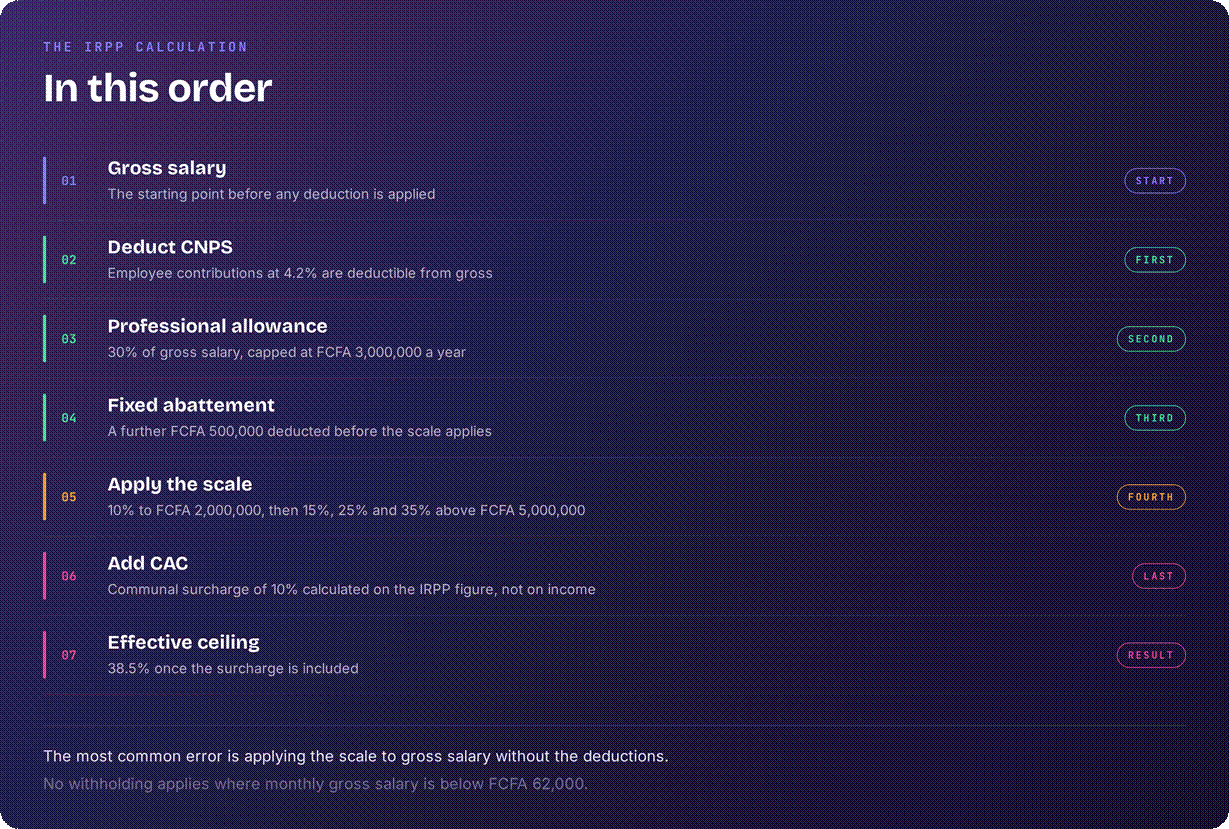
The order of the calculation, step by step.
How the calculation runs
The order of operations decides the answer, and getting it wrong overstates the tax substantially. The sequence is:
• Start with gross salary;
• Deduct CNPS at 4.2%, which is deductible;
• Deduct the 30% professional expenses allowance, capped at FCFA 3,000,000 a year;
• Deduct the fixed abattement of FCFA 500,000;
• Apply the four-band scale to the resulting net taxable income; then
• Add CAC at 10% of the IRPP figure.
The most common error is applying the scale to gross salary without first deducting CNPS and the allowances. That produces a figure well above what is actually due.
Maintain accurate records of:
• Gross salary and CNPS deducted;
• The professional expenses allowance against its annual cap;
• Net taxable income against each of the four band thresholds;
• The CAC calculated on the tax rather than on income;
• Dividend and interest income, which is dealt with separately; and
• Monthly gross against the FCFA 62,000 withholding threshold.
The tax rates
Annual net taxable income (FCFA) | Rate |
0 to 2,000,000 | 10% |
2,000,001 to 3,000,000 | 15% |
3,000,001 to 5,000,000 | 25% |
Above 5,000,000 | 35% |
Communal surcharge (CAC) | 10% of the IRPP payable |
Effective maximum rate | 38.5% |
Dividends and interest (IRCM) | 16.5%, final |
CNPS, employee | 4.2%, deductible |
The IRCM is the provision worth planning around. At 16.5% and libératoire, investment income is taxed at less than half the top IRPP rate and never enters the progressive computation — so it cannot push salary income into a higher band.
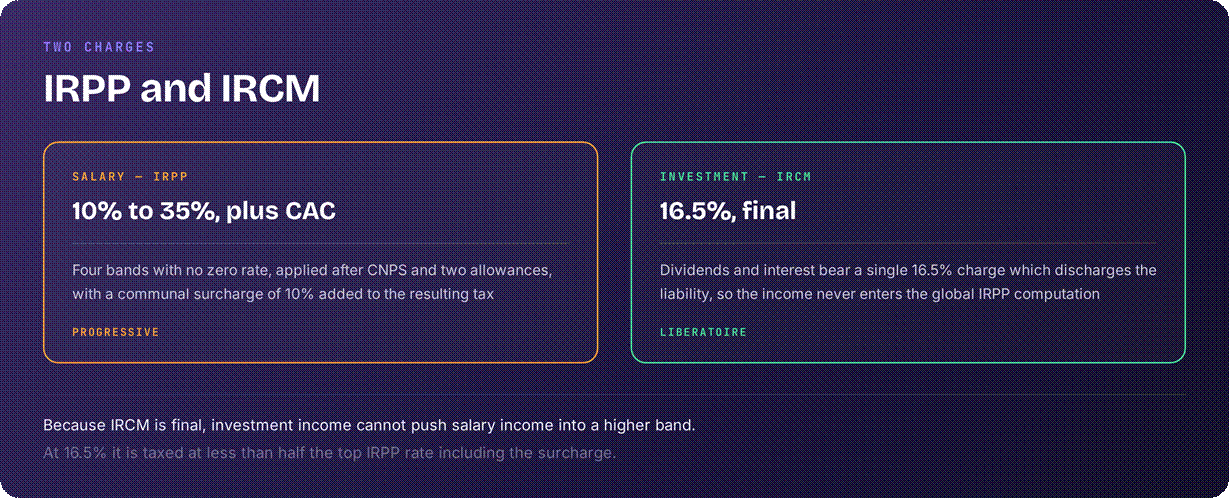
Two charges, two very different bases.
What makes Cameroon workable
Despite the absence of a zero band, the position is more moderate than the 38.5% ceiling suggests:
• A 30% professional expenses allowance, capped at FCFA 3,000,000 a year;
• A further fixed abattement of FCFA 500,000 before the scale applies;
• CNPS deductible at 4.2% before the allowances;
• No withholding where monthly gross is below FCFA 62,000;
• A wide 10% band covering net taxable income to FCFA 2,000,000;
• IRCM at 16.5% and final, so investment income is taxed lightly and separately; and
• A *prélèvement libératoire* mechanism for employees, meaning generally no annual return where the employer withholds correctly.
The honest qualifications are that the CAC adds 10% to whatever the tax figure is, that 35% engages at FCFA 5,000,000 of net taxable income, and that published sources differ on the family parts arrangement and on the annual filing date — some give 15 March, others 30 June.
Case study: where the allowances land
A manager on FCFA 1,000,000 gross a month has FCFA 12,000,000 of annual gross. CNPS at 4.2% removes around FCFA 504,000. The 30% professional allowance and the FCFA 500,000 abattement come off next.
The scale then applies to what remains — a figure meaningfully below the gross. The 10% band absorbs the first FCFA 2,000,000, the 15% and 25% bands the next tranches, and only the balance reaches 35%.
Applying 35% to the gross would give a wildly different answer. In Cameroon the deductions do a great deal of work, and any comparison against another country should be run on net taxable income rather than on headline rates.
Filing and the compliance calendar
The framework sits in Articles 24 to 82 of the Code Général des Impôts, updated each year by the Loi de Finances. The employer calculates, withholds and remits IRPP and CNPS monthly, with withholding on the 15th of the month.
Because the mechanism operates as a *prélèvement libératoire* for employees, there is generally no annual return to file where the employer has withheld correctly. Penalties for late filing run at 25% of the amount due plus monthly interest.
Prepare in good time:
• Registration with the Direction Générale des Impôts;
• Payroll records showing CNPS and both allowances applied;
• Confirmation that CAC has been added on the tax, not the income;
• Separate records of dividend and interest income;
• Confirmation of the current filing date with the DGI; and
• Evidence of family circumstances, if claiming parts.
Deduct before you apply the scale
Consider:
• That there is no zero band — 10% starts immediately;
• That CNPS, the 30% allowance and the FCFA 500,000 abattement all come off first;
• That applying the scale to gross overstates the tax substantially;
• That CAC adds 10% of the tax figure on top;
• That the effective ceiling is therefore 38.5%, not 35%;
• That IRCM at 16.5% keeps investment income out of the scale; and
• That the filing date differs between sources and needs confirming.
Your Cameroon checklist
1. Deduct CNPS at 4.2% from gross first;
2. Apply the 30% professional allowance, capped at FCFA 3,000,000;
3. Deduct the fixed FCFA 500,000 abattement;
4. Apply the four-band scale to what remains;
5. Add CAC at 10% of the IRPP figure;
6. Note the effective ceiling is 38.5%, not 35%;
7. Keep dividend and interest income separate under IRCM;
8. Note no withholding below FCFA 62,000 a month;
9. Confirm the annual filing date with the DGI; and
10. Expect no annual return if the employer withholds correctly.
Frequently asked questions
What are the Cameroonian IRPP rates?
10% on net taxable income to FCFA 2,000,000, 15% to FCFA 3,000,000, 25% to FCFA 5,000,000 and 35% above. There is no zero band — the 10% applies from the first franc of net taxable income.
What is the CAC?
The Centimes Additionnels Communaux, a surcharge of 10% calculated on the IRPP payable rather than on income, for the benefit of local authorities. It lifts the effective maximum rate from 35% to 38.5%.
What deductions apply before the scale?
Employee CNPS contributions at 4.2%, a professional expenses allowance of 30% of gross salary capped at FCFA 3,000,000 a year, and a fixed abattement of FCFA 500,000.
What is the most common mistake?
Applying the scale to gross salary without first deducting CNPS and the allowances. That overstates the tax substantially, because the deductions do a great deal of work in Cameroon.
How are dividends taxed?
Through the IRCM at a single rate of 16.5%, made up of 15% plus 1.5% CAC. It is libératoire, so the income is discharged in full and never enters the global IRPP computation.
Is there a threshold below which nothing is withheld?
Yes. No withholding at source applies where monthly gross salary is below FCFA 62,000.
Do I need to file an annual return?
Generally not, if you are an employee and your employer withholds correctly. The mechanism operates as a prélèvement libératoire for employees. Penalties for late filing where required run at 25% plus monthly interest.
What should I confirm before relying on a figure?
The family parts arrangement and the annual filing date, both of which differ between published sources — some give 15 March and others 30 June. The band structure and allowances are well established.
Official sources and further reading
• Direction Générale des Impôts, Cameroun
Important information
This article is general information and does not constitute tax, legal, immigration or financial advice, and does not create a client relationship. Tax outcomes depend on travel history, income sources, treaty status and the law applying to the relevant year. Rates, thresholds and regimes change, and some measures described may be proposed rather than enacted; this article reflects our understanding as at the date of publication. Obtain advice from a suitably qualified professional before acting or refraining from action.
