
Several jurisdictions advertise 0% and then charge income under another name. Cayman does not. There is no income tax and no payroll tax equivalent — the constraint lies somewhere else entirely.
Cayman levies no personal income tax on salary and employment income, freelance and self-employed earnings, dividends and interest, rental income, pension income, royalties, capital gains or foreign-source income. There is no annual personal return and no advance instalments.
That distinction is worth drawing carefully, because it separates Cayman from jurisdictions that claim the same thing. Bermuda, for instance, also has no personal income tax but levies a payroll tax whose employee portion is graduated by income band and withheld from pay, which is an income tax in substance.
Cayman has no equivalent. There is no payroll tax on individuals, no social insurance percentage on earnings taking its place, and no graduated charge operating under another label. The zero is a genuine zero.
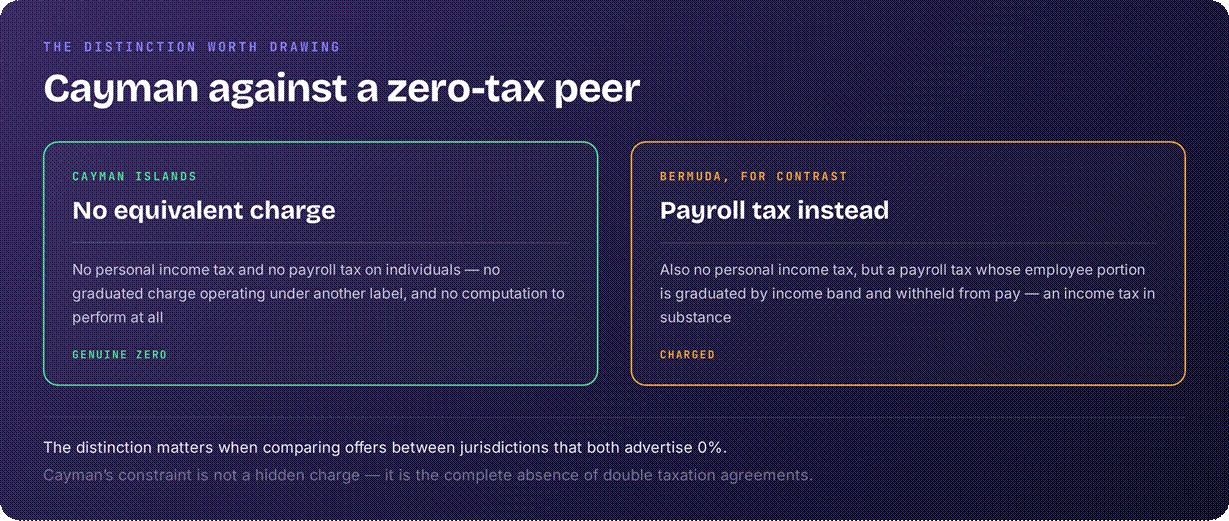
Two jurisdictions that both advertise 0%.
What the absence covers
Every category of personal income sits outside the charge, and there is no computation to perform:
• Salary and employment income;
• Freelance and self-employed earnings;
• Dividends and interest;
• Rental income;
• Pension income;
• Royalties;
• Capital gains; and
• Foreign-source income of any kind.
There is no wealth tax, no gift tax and no inheritance tax. You will not normally calculate a Cayman liability on your worldwide income at all.
Where the revenue comes from instead
Charge | Applies to you in Cayman? |
Personal income tax | No — on local and foreign income alike |
Capital gains tax | No |
Wealth, gift and inheritance tax | No |
Payroll tax on individuals | No — unlike some zero-tax peers |
Personal income tax return | None required |
Import duty | Yes, on many imported goods |
Stamp duty | Yes, on property transfers |
Foreign withholding | Can apply at source, on income from abroad |
Because the revenue base is indirect, it falls on consumption and transactions rather than on earnings. The practical effect is that the tax position does not vary with how much you earn — it varies with what you buy and what property you transfer.
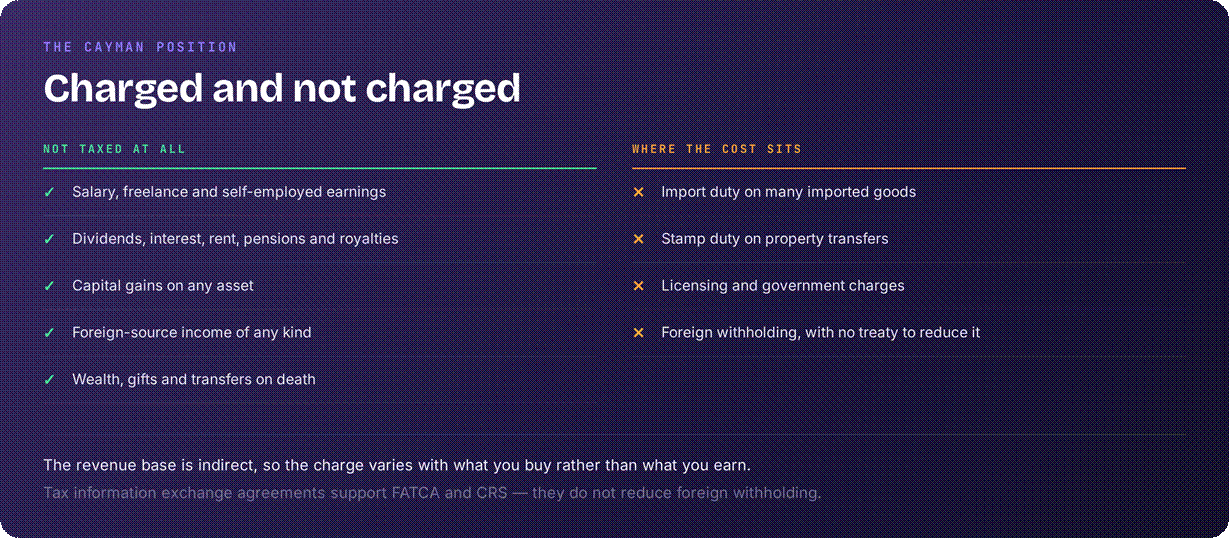
What is charged, and where the constraint lies.
No treaties at all — and why that matters
This is the part that most deserves attention, and it is easy to dismiss. At first it seems unimportant that Cayman has no double taxation agreements, because Cayman does not tax your income anyway.
But treaties are most valuable precisely when income originates elsewhere. A treaty allocates taxing rights between two states, limits withholding on dividends, interest and royalties, provides a residence tie-breaker, and gives a mechanism for resolving disputes. With no agreements in place, none of that is available.
In practice that means:
• A source country may withhold tax on dividends paid to you, at its full domestic rate;
• A foreign pension provider may apply withholding under its own rules;
• Interest or royalty income may be taxed before payment reaches you;
• A former country may not accept that you have become resident elsewhere; and
• There is no Cayman tax to credit against any of it, because none was charged.
Cayman does maintain a network of tax information exchange agreements, administered by the Department for International Tax Cooperation, supporting FATCA and the Common Reporting Standard. Those share financial account information. They are not double taxation treaties and they do not reduce foreign withholding.
Case study: Felicity’s pension
Felicity retires to Cayman from the United Kingdom and draws a UK pension. Her Cayman income tax liability is nil genuinely so, with no payroll tax or equivalent charge behind it.
The UK may still apply tax or withholding to that pension, depending on the type of pension and her UK residence position. Because Cayman has no double taxation agreements, she cannot rely on a treaty to reduce that withholding or to resolve a residence dispute.
Her Cayman position is the simplest it could be. Her overall position is decided almost entirely by UK law. That is the correct way round to think about a zero-tax jurisdiction with no treaty network.
What makes Cayman attractive
For the right income profile the case is about as clean as it gets:
• No personal income tax on any category, local or foreign;
• No payroll tax or equivalent operating under another name;
• No capital gains, wealth, gift or inheritance tax;
• No annual return and no advance instalments: local compliance is genuinely nil;
• A revenue base built on consumption and transactions, so the charge does not scale with income;
• A large and well-developed financial services sector; and
• The KYD pegged to the US dollar, giving stability against dollar income.
The honest qualification is the treaty position. For someone whose income arises in Cayman or from sources that do not withhold, the zero is complete. For someone drawing a foreign pension, foreign dividends or royalties, the source country decides most of the outcome and Cayman offers no instrument to influence it.
Filing and the compliance calendar
There is nothing to file for personal income tax purposes — no annual return, no advance instalments and no registration. Local personal compliance is genuinely nil.
What you should still maintain:
• A schedule of every income stream by source country;
• Details of each employer, client, bank, investment, pension and property interest;
• Records of any withholding applied at source;
• Evidence of your residence position, for a former country’s tests;
• Documentation for FATCA and Common Reporting Standard purposes; and
• Filings made in any other country.
Map the sources, not the rate
Consider:
• That the zero is genuine — there is no payroll tax equivalent;
• That no category of personal income is charged;
• That there is no return and no instalments;
• That revenue comes from import duty, stamp duty and licensing;
• That Cayman has no double taxation agreements at all;
• That tax information exchange agreements are not treaties; and
• That the countries your income comes from decide most of the outcome.
Your Cayman Islands checklist
1. Note the zero is genuine, with no payroll tax equivalent;
2. Confirm no category of personal income is charged;
3. Expect no return, no instalments and no registration;
4. Budget for import duty and stamp duty instead;
5. Map every income stream by source country;
6. Check withholding rates in each of those countries;
7. Do not expect a treaty to reduce them — there are none;
8. Distinguish exchange agreements from double tax treaties;
9. Establish whether a former country still claims you; and
10. Keep records for FATCA and CRS purposes.
Frequently asked questions
Does Cayman really charge no income tax?
Yes, and unusually the zero is genuine. There is no personal income tax on any category of income and unlike some zero-tax peers, no payroll tax or equivalent charge operating under another name.
How does that differ from Bermuda?
Bermuda also has no personal income tax, but levies a payroll tax whose employee portion is graduated by income band and withheld from pay. That functions as an income tax on employment earnings. Cayman has no such charge.
Where does government revenue come from?
Largely from import duties, stamp duty on property transfers, work-permit fees and licensing charges. The base is indirect, so the cost varies with what you buy and transfer rather than what you earn.
Do I file a Cayman tax return?
No. There is no annual personal income tax return, no advance instalments and no registration requirement. Local personal compliance is genuinely nil.
Why do the missing treaties matter?
Because treaties are most valuable when income originates elsewhere. With no double taxation agreements, a source country may withhold at its full domestic rate, you have no residence tie-breaker, and there is no Cayman tax to credit against the charge.
What about the exchange agreements?
Cayman maintains tax information exchange agreements administered by the Department for International Tax Cooperation, supporting FATCA and the Common Reporting Standard. They share financial account information they are not double taxation treaties and do not reduce foreign withholding.
Who does Cayman suit best?
Someone whose income arises in Cayman, or from sources that do not withhold. For them the zero is complete. Someone drawing a foreign pension, foreign dividends or royalties will find the source country decides most of the outcome.
What should I prepare before moving?
A schedule of every income stream by source country, showing each employer, client, bank, investment, pension and property interest, together with the country that may tax the payment and at what rate.
Official sources and further reading
Important information
This article is general information and does not constitute tax, legal, immigration or financial advice, and does not create a client relationship. Tax outcomes depend on travel history, income sources, treaty status and the law applying to the relevant year. Rates, thresholds and regimes change, and some measures described may be proposed rather than enacted; this article reflects our understanding as at the date of publication. Obtain advice from a suitably qualified professional before acting or refraining from action.
