
If you teach in China, work remotely from Shanghai, or spend most of the year in mainland China while receiving income from overseas, one question deserves your attention: when does China begin taxing your foreign income?
China follows a residence-based model. Chinese tax residents may be taxed on worldwide income, while non-residents are generally taxed only on China-source income. But a special rule applies to non-domiciled individuals: foreign-source income may remain outside the Chinese net for a six-year period.
⚠️ Why this matters now. The six-year rule took effect on 1 January 2019, and the count began from that year. That makes the earliest sixth qualifying year 2024 — so the first years in which worldwide taxation can actually bite under this rule have only recently arrived. If you have been in China since 2019 without a qualifying break, this is not a theoretical question.
First, establish whether you are a China tax resident
Your residency status determines whether China looks only at your China-source income or also considers income connected with other countries. You may be treated as a China tax resident if you are present in China for 183 days or more during the calendar year, or if you are considered domiciled in China. The tax year follows the calendar year.
🔄 On the day count. A day generally counts toward the 183-day threshold only where you are physically present for a full 24 hours, so days of arrival and departure may not count. Do not plan to sit just under a number you have seen quoted online — immigration records, entry and exit times, treaty position and local tax bureau practice can all bear on the outcome.
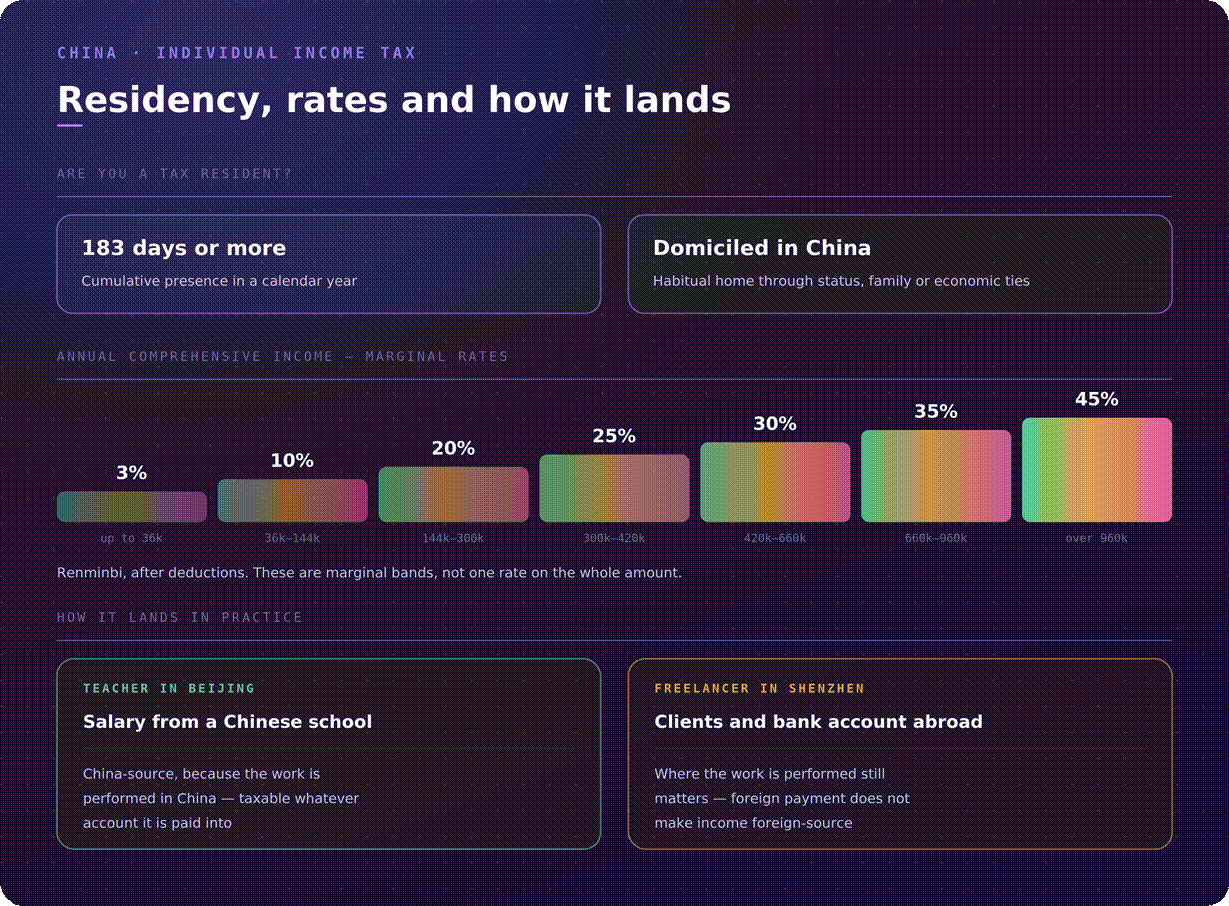
Residency, the rate bands, and how source works in practice.
What does "domiciled" mean?
Domicile is not the same as holding a residence permission or renting an apartment. It concerns whether China is treated as your habitual or permanent home because of your legal status, family connections or economic ties.
Chinese nationals are generally treated as domiciled in China. Foreign nationals, including many expat teachers, are more often assessed on physical presence and non-domiciled status. If you are domiciled in China, the six-year rule may not protect your foreign income in the same way — so settle your domicile position before counting days.
How the six-year rule actually works
The rule is set out in guidance issued jointly by the Ministry of Finance and the State Taxation Administration in 2019, dealing with how the residence period of individuals without domicile in China is determined. It allows certain foreign-source income to sit outside Chinese individual income tax during the qualifying period.
What the rule looks at | How it works |
Who it applies to | Individuals without domicile in China |
What counts as a year | A calendar year with 183 days or more of presence |
How many years | Six consecutive qualifying years |
What resets the count | A single absence of more than 30 consecutive days |
What also breaks it | Any year with fewer than 183 days of presence |
When it bites | From the seventh year, if you still meet the threshold |
What it does not cover | China-source income, which is taxable throughout |
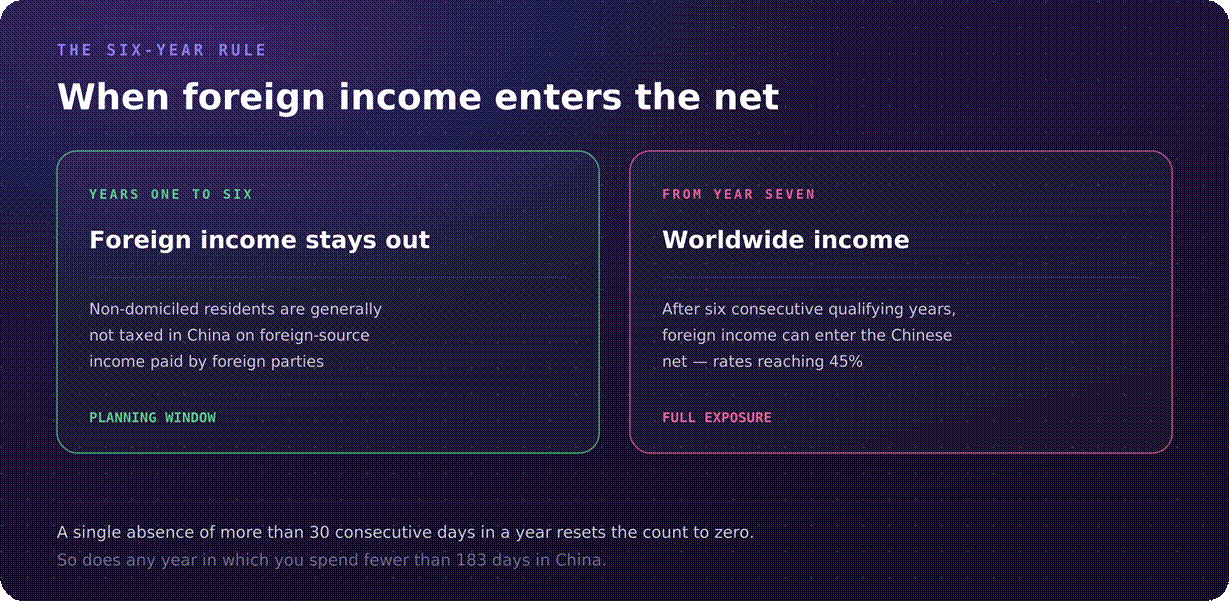
One trip of more than 30 consecutive days resets the clock entirely.
The reset is the planning lever. A single continuous absence of more than 30 days in a tax year resets the count to zero, and you begin accumulating again. This is deliberate, and it is why long-term residents often structure an extended trip home. It has to be one continuous absence, not thirty days added up across the year.
Keep complete travel records rather than relying on memory or permission validity dates. Border movements, passport stamps, airline records, residence registrations and employer travel data may all be relevant if your history is reviewed.
What happens after six qualifying years?
Once you complete six consecutive qualifying years, foreign-source income may become taxable in China from the following year, if you continue to meet the residence conditions.
This is the point most often missed by long-term expat teachers. Someone may arrive expecting that foreign savings, investment income or overseas freelance income will stay outside the Chinese system indefinitely. The rule is not an unlimited exemption; it is a time-limited planning framework.
Case study: Mark, an international school teacher
Mark begins teaching in Beijing in January. His salary is paid by a Chinese school, and he also receives dividends from an investment account in the United Kingdom. He spends more than 183 days in China during the year.
His teaching salary is China-source employment income because the work is physically performed in China. It falls within the scope of Chinese taxation regardless of whether part of the salary is paid into a foreign bank account.
His foreign dividends need separate analysis. If Mark is non-domiciled and has not completed six consecutive qualifying years, that income may benefit from the regime, subject to the applicable rules and reporting requirements. If the dividends are connected with a China entity, or otherwise fall within a China-source category, the result may differ.
Consider how your work is performed, not only where you are paid
Remote workers often ask why China would tax income from a client in Canada or the United Kingdom. The answer usually turns on where the work is performed. Income from services carried out while you are physically in China may be treated differently from income generated through activities performed outside it.
The costliest assumption. Payment by an overseas platform, client or employer does not by itself make income foreign-source. For an online teacher, consultant, designer or freelance writer, the place where the services are carried out can be decisive.
Case study: Felicity, a remote freelancer
Felicity lives in Shenzhen and provides marketing services to clients in Australia and Ireland. Each client pays her directly into an Australian account. She has exceeded the residence threshold and is non-domiciled.
She may believe all of her income is foreign because the clients and bank account are overseas. But the work is performed while she is in China, which affects the source analysis. She should document where each service was performed, where clients are located, which entity contracted with her, whether any China entity bears the cost, and how the income should be classified under Chinese rules and any applicable treaty.
Know the rates
China applies progressive rates to annual comprehensive income, running from 3% up to a top marginal rate of 45%. Your effective rate depends on your taxable income, deductions, income category and available reliefs.
These are marginal bands, not a single rate applied to every yuan. Salary, professional services, dividends, rental income, capital gains and other categories may each be treated differently, so classify your income before estimating any liability. A teacher on a salary, a freelancer earning service income and an investor receiving dividends will each face different calculation and reporting requirements.
A separate short-stay exemption may also be relevant: where you are employed by an overseas employer with no permanent establishment in China and spend no more than 90 days in China in a calendar year, that foreign-employer income may be exempt. Under many treaties that threshold extends to 183 days.
Use the treaty network
China has concluded double taxation agreements with well over 100 jurisdictions, which makes its treaty network highly relevant to international workers and investors.
A treaty allocates taxing rights between two jurisdictions and may provide relief where the same income could otherwise be taxed twice. It can affect the definition of tax residence, the calculation of days of presence, employment income, independent personal services, foreign tax credits, pension and investment income, and the process for claiming relief.
Do not assume a treaty eliminates Chinese tax. More often it determines which country may tax first, and how double taxation is relieved. Claiming benefits generally requires you to self-assess eligibility, report it correctly and retain supporting records.
Filing and advance payments
The tax year is the calendar year, and the annual reconciliation filing deadline is 30 June following it. Advance payments may also be required, particularly where tax is not fully withheld at source or where you receive income outside a standard employer payroll system.
Prepare your records in good time, including:
• Monthly payslips and withholding certificates;
• Employment and contractor agreements;
• Foreign income statements;
• Dividend, interest and rental records;
• Foreign tax paid;
• Travel and entry-exit records;
• Evidence supporting deductions; and
• Documentation relevant to your domicile and treaty position.
Case study: Sarah, a long-term expat
Sarah has taught in Guangzhou for six consecutive years. She has remained in China for more than 183 days each year and has never taken a continuous absence long enough to reset her count. She also receives rental income from property in France.
She should not wait until the filing deadline to work out whether her foreign rental income has entered the Chinese net. She should reconstruct her residence history, review the six-year calculation, and assess the treaty position before preparing her return. The question is not simply whether she paid tax in France — it is whether China has acquired taxing rights, and whether foreign tax credit or treaty relief can apply.
Your China checklist
1. Count your China days for each calendar year, using reliable travel records;
2. Confirm whether you are non-domiciled under the relevant rules;
3. Map the six-year timeline, including any qualifying absence;
4. Classify each income stream as employment, services, dividends, rent, gains or another category;
5. Identify where the work was physically performed;
6. Check whether a China entity pays or bears the income;
7. Review the relevant treaty if another country is involved;
8. Prepare for the 30 June filing deadline;
9. Check whether advance payments or additional registrations apply; and
10. Take specialist advice before relying on the foreign income rule.
Frequently asked questions
Is the threshold 183 days or 181 days?
183 days of cumulative presence in the calendar year. A day generally counts only where you are present for a full 24 hours, so arrival and departure days may not count — which is why the number sometimes gets quoted differently.
How exactly do I reset the six-year count?
By leaving China for more than 30 consecutive days at once during a tax year. It must be a single continuous absence; thirty days accumulated across several trips will not do it. A year in which you spend fewer than 183 days in China also breaks the sequence.
Does the rule mean all my foreign income is tax-free for six years?
No. It concerns foreign-source income paid by foreign parties. China-source income is taxable throughout, and income connected with a China entity or borne by one may fall outside the relief even if it looks foreign.
I work remotely for an overseas client. Is that foreign income?
Not necessarily. Where you physically perform the work carries significant weight, so services carried out from China may be China-source even though the client, platform and bank account are all abroad. This is the most common and most expensive misreading of the rules.
Does the six-year rule apply to Chinese nationals?
Generally not. It is for individuals without domicile in China, and Chinese nationals are usually treated as domiciled. Domicile turns on where your habitual home is, judged by status, family and economic ties, rather than on permissions or tenancies.
What is the 90-day rule I keep reading about?
A separate short-stay exemption. Where you are employed by an overseas employer with no permanent establishment in China and spend no more than 90 days there in a calendar year, that income may be exempt — extended to 183 days under many treaties. It is different from the six-year rule.
When is the filing deadline?
The annual reconciliation for comprehensive income runs to 30 June following the end of the calendar year. Advance payments may be required during the year, particularly where tax is not fully withheld at source.
Will a treaty stop China taxing me?
Usually it decides which country taxes first and how relief is given, rather than removing Chinese tax. You generally need to self-assess eligibility, report the claim and keep supporting documentation.
Official sources and further reading
• State Taxation Administration (STA)
• STA guidance on claiming tax treaty benefits
• STA guidance on double taxation agreements and the treaty network
Important information
This article is general information and does not constitute tax, legal, immigration or financial advice, and does not create a client relationship. Tax outcomes depend on travel history, income sources, treaty status and the law applying to the relevant year. Rates, thresholds and regimes change, and some measures described may be proposed rather than enacted; this article reflects our understanding as at the date of publication. Obtain advice from a suitably qualified professional before acting or refraining from action.
