
Colombia counts 183 days across any rolling twelve months rather than a calendar year. Where those days straddle a year end, residence begins in the second year — and worldwide taxation begins with it.
Medellín and Bogotá have absorbed a substantial share of the remote-working population over the last few years, and the tax question that follows most of them is the same: when exactly does Colombia start taxing everything?
The answer turns on a rolling count. You become a Colombian tax resident by remaining in the country, continuously or not, for more than 183 days within any 365-day period. It is not a calendar-year test, which means an arrival in September can produce residence the following year on a pattern that never looks like 183 days in either one.
Once resident, you are taxed on worldwide income and worldwide assets. There is no transitional window, no remittance basis and no incoming-resident regime. Colombia moves you from Colombian-source only to everything, in a single step.
Two details most guides miss. Where the 183 days fall across two consecutive years, residence arises in the second of them — so the trigger year is often not the year you arrived. And Colombian nationals face several additional residence limbs that operate regardless of how little time they spend in the country.
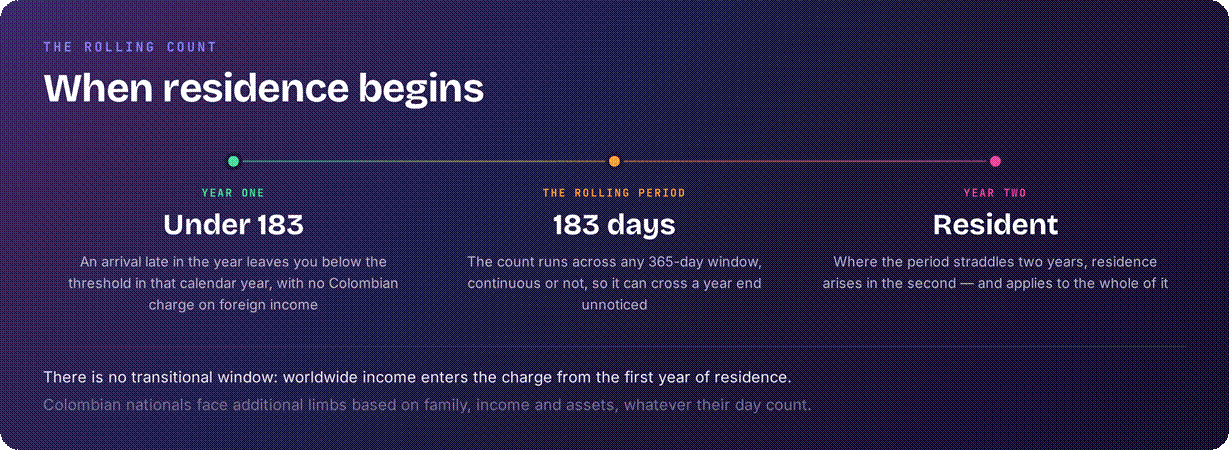
The trigger year is often not the year you arrived.
Your residency status is the first step
The basic test is 183 days, continuous or not, in any 365-day period. Where that period spans two tax years, the individual is treated as resident from the second year.
For Colombian nationals living abroad, residence can also arise where their spouse or dependent children are resident in Colombia; where 50% or more of their income is Colombian-source; where 50% or more of their assets are managed in Colombia; where 50% or more of their assets are physically located in Colombia; where the tax authority requests proof of residence elsewhere and it is not supplied; or where they are resident in a jurisdiction Colombia treats as a tax haven. For those limbs, time spent in Colombia is irrelevant.
Maintain accurate records of:
• Arrival and departure dates across rolling 365-day periods, not calendar years;
• The date the 183rd day falls, and which tax year it lands in;
• Where your spouse and dependent children are resident;
• The proportion of your income that is Colombian-source;
• The location and management of your assets; and
• Proof of tax residence in another country, if you have it.
What changes when you become resident
Position | What Colombia taxes |
Non-resident | Colombian-source income only, at a flat 35% |
Resident | Worldwide income and worldwide assets |
Residence trigger | More than 183 days in any 365-day period |
Straddling two years | Residence arises in the second year |
Transitional relief | None — there is no incoming-resident regime |
Resident rates | Progressive, reaching 39% |
Occasional gains | Generally 15% |
Wealth tax | On net worth above a high UVT threshold |
The absence of a transitional window is the point. Chile gives three years, New Zealand four, Uruguay eleven. Colombia gives nothing the day you become resident, your foreign portfolio, foreign rent and foreign pension enter the Colombian base in full.
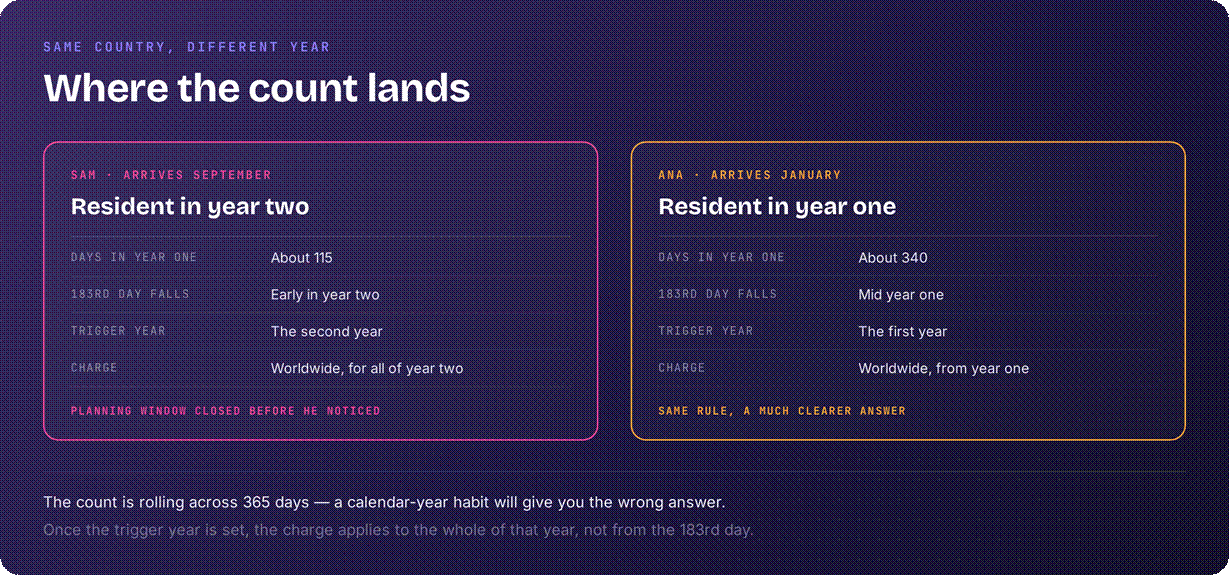
Two arrivals, four months apart, in different tax years.
How the rates work
Colombia uses a cédular system, splitting income into schedules — general income, pensions and dividends — each with its own treatment, and expresses thresholds in UVT, a tax value unit revalued annually by DIAN. Because the thresholds move every year, any figure quoted in pesos dates quickly.
The general schedule runs from nil on the first band up through 19%, 28%, 33%, 35% and 37% to a top rate of 39%. Non-residents pay a flat 35% on Colombian-source income, generally collected by withholding at source.
That flat 35% is worth noting carefully. For someone with substantial foreign income and modest Colombian income, non-residence can be the better outcome even at a higher headline rate, because the base is so much narrower.
What happened to the 2026 reform
A tax reform package was put to Congress and rejected on 9 December 2025, so the rates and thresholds described here continue unchanged. The government subsequently introduced an emergency equity measure by decree in 2026, but it applies to Colombian legal entities rather than to individual taxpayers.
Colombia legislates on tax frequently, and reform proposals surface most years. Any plan built on a specific rate should be re-checked rather than assumed to hold for the duration of a stay.
Case study: Sam arrives in September
Sam moves to Medellín in early September and stays. By the end of December he has spent around 115 days in Colombia — comfortably under 183 in that calendar year, and he files nothing.
By early March the following year his rolling count passes 183 days. Because the 365-day period straddles two tax years, he becomes resident in the second year — and for the whole of it, not from March onwards. His foreign income for that entire year is within the Colombian charge.
Sam’s error was counting calendar years. The trigger was set before the second year began, and by the time he noticed, the planning opportunity had gone.
Filing and the compliance calendar
The Colombian tax year follows the calendar year. Annual returns are filed to a schedule set by the last digits of your NIT tax identification number, generally running from August into October, so two taxpayers have different deadlines in the same year.
Residents must also report foreign assets above a threshold in a separate declaration. Prepare in good time:
• NIT registration and RUT enrolment;
• Day-count records on a rolling basis;
• Foreign income statements by category, for the cédular schedules;
• A full inventory of foreign assets and their values;
• Evidence of foreign tax paid, for credit purposes; and
• Your filing date under the NIT calendar.
Timing is the whole of the planning
Model your position before you settle, considering:
• When your rolling 183rd day will fall, and in which tax year;
• Whether adjusting travel in the first year changes the trigger year;
• Whether foreign gains should be realised before residence begins;
• Whether non-residence at a flat 35% on a narrow base suits you better;
• Whether any additional limb applies to you as a Colombian national;
• What your foreign asset reporting obligation will look like; and
• Whether a treaty exists with your other country, since the network is limited.
Your Colombia checklist
1. Count days across rolling 365-day periods, never by calendar year;
2. Work out the date your 183rd day falls and which tax year it lands in;
3. Check whether adjusting first-year travel changes the trigger year;
4. Assume no transitional relief — worldwide income applies immediately;
5. Realise foreign gains before residence begins if that suits you;
6. Compare resident treatment against flat 35% non-resident treatment;
7. Check the additional limbs if you are a Colombian national;
8. Inventory foreign assets for the separate reporting obligation;
9. Find your filing date under the NIT calendar; and
10. Re-check the rates, since Colombia legislates on tax frequently.
Frequently asked questions
How does Colombia count the 183 days?
Across any 365-day period, continuous or not — not by calendar year. That rolling basis is what makes an arrival late in the year produce residence the following year.
If my days straddle two years, when does residence start?
In the second year, and for the whole of it. The charge does not begin on the 183rd day — once that year is the trigger year, worldwide income for the entire year is within the Colombian base.
Is there any transitional relief for new residents?
None. Colombia has no incoming-resident regime, no remittance basis and no exemption window. Foreign income enters the charge from the first year of residence in full.
What are the rates?
The general schedule runs progressively to a top rate of 39%, with thresholds expressed in UVT and revalued annually. Non-residents pay a flat 35% on Colombian-source income.
Could being non-resident be better?
Sometimes. A flat 35% on Colombian-source income only can beat progressive rates on worldwide income where your foreign income is substantial and your Colombian income is modest. It is worth modelling rather than assuming residence is preferable.
Do Colombian nationals face different rules?
Yes. Several additional limbs can make a Colombian national resident regardless of days spent in the country — family resident in Colombia, 50% or more of income Colombian-source, 50% or more of assets managed or located there, failure to prove residence elsewhere, or residence in a tax haven.
Did the 2026 tax reform change anything for individuals?
The reform package was rejected by Congress on 9 December 2025, so rates remain unchanged. A later emergency equity measure introduced by decree applies to Colombian legal entities, not to individuals.
When do I file?
The tax year follows the calendar year, and the annual return is due on a date set by the last digits of your NIT, generally running from August into October. Two taxpayers can have very different deadlines in the same year.
Official sources and further reading
• Dirección de Impuestos y Aduanas Nacionales (DIAN)
Important information
This article is general information and does not constitute tax, legal, immigration or financial advice, and does not create a client relationship. Tax outcomes depend on travel history, income sources, treaty status and the law applying to the relevant year. Rates, thresholds and regimes change, and some measures described may be proposed rather than enacted; this article reflects our understanding as at the date of publication. Obtain advice from a suitably qualified professional before acting or refraining from action.
