
Costa Rica taxes income from Costa Rican sources and leaves everything else alone. The question that decides your position is not where your clients are — it is where you were sitting when you did the work.
Costa Rica is one of the clearest territorial systems in the Americas. Income tax under Ley 7092, as amended by Ley 9635, reaches income from a Costa Rican source and nothing else. A foreign pension, a portfolio of overseas shares, rent from a flat in another country — none of it enters the Costa Rican base, and that is true whether or not you are resident.
That simplicity is why so many retirees and remote workers land here. It also produces a false sense of security, because the definition of what counts as Costa Rican-source is broader than most arrivals assume.
Income is Costa Rican-source where it derives from assets used, goods located, or services rendered within Costa Rican territory. That last limb is the one that matters for anyone working from a laptop in Tamarindo.
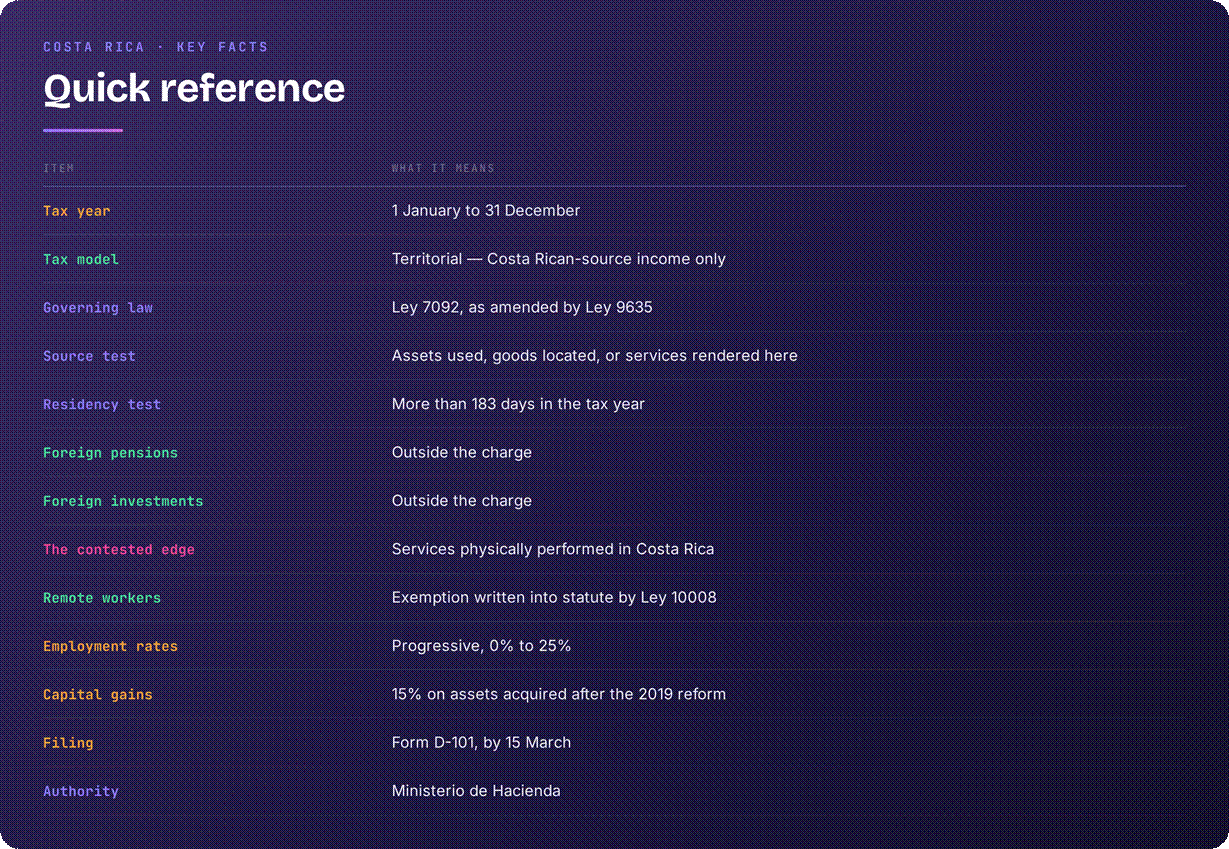
The Costa Rican position at a glance.
Your residency status is the first step
You generally become Costa Rican tax resident by being present in the country for more than 183 days in the tax year, whether continuously or in separate periods. Costa Rica does not layer on the ties-based tests that countries like Canada and the UK apply, which makes the residence question unusually simple to answer.
What residence does not do here is change what Costa Rica taxes. Under a territorial system, crossing the residence threshold does not bring your foreign income into charge. Residence affects filing obligations, rates and reliefs rather than the scope of the tax.
Maintain accurate records of:
• Arrival and departure dates within each tax year;
• Workdays physically performed inside Costa Rica;
• Where clients are located and where the work was actually done;
• Contracts and invoices showing the place of performance;
• Any Costa Rican assets generating income; and
• Any other country that may also treat you as resident.
What territorial actually means
The test is the source of the income, not your status. Applied to a typical arrival, it produces a clean split:
Income | Costa Rican treatment |
Foreign pensions and social security | Outside the charge |
Dividends and interest from abroad | Outside the charge |
Rent from property outside Costa Rica | Outside the charge |
Gains on foreign assets | Outside the charge |
Salary from a Costa Rican employer | Costa Rican-source — taxable |
Rent from Costa Rican property | Costa Rican-source — taxable |
Services performed inside Costa Rica | Can be Costa Rican-source — take advice |
📍 Source is fact-sensitive. The location of your bank account does not determine the source of income, and the location of your client does not always determine where a service was rendered. For online work performed from Costa Rican soil, the analysis needs advice rather than an assumption.

The difference is where the income is generated, not where the client is.
The statutory exemption for remote workers
Costa Rica did something its neighbours did not. Ley 10008, referencing the income tax law, provides an express exemption for qualifying foreign-source income earned by holders of the remote-worker status. The law states that such income is not to be treated as Costa Rican-source for tax purposes.
The significance is legal rather than numerical. In most territorial jurisdictions, a remote worker relies on a general source rule and an accountant’s interpretation of it. Here the treatment is written into the enabling statute, which is a materially stronger position if the question is ever tested.
Rates on what Costa Rica does tax
Employment income is taxed on a progressive monthly scale running from 0% through 10%, 15% and 20% to 25% at the top. Self-employed and professional income is taxed on its own progressive scale, also reaching 25%, assessed annually on net income.
Capital gains are taxed at 15% on assets acquired after the 2019 reform took effect, with transitional treatment for assets held before then. Costa Rican-source dividends and interest are generally subject to a 15% final withholding. Bracket thresholds are adjusted periodically, so confirm the figures published for your year.
Case study: Diego and Sarah, same beach
Diego retired to Costa Rica on a United States pension and a dividend portfolio. Neither is Costa Rican-source, so neither enters the Costa Rican charge, and crossing 183 days changes nothing about that.
Sarah moved to the same town and freelances for agencies in Europe. Her clients are foreign, her invoices are in euros and her bank account is in Germany. But she performs the services sitting in Costa Rica, and that is the limb of the source rule that can bring her fees into charge.
The difference is not their income or their residence. Diego’s income is generated by assets located abroad; Sarah’s is generated by work performed here. That distinction is the whole of Costa Rican tax planning for foreign arrivals.
Filing and the compliance calendar
Since the 2019 reform aligned the tax year with the calendar, Costa Rica’s tax year runs 1 January to 31 December. The annual return — form D-101 — is filed by 15 March of the following year, through the tax administration’s online platform. Guidance written before the reform refers to an October-to-September year and a February deadline, and is out of date.
Most individuals whose only income is employment income taxed through payroll withholding do not need to file. Anyone with self-employment income, business income, Costa Rican rental income or professional fees generally does, and partial payments during the year may be required.
Prepare in good time:
• A tax identification number and access to the online filing platform;
• Costa Rican income records by category;
• Invoices and contracts showing where services were performed;
• Records of days spent in and out of the country;
• Documentation of any remote-worker status relied on; and
• Evidence supporting the foreign source of income you have not declared.
Timing matters less here, place matters more
In most countries the planning question is when. In Costa Rica it is where. Model your position before you move, considering:
• Whether your income comes from assets abroad or from work you perform here;
• Whether any part of your work is performed on Costa Rican soil;
• Whether the statutory remote-worker exemption is available to you;
• Whether Costa Rican-source income will push you into a filing obligation;
• Whether your home country will release you from its own residence rules;
• Whether a treaty is in place, and Costa Rica’s network is narrow; and
• What documentation you would produce if the source of your income were questioned.
Your Costa Rica checklist
1. Separate income generated by foreign assets from income generated by your own work;
2. Identify any work physically performed on Costa Rican soil;
3. Track days in and out of the country across the calendar year;
4. Keep contracts and invoices that evidence the place of performance;
5. Check whether the statutory remote-worker exemption applies to you;
6. Identify any Costa Rican-source income that creates a filing obligation;
7. Confirm whether partial payments are required during the year;
8. Register for a tax identification number and online filing access;
9. Diarise the 15 March deadline for form D-101; and
10. Confirm whether your home country still treats you as resident.
Frequently asked questions
Does Costa Rica tax my foreign pension?
No. Under the territorial system, a pension paid from abroad is not Costa Rican-source income and does not enter the Costa Rican charge, regardless of how many days you spend in the country.
Does crossing 183 days change what I am taxed on?
No. Residence affects filing obligations, rates and reliefs, but it does not extend the scope of the tax to foreign income. This is the key structural difference between a territorial system and a worldwide one.
I work remotely for foreign clients. Is that foreign income?
Not necessarily. Income is Costa Rican-source where it derives from services rendered within Costa Rican territory, so work performed from Costa Rica can fall inside the charge even where the client and the payment are abroad. This is the point that needs advice.
What is the Ley 10008 exemption?
It provides an express statutory exemption for qualifying foreign-source income earned by holders of remote-worker status, stating that such income is not to be treated as Costa Rican-source. Most territorial countries leave this to inference, so the statutory basis is a stronger position.
When is the tax year, and when do I file?
The tax year follows the calendar year since the 2019 reform, and the annual return on form D-101 is filed by 15 March. Older guidance referring to an October-to-September year and a February deadline predates the change.
Do employees have to file a return?
Generally not, where the only income is employment income taxed through payroll withholding. Self-employment income, business income, Costa Rican rental income and professional fees usually create a filing obligation.
Is there capital gains tax?
Yes, at 15% on assets acquired after the 2019 reform took effect, with transitional treatment for assets held before then. Gains on assets located outside Costa Rica remain outside the charge under the territorial rule.
Does Costa Rica have many tax treaties?
Its network is narrow compared with larger economies, so relief from double taxation cannot be assumed. Where your home country taxes you on worldwide income, check what unilateral credit it offers rather than relying on a treaty existing.
Official sources and further reading
Important information
This article is general information and does not constitute tax, legal, immigration or financial advice, and does not create a client relationship. Tax outcomes depend on travel history, income sources, treaty status and the law applying to the relevant year. Rates, thresholds and regimes change, and some measures described may be proposed rather than enacted; this article reflects our understanding as at the date of publication. Obtain advice from a suitably qualified professional before acting or refraining from action.
