
Croatia offers one of the more useful statutory exemptions in the EU for remote workers from outside the EU, EEA and Switzerland. The benefit is real: qualifying foreign employment or self-employment income is exempt from Croatian personal income tax while you hold approved digital nomad status.
The exemption is written into the statute. Article 9(1)(26) of the Personal Income Tax Act exempts income from employment or activity performed for an employer not registered in Croatia, received on the basis of digital nomad status. This is not a grey area or an enforcement gap — and it holds even if you become Croatian tax resident.
What it does not do is make your income tax-free everywhere. Your home country, citizenship, residence position and income type can all still create obligations.
Who the exemption covers
The exemption attaches to digital nomad status. To hold it you must be a third-country national who works remotely through communication technology, for an employer or company registered outside Croatia or through your own foreign-registered company, and who does not perform work or provide services for Croatian employers or clients.
EU, EEA and Swiss citizens are outside this route — different registration and residence rules apply to them.
The stay can be granted for up to 18 months, though a shorter period may be granted. Where the initial grant is shorter, an extension of up to six further months may be available if applied for no later than 60 days before the existing permission expires. A fresh application can generally be made six months after a previous qualifying stay expires.
What the exemption covers
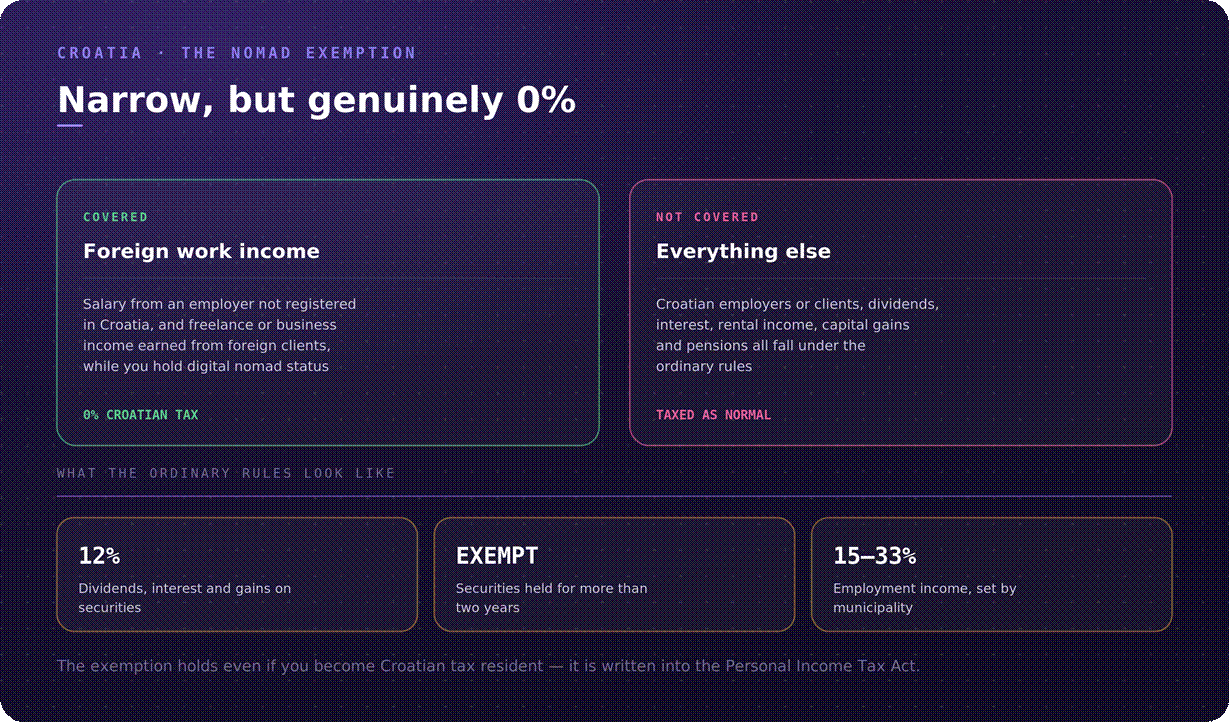
Deliberately narrow — earned income from foreign remote work only.
Qualifying income may include salary from a foreign employer, freelance or professional income from foreign clients, and business income earned through a foreign-registered company depending on how your work is structured.
Income | Croatian treatment |
Foreign work income under nomad status | Exempt from Croatian income tax |
Employment or business income generally | 15% to 33%, depending on your municipality |
Dividends, interest and securities gains | 12% |
Securities held more than two years | Exempt |
Rental income | 12%, after a notional expense deduction |
Croatian clients or employers | Outside the exemption, and outside the permit terms |
The boundary matters more than the headline. Dividends, interest, rental income, capital gains and pensions all fall outside the exemption. If you take dividends from your own company, or hold a securities portfolio, those sit under the ordinary rules once you are resident — and the ordinary rules are where most of the planning work actually is.
If you begin working for Croatian clients, that activity falls outside the exemption and may also breach the conditions of your stay. Keep client and employer records organised, particularly if your business serves customers in several countries.
Case study: Felicity's foreign employment income
Felicity is employed by a company registered in the United Kingdom. She moves to Croatia under the digital nomad regime and keeps working remotely for that employer.
Provided she maintains approved status and does not work for Croatian employers or clients, her employment income may be exempt from Croatian personal income tax. That does not remove her UK obligations — the UK may continue to assess her depending on residence, payroll arrangements, workdays and the treaty position. Both countries need reviewing before she moves.
Residency is a separate question
Your permit and your tax residence are related but distinct, and Croatia has two independent residency triggers — one of which needs no physical presence at all.
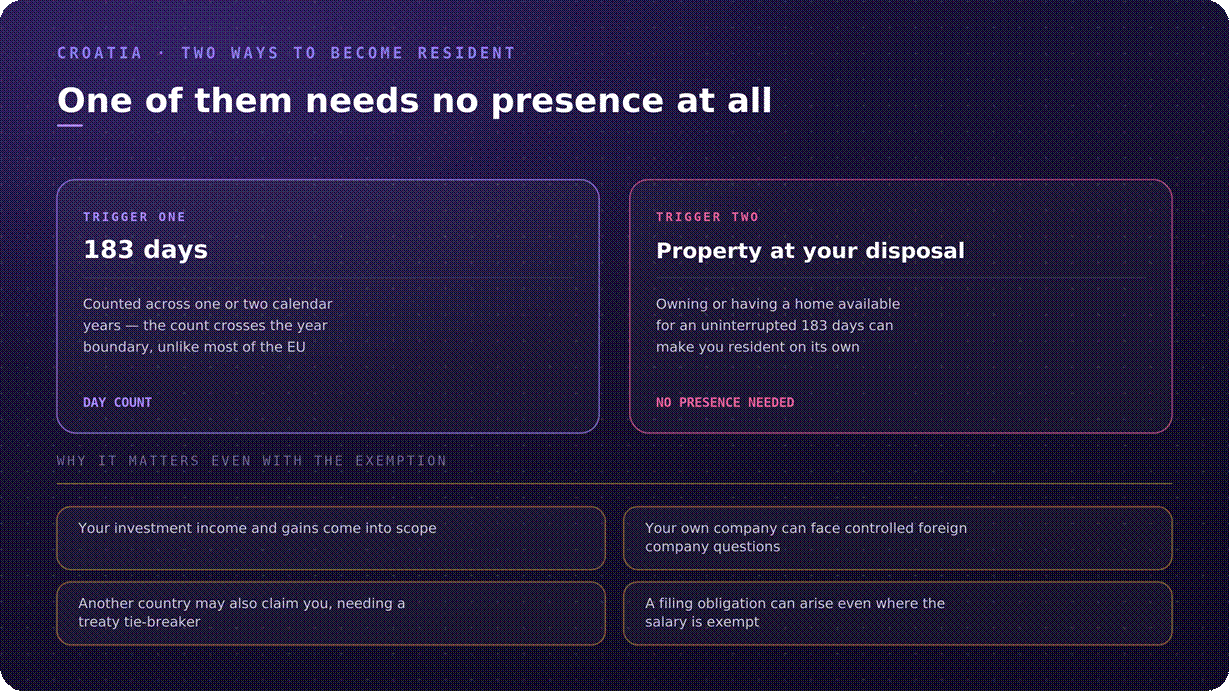
Either trigger alone is enough.
Two features to watch. The day count runs across one or two calendar years rather than resetting at New Year, so a stay straddling the year end can pass 183 days without either year looking problematic on its own. And owning or having a home at your disposal in Croatia for an uninterrupted 183 days can make you resident without you being there.
Becoming resident does not remove the nomad exemption on your foreign work income. It does bring everything else into scope: your investment income and gains, your own company under controlled foreign company rules, and the possibility that another country also claims you and a treaty tie-breaker is needed. A filing obligation can arise even where the salary itself is exempt.
The wider Croatian system
It is worth knowing what the ordinary rules look like, because the exemption sits inside them rather than replacing them.
The municipal surtax was abolished in 2024 and replaced by locally set income tax rates within national bands — 15% to 23% on the lower band and 25% to 33% on the upper, with the upper band beginning at €60,000 a year. Where a municipality has not set its own rates, defaults of 20% and 30% apply. Zagreb sits at or near the maximum. A basic personal allowance of €600 a month reduces the taxable base.
Capital income — dividends, interest and gains on securities — is taxed at 12%, having risen from 10% in 2024. Securities held for more than two years are exempt from the gains charge. Rental income is taxed at 12% after a notional expense deduction, and gains on real estate sold within two years are taxed at income tax rates.
▶️ New for 2026. Croatia introduced a five-year 100% income tax exemption on employment income for Croatian emigrants returning after at least two years abroad, extending also to Croatian citizens who never registered permanent residence. If you have a Croatian connection, this may be more valuable to you than the nomad route.
The annual return is due by the end of February following the tax year, and mandatory B2B e-invoicing began in January 2026 if you trade locally.
Your checklist
1. Confirm you are a third-country national and eligible for the permit at all;
2. Check the current financial threshold and the family uplift;
3. Confirm your employer or clients are all outside Croatia;
4. Track your days, remembering the count spans two calendar years;
5. Be careful about acquiring or holding property at your disposal in Croatia;
6. Identify which of your income falls outside the exemption;
7. Review controlled foreign company exposure if you own a company;
8. Check whether your home country still treats you as resident;
9. If you have a Croatian connection, compare the returning-emigrant exemption; and
10. Register your address within three days of arrival and diarise the permit expiry.
Frequently asked questions
Is my foreign salary really untaxed in Croatia?
Yes, if you hold approved digital nomad status and the employer is not registered in Croatia. It is a statutory exemption under the Personal Income Tax Act, and it applies even if you become Croatian tax resident.
What is not covered?
Dividends, interest, capital gains, rental income, pensions, and anything from Croatian employers or clients. Those follow the ordinary rules, which for capital income means 12%.
Can I work for Croatian clients?
No. Doing so takes that income outside the exemption and may breach the terms of your stay. The permit is specifically for work performed for non-Croatian employers and clients.
How long can I stay?
Up to 18 months, with an extension of up to six further months available where the initial grant was shorter. A new application can generally be made six months after the previous stay expires.
Can I become tax resident without living there?
Yes. Owning or having a home at your disposal in Croatia for an uninterrupted 183 days is an independent trigger requiring no physical presence. It is the trap most guides miss.
Is there a separate exemption for returning Croatians?
Possibly. From 2026 a five-year full income tax exemption applies to Croatian emigrants returning after at least two years abroad, and to Croatian citizens who never registered permanent residence.
Official sources and further reading
• Croatian Ministry of the Interior — digital nomad stay
Important information
This article is general information and does not constitute tax, legal, immigration or financial advice, and does not create a client relationship. Tax outcomes depend on travel history, income sources, treaty status and the law applying to the relevant year. Rates, thresholds and regimes change, and some measures described may be proposed rather than enacted; this article reflects our understanding as at the date of publication. Obtain advice from a suitably qualified professional before acting or refraining from action.
