
The Czech Republic taxes most income at 15% and the rest at 23%. For the self-employed there are three separate ways of computing the base, and choosing between them matters more than the rate does.
Czech personal income tax has two rates. 15% applies to the annual tax base up to a threshold set at 36 times the average wage, and 23% applies to the excess. For 2026 that threshold is CZK 1,762,812 a year, or CZK 146,901 a month, based on an average wage of CZK 48,967.
The threshold moves each year with the average wage, and it moved sharply in 2024 when the consolidation package cut it from 48 times the average wage to 36. That change pulled a considerably wider group into the higher rate than had previously been affected.
A taxpayer credit of CZK 30,840 a year reduces the tax owed directly rather than the base, which produces an effective tax-free amount of roughly CZK 205,600 of income.
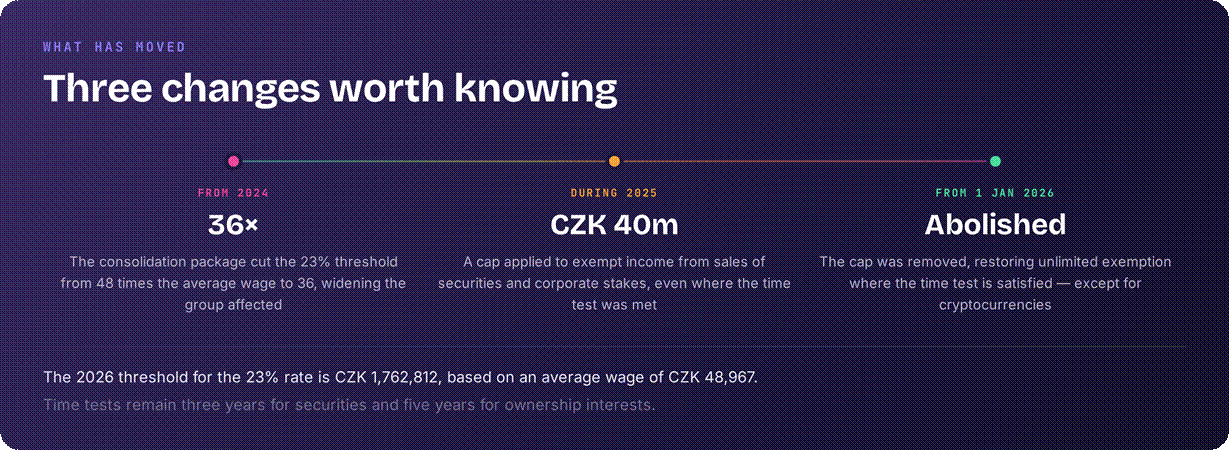
Two rates, and a threshold that moves every year.
Your residency status is the first step
You are Czech tax resident if you have a permanent home in the Czech Republic available in circumstances indicating an intention to remain, or if you are present for 183 days or more in a calendar year. Residents are taxed on worldwide income; non-residents on Czech-source income.
Maintain accurate records of:
• Days present in the Czech Republic in each calendar year;
• Housing arrangements and whether a home is continuously available;
• Your annual tax base against the 36× average wage threshold;
• Gross self-employment revenue, for the flat-rate scheme;
• Acquisition dates of securities and corporate stakes, for the time tests; and
• Any other country that may also treat you as resident.
Three ways to be self-employed
A Czech self-employed person — an OSVČ — has three routes, and the choice is genuinely consequential:
Route | How the base is calculated |
Actual expenses | Deduct documented costs from revenue |
Lump-sum expenses, licensed professions | 40% of revenue deducted |
Lump-sum expenses, most businesses | 60% of revenue deducted |
Lump-sum expenses, crafts and agriculture | 80% of revenue deducted |
Lump-sum expenses, property rental | 30% of revenue deducted |
Flat-rate scheme, band I | Revenue up to CZK 1m, or more on composition tests |
Flat-rate scheme, band II | Revenue up to CZK 1.5m, or more on composition tests |
Flat-rate scheme, band III | Revenue up to CZK 2m regardless of activity |
The flat-rate scheme replaces the return itself. A single monthly payment covers income tax and mandatory contributions together, and a taxpayer inside it generally files no annual income tax return at all. The band is determined by the previous year’s revenue and by the composition of the activities that generated it.
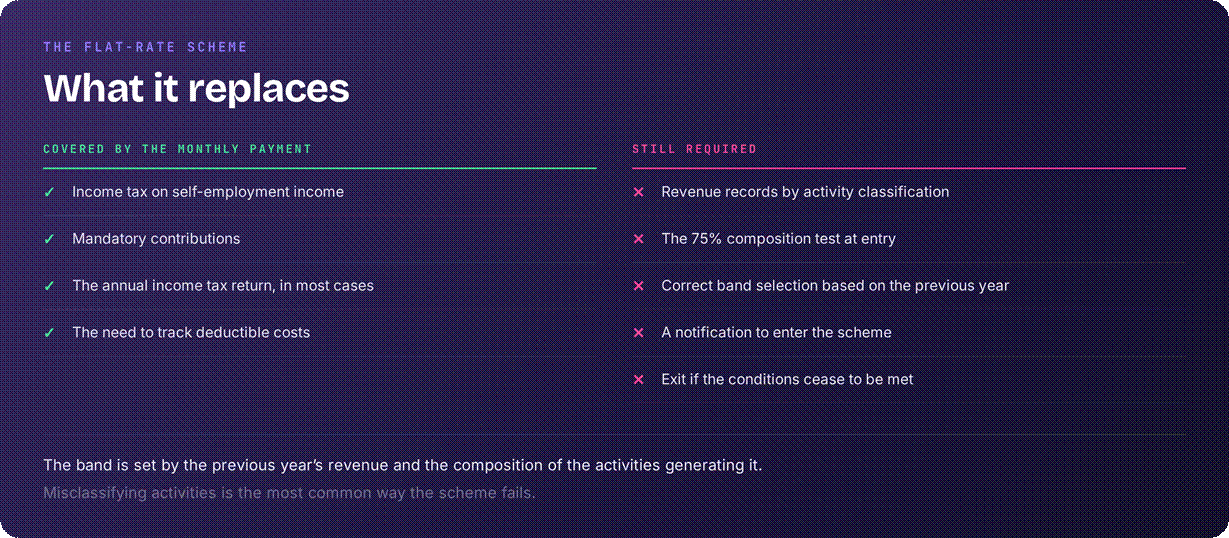
Inside the flat-rate scheme, and outside it.
The 75% composition test
The flat-rate bands are not three profit-margin categories, which is a common misreading. Band I can accommodate up to CZK 2 million of revenue where at least 75% comes from activities eligible for the 80% lump-sum expense percentage, and up to CZK 1.5 million where at least 75% comes from activities eligible for 80% or 60%.
The test asks whether three quarters of your revenue derives from activities that would qualify for the relevant expense percentage under the income tax rules. It is a classification question rather than an assertion about your actual costs, and getting the activity classification wrong is the most common way the scheme fails.
The 2026 capital gains change
From 2025 a CZK 40 million annual cap applied to exempt income from the sale of securities and stakes in corporations, even where the time test was satisfied. That cap was abolished from 1 January 2026.
Individuals can once again obtain full exemption on such sales regardless of the amount, provided the time test is met — three years for securities and five years for ownership interests. The exception is cryptocurrencies, where the CZK 40 million limit continues to apply.
For anyone who deferred a disposal because of the cap, or structured around it during 2025, the position has reverted and is worth revisiting.
Case study: Tomáš picks the wrong band
Tomáš is a consultant with CZK 1.4 million of revenue, of which 80% comes from an activity eligible for the 80% expense percentage and 20% from a different activity classification.
He may fall within band I of the flat-rate scheme, but only if the activity classifications and the 75% calculation are correct. If the composition test fails, he is in a higher band or outside the scheme entirely, and the monthly payments he has been making do not match his actual position.
The scheme is designed to remove administration, and it does — but the entry conditions require exactly the analysis it is meant to avoid, performed once, correctly, at the start.
Filing and the compliance calendar
The Czech tax year follows the calendar year. The annual return is generally due by 1 April of the following year, extended to 1 May for electronic filing and to 1 July where a registered tax adviser files on your behalf. Taxpayers inside the flat-rate scheme generally file no return.
Prepare in good time:
• A tax identification number and data box access;
• Revenue records by activity classification;
• The flat-rate band notification, where applicable;
• Acquisition and disposal dates for securities and stakes;
• Evidence supporting the time tests; and
• Records of foreign income and any foreign tax paid.
The base matters more than the rate
Consider:
• Where your income sits against the 36× average wage threshold;
• Which lump-sum expense percentage applies to your activity;
• Whether the flat-rate scheme removes more administration than it costs;
• Whether your activity composition satisfies the 75% test;
• Whether a deferred disposal should now proceed after the cap’s abolition;
• That cryptocurrencies remain subject to the CZK 40 million limit; and
• Whether the time tests are met before disposing of anything.
Your Czech Republic checklist
1. Establish whether you are resident by permanent home or by 183 days;
2. Model your annual base against the 36× average wage threshold;
3. Identify the correct lump-sum expense percentage for your activity;
4. Run the 75% composition test before entering the flat-rate scheme;
5. Choose the band on the previous year’s revenue, not this year’s;
6. Notify entry to the scheme properly and keep the confirmation;
7. Check the time tests before disposing of securities or stakes;
8. Revisit any disposal deferred because of the CZK 40 million cap;
9. Remember cryptocurrencies still carry that cap; and
10. Diarise the filing deadline applicable to your filing method.
Frequently asked questions
What are the Czech income tax rates?
15% on the annual tax base up to 36 times the average wage, and 23% on the excess. For 2026 the threshold is CZK 1,762,812 a year, based on an average wage of CZK 48,967.
What changed for capital gains in 2026?
The CZK 40 million annual cap on exempt income from sales of securities and corporate stakes was abolished from 1 January 2026, restoring unlimited exemption where the time test is met. Cryptocurrencies remain subject to the cap.
What are the time tests?
Three years for securities and five years for ownership interests in corporations. Meeting the test is what makes the disposal exempt; the cap, while it existed, limited how much of that exemption you could use.
What is the flat-rate scheme?
A regime for the self-employed under which a single monthly payment covers income tax and mandatory contributions, generally removing the need to file an annual income tax return. There are three bands keyed to revenue and activity composition.
How do I choose a flat-rate band?
By the previous year’s revenue and by the composition of the activities that generated it. The 75% test asks whether three quarters of revenue comes from activities eligible for a given expense percentage — it is a classification question, not a margin question.
What are the lump-sum expense percentages?
80% for crafts and agriculture, 60% for most business activities, 40% for licensed professions and 30% for property rental. These are an alternative to deducting documented costs.
What is the taxpayer credit?
CZK 30,840 a year, deducted directly from tax owed rather than from the base. It produces an effective tax-free amount of roughly CZK 205,600 of income.
When is the return due?
Generally 1 April following the calendar tax year, extended to 1 May for electronic filing and to 1 July where a registered tax adviser files. Taxpayers inside the flat-rate scheme generally do not file.
Official sources and further reading
• Finanční správa — Czech Financial Administration
Important information
This article is general information and does not constitute tax, legal, immigration or financial advice, and does not create a client relationship. Tax outcomes depend on travel history, income sources, treaty status and the law applying to the relevant year. Rates, thresholds and regimes change, and some measures described may be proposed rather than enacted; this article reflects our understanding as at the date of publication. Obtain advice from a suitably qualified professional before acting or refraining from action.
