
The Dominican Republic is territorial with a single exception — income from financial investments abroad. New residents get three years before that exception starts applying to them.
Most territorial countries are territorial with caveats. The Dominican Republic is unusually close to the pure form, and the one place it departs from the principle is narrow enough to state in a sentence: income from financial sources abroad.
Taxation is governed by Law 11-92, the Tax Code, administered by the Dirección General de Impuestos Internos. Articles 269 and 270 establish the territorial rule. Income from work or business activity carried on in the Dominican Republic is taxable whoever earns it. Income from work done outside the country is not taxable, even when received by a Dominican national or a resident foreigner.
The exception in Article 269 brings foreign financial income — dividends, interest, income from stocks, bonds, funds and deposits — into the Dominican base for residents. And Article 271 gives new residents three years before that obligation begins.
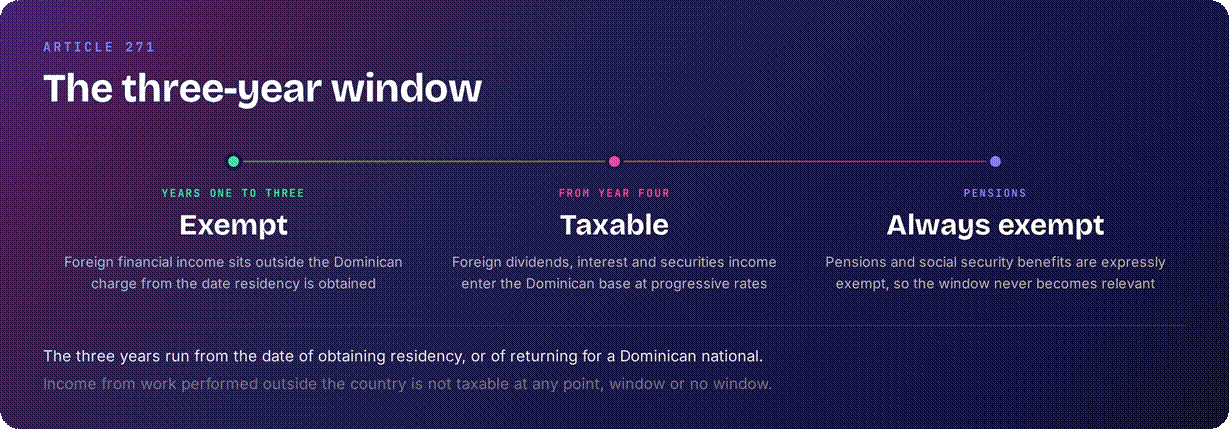
Three years of exemption, and then the exception applies.
Your residency status is the first step
Under Article 12, a person residing in the Dominican Republic for more than 182 days — continuously or cumulatively within a twelve-month period — is treated as resident. Residence can also follow from maintaining the centre of your economic or vital interests in the country while living elsewhere.
What residence does not do is widen the charge to your foreign earnings generally. In a territorial system, crossing the threshold affects filing obligations and the narrow financial-income exception, not the scope of the tax as a whole.
Maintain accurate records of:
• Arrival and departure dates across rolling twelve-month periods;
• The date residency was obtained, because the three years run from it;
• Workdays physically performed inside the Dominican Republic;
• Foreign financial income by type and by year;
• Any Dominican-source income of any kind; and
• Any other country that may also treat you as resident.
What the three-year window covers
For a foreigner who becomes resident, and for a Dominican returning after living abroad, the obligation to pay tax on foreign financial income begins three years after the date of return or of obtaining residency. Before that point it simply does not apply.
Income | Dominican treatment |
Work performed in the Dominican Republic | Dominican-source — taxable |
Business carried on in the country | Dominican-source — taxable |
Rent from Dominican property | Dominican-source — taxable |
Work performed outside the country | Not taxable, even for residents |
Foreign dividends, interest and securities income | Exempt for three years, then taxable |
Foreign pensions and social security | Expressly exempt |
Income of residents under Law 171-07 | Expressly exempt |
Three years is short by regional standards. Chile gives three with a discretionary extension, Uruguay eleven, and New Zealand four. The Dominican window is narrow, but it is also narrow in what it shelters for many arrivals the foreign financial income at stake is modest, and the territorial rule is doing the real work.
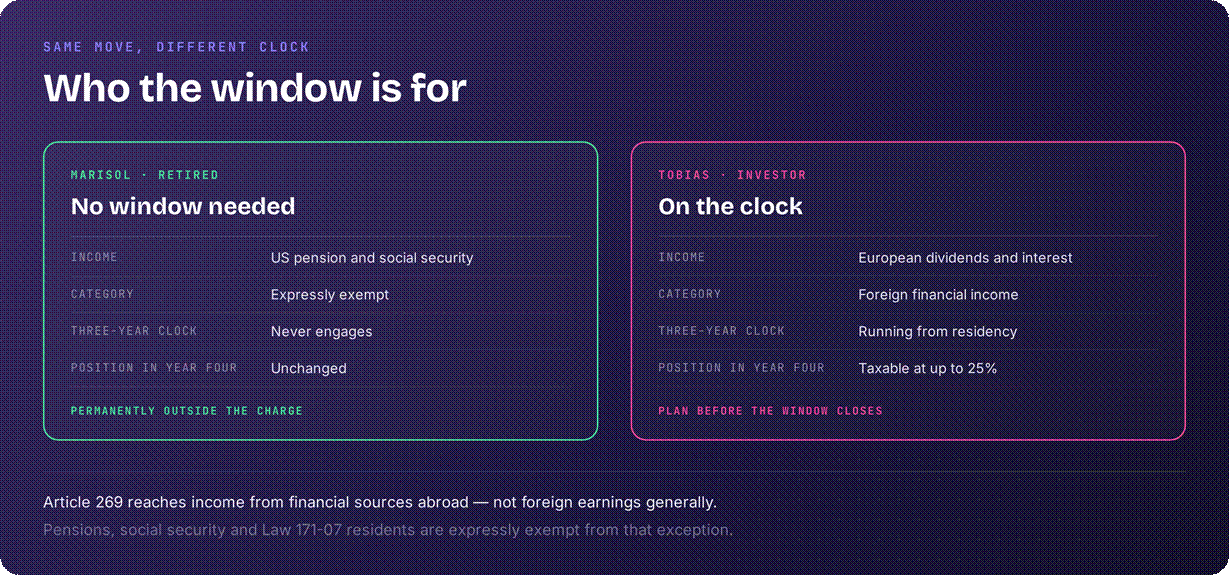
One window matters to one of them and not at all to the other.
Where the territorial rule stops
The protected category is income from work done outside the Dominican Republic. That is a geographic test about where the work happened, not a commercial test about who paid for it.
Someone living in Santo Domingo and performing services from there for clients in Miami is doing work inside the country. Someone living in Santo Domingo who travels to Miami and performs the work there is not. The invoice looks identical in both cases and the analysis is entirely different, which is why remote workers need a view on this before rather than after.
Rates on what is taxable
Individuals are taxed on a progressive scale under Article 296, with an exempt first band and rates rising through 15% and 20% to a top rate of 25%. The bracket thresholds are indexed annually for inflation, so figures quoted in older guides understate them — confirm the scale published for your year.
Companies pay a flat 27%. ITBIS, the value added tax, applies at 18% to most goods and services, which is high by regional standards and a genuine cost of living that the income tax position obscures.
Case study: Marisol and Tobias
Marisol retires to Cabarete on a United States pension and social security. Neither is taxable in the Dominican Republic at any point — pensions and social security are expressly exempt, so she never reaches the end of a window because no window applies to her.
Tobias becomes resident in the same year, living on a portfolio of European dividends and bond interest. That is exactly the category Article 269 reaches. He has three years of exemption under Article 271, and from year four the income enters the Dominican base at progressive rates.
Tobias should be deciding in year two what year four looks like. The common mistake is to treat the three years as a settled position rather than a countdown.
Filing and the compliance calendar
The Dominican tax year follows the calendar year. Individuals file the annual income tax return, form IR-1, by 31 March of the following year, and all taxpayers must register with the DGII and obtain an RNC before filing.
Prepare in good time:
• RNC registration and access to the DGII filing system;
• Dominican-source income records by category;
• Documentation of the date residency was obtained;
• Statements for all foreign financial income, whether taxable yet or not;
• Evidence showing where work was physically performed; and
• Any documentation supporting an exemption you rely on.
Timing matters, and so does place
Model your position before you move, considering:
• Whether your foreign income is financial income or earnings from work;
• Whether any of your work will be performed on Dominican soil;
• The exact date residency begins, since the three years run from it;
• Whether restructuring foreign investments before year four would help;
• Whether pensions or a special regime make the window irrelevant to you;
• Whether the 18% ITBIS changes your cost-of-living comparison; and
• Whether your home country still treats you as resident.
Your Dominican Republic checklist
1. Separate foreign financial income from earnings for work performed;
2. Record the exact date residency was obtained;
3. Identify any work physically performed inside the Dominican Republic;
4. Check whether pensions or a special regime exempt you regardless;
5. Track days across rolling twelve-month periods against the 182-day test;
6. Diarise the end of the three-year window from year one;
7. Review foreign investment structure before year four, not during it;
8. Register for an RNC with the DGII;
9. File form IR-1 by 31 March; and
10. Confirm your home country accepts that you have left.
Frequently asked questions
Is the Dominican Republic a territorial tax country?
Substantially yes. Income from work or business carried on in the country is taxable, and income from work done outside it is not, even for residents. The single exception is income from financial sources abroad.
What does the three-year exemption actually cover?
Income from foreign financial investments — dividends, interest, stocks, bonds, funds and deposits. Under Article 271 the obligation to pay tax on that category begins three years after obtaining residency or returning to the country.
Are my foreign pensions taxable?
No. Pensions and social security benefits are expressly exempt, so the three-year window is irrelevant to most retirees — the exemption is permanent rather than temporary.
I work remotely for foreign clients. Am I protected?
The protection is for work done outside the Dominican Republic. If you are physically in the country when you perform the work, it is Dominican-source regardless of where your clients are. This is the point that most often catches remote workers.
When do I become tax resident?
Broadly, after more than 182 days in the country within a twelve-month period, counted continuously or cumulatively. Residence can also arise from maintaining your centre of economic or vital interests there.
What happens in year four?
Foreign financial income enters the Dominican base at progressive rates reaching 25%. The decision about whether to stay, restructure or move should be taken in year two, not when the first assessment arrives.
What are the tax rates?
A progressive scale under Article 296 with an exempt first band and rates rising through 15% and 20% to 25%. The thresholds are indexed annually, so check the figures published for your filing year rather than relying on older guides.
When is the filing deadline?
The tax year follows the calendar year and individuals file form IR-1 by 31 March of the following year. Registration with the DGII and an RNC number are required first.
Official sources and further reading
• Dirección General de Impuestos Internos (DGII)
Important information
This article is general information and does not constitute tax, legal, immigration or financial advice, and does not create a client relationship. Tax outcomes depend on travel history, income sources, treaty status and the law applying to the relevant year. Rates, thresholds and regimes change, and some measures described may be proposed rather than enacted; this article reflects our understanding as at the date of publication. Obtain advice from a suitably qualified professional before acting or refraining from action.
