
A great deal of published guidance describes Ecuador as taxing only local income, making foreign earnings exempt. That is not what the law says, and the difference matters enormously.
Search for Ecuador and remote work and you will find the same claim repeatedly: that Ecuador is territorial, that foreign income is entirely exempt, and that a remote worker earning from abroad pays nothing. It is an appealing proposition and it is not accurate.
Ecuador charges primarily on Ecuador-source income, defined as income from activities executed in Ecuador regardless of where it is received or paid. But income generated abroad by Ecuador-resident individuals, local or foreign, is taxable, with a credit granted up to the Ecuadorian tax attributable to that income.
That is a worldwide system with a foreign tax credit, not a territorial exemption. The credit often reduces the Ecuadorian charge to nil where foreign tax has already been paid at a similar or higher rate — which is probably how the misconception took hold — but it is a credit mechanism, and it does nothing where the foreign income was lightly taxed or untaxed.
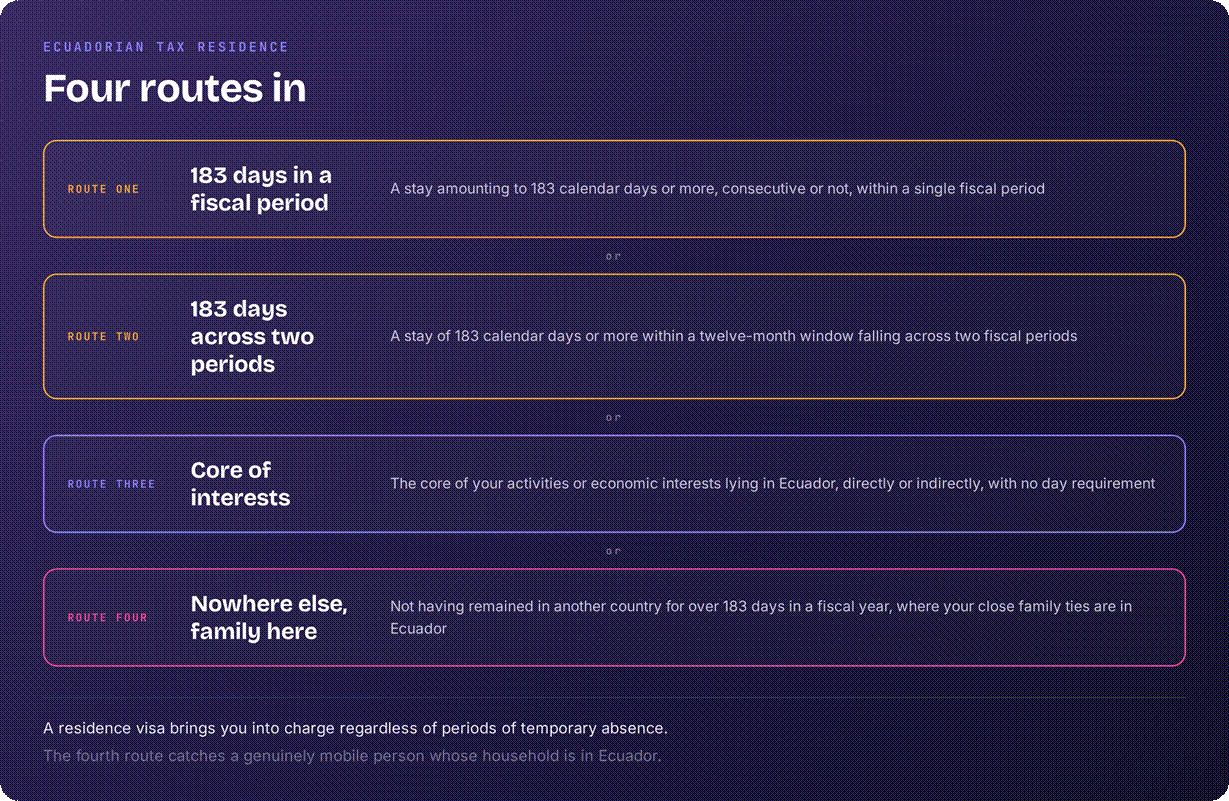
Four routes in, and only two involve counting days.
Your residency status is the first step
You are an Ecuadorian tax resident if any of the following applies:
• Your stay in Ecuador amounts to 183 calendar days or more, consecutive or not, within a fiscal period;
• Your stay amounts to 183 calendar days or more within a twelve-month period falling across two fiscal periods;
• The core of your activities or economic interests lies in Ecuador, directly or indirectly; or
• You have not remained in another country for over 183 calendar days in a fiscal year and your close family ties are in Ecuador.
The fourth limb is unusual and worth reading twice. It catches someone who is nowhere long enough to be resident anywhere else while their family is in Ecuador — a genuinely mobile person with an Ecuadorian household is resident by default rather than by choice.
Maintain accurate records of:
• Days present in each fiscal period;
• Days present across twelve-month periods spanning two fiscal periods;
• Days spent in every other country, for the fourth limb;
• Where your close family ties are;
• Where the core of your economic interests lies; and
• Foreign tax paid, for the credit.
The 2026 tax rates
The Internal Revenue Service published the brackets for 2026 by resolution at the end of December 2025:
Taxable income (USD) | Rate on the excess |
0 to 12,208 | 0% |
12,208 to 15,549 | 5% |
15,549 to 20,188 | 10% |
20,188 to 26,700 | 12% |
26,700 to 35,136 | 15% |
35,136 to 46,575 | 20% |
46,575 to 62,005 | 25% |
62,005 to 82,679 | 30% |
82,679 to 109,956 | 35% |
Over 109,956 | 37% |
Ecuador is dollarised, so these thresholds are in US dollars and carry no currency risk for anyone earning in dollars. Non-residents pay a flat 25% on income received from local sources, withheld at source. There are no provincial, county or municipal taxes on income.
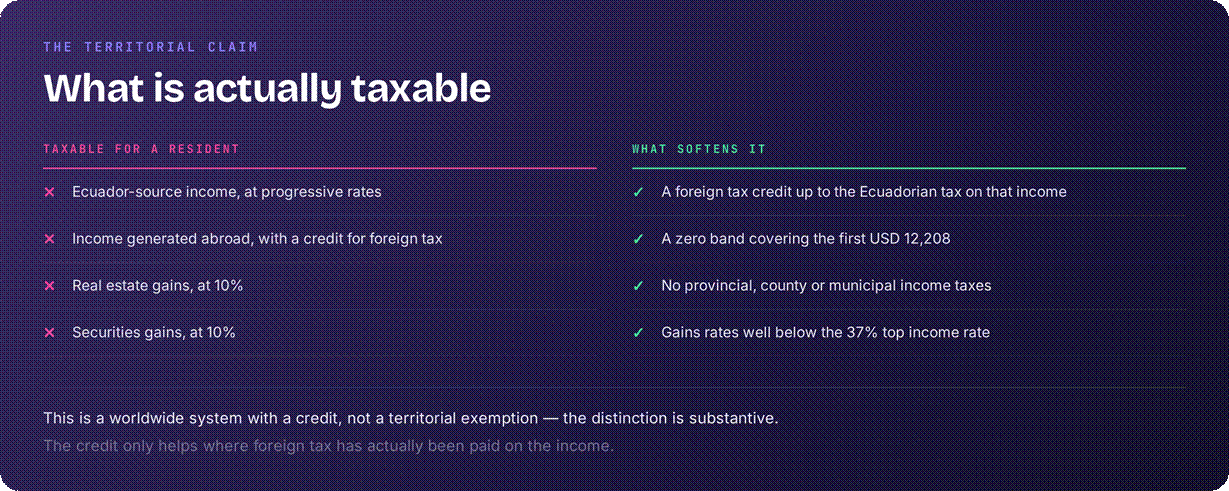
What is taxable, and what the credit actually does.
Capital gains
Gains on the sale of real estate are taxed at 10%, with relief where the property was held for personal use over a long period. Gains on securities are also taxed at 10%. Neither sits within the progressive scale.
Those rates are low relative to the 37% top rate on income, which makes the characterisation of a receipt as a gain rather than as income a question worth getting right.
What makes Ecuador attractive
The territorial claim is wrong, but several genuine advantages survive it:
• A foreign tax credit that frequently eliminates the Ecuadorian charge on income already taxed abroad at a similar or higher rate;
• A zero band covering the first USD 12,208, with the 5% and 10% bands extending well beyond it;
• Capital gains at 10% on both real estate and securities, well below the top income rate;
• Full dollarisation, removing currency risk for anyone earning or holding in US dollars;
• No local income taxes at any provincial, county or municipal level; and
• A low cost of living in Quito and Cuenca relative to comparable destinations.
The honest position is that Ecuador suits someone whose foreign income has already borne tax elsewhere, or whose income is modest enough to sit in the lower bands. It does not suit someone with substantial untaxed foreign income who has been told it will be exempt, because it will not be.
Case study: Tomás believes the internet
Tomás moves to Cuenca and continues consulting for clients in the United States and Europe, billing around USD 90,000 a year. He has read repeatedly that Ecuador is territorial and that his foreign income is exempt, and he plans on that basis.
He crosses 183 days and becomes resident. His foreign income is taxable in Ecuador, and because he structured his affairs to minimise tax in the source countries, there is very little foreign tax to credit. His income falls through the bands into the 35% range.
Had his income already been taxed at 30% or more abroad, the credit would have absorbed most or all of the Ecuadorian charge and the outcome would have looked like the exemption he expected. The credit is what creates the illusion, and it only works when there is foreign tax to credit.
Filing and the compliance calendar
The Ecuadorian fiscal year follows the calendar year, and individual returns are generally filed in March, with the exact window set each year. Filing is through the SRI portal. Anyone carrying on an economic activity without an employment relationship must also obtain a municipal commercial registry entry.
Someone terminating their activities before the end of a fiscal year files an anticipated return, after which their registration in the taxpayer register is cancelled. Prepare in good time:
• Registration in the taxpayer register and SRI portal access;
• Day-count records across fiscal periods and twelve-month windows;
• Records of days spent in every other country;
• Foreign income statements and evidence of foreign tax paid;
• Acquisition and disposal records for real estate and securities; and
• An anticipated return if you are leaving mid-year.
Model the credit, not the exemption
Consider:
• That foreign income of a resident is taxable, not exempt;
• How much foreign tax you actually pay, since that is what the credit depends on;
• Which of the four residence limbs could apply to you;
• That a residence visa brings you into charge regardless of absences;
• Whether the fourth limb catches you through family ties;
• Whether a receipt is properly a capital gain at 10% rather than income; and
• That dollarisation removes currency risk but not the tax.
Your Ecuador checklist
1. Discard any guidance describing foreign income as exempt;
2. Establish how much foreign tax you actually pay, for the credit;
3. Work all four residence limbs, not just the day counts;
4. Count days in every other country, for the fourth limb;
5. Note that a residence visa brings you into charge regardless of absences;
6. Check where the core of your economic interests lies;
7. Separate capital gains, taxed at 10%, from income;
8. Use the 2026 brackets published by resolution, not older figures;
9. Obtain a municipal commercial registry entry if self-employed; and
10. File an anticipated return if leaving mid-year.
Frequently asked questions
Is Ecuador a territorial tax system?
Not for residents. Ecuador charges primarily on Ecuador-source income, but income generated abroad by Ecuador-resident individuals is taxable, with a credit granted up to the Ecuadorian tax attributable to that income. That is a worldwide system with a credit, not an exemption.
Why do so many guides say foreign income is exempt?
Probably because the foreign tax credit often reduces the Ecuadorian charge to nil where the income has already borne tax abroad at a similar or higher rate. The outcome can look like an exemption, but the mechanism is a credit and it does nothing where little or no foreign tax was paid.
How do I become tax resident?
Through any of four routes: 183 days or more in a fiscal period; 183 days or more across a twelve-month window spanning two fiscal periods; having the core of your activities or economic interests in Ecuador; or not having been in another country over 183 days while your close family ties are in Ecuador.
What if I hold a residence visa?
Foreigners with residence visas are subject to income tax on their earnings and are not entitled to exclude income for periods of temporary absence from Ecuador. The visa does not need to be paired with a day count.
What are the 2026 rates?
Ten brackets in US dollars: nil to 12,208, then 5%, 10%, 12%, 15%, 20%, 25%, 30% and 35%, reaching 37% above 109,956. Non-residents pay a flat 25% on local-source income, withheld at source.
How are capital gains taxed?
Real estate gains at 10%, with relief where the property was held for personal use over a long period, and securities gains at 10%. Neither falls within the progressive scale, so both sit well below the top income rate.
Does dollarisation matter for tax?
It removes currency risk, since thresholds are set in US dollars and Ecuador has been dollarised since 2000. It does not change the scope of the charge, which is a separate question.
Are there local income taxes?
No. There are no provincial, county or municipal taxes on income, though anyone carrying on an economic activity without an employment relationship must obtain a municipal commercial registry entry.
Official sources and further reading
• Servicio de Rentas Internas (SRI)
Important information
This article is general information and does not constitute tax, legal, immigration or financial advice, and does not create a client relationship. Tax outcomes depend on travel history, income sources, treaty status and the law applying to the relevant year. Rates, thresholds and regimes change, and some measures described may be proposed rather than enacted; this article reflects our understanding as at the date of publication. Obtain advice from a suitably qualified professional before acting or refraining from action.
