
Egypt sits at the join between Africa, the Middle East and Europe, and Cairo has become a serious base for people working remotely for employers elsewhere. The cost of living is low against a foreign salary, the treaty network is wide, and the top rate is moderate by regional standards.
The tax rule that matters most, though, is the one that gets flattened in most guides. Egypt does not simply tax residents on worldwide income. It taxes residents on Egyptian-source income, and on foreign income only where the individual’s centre of commercial, industrial or professional activity is in Egypt.
That second condition is doing a great deal of work. Two people can both be Egyptian tax resident on identical day counts and end up in completely different positions, because one has moved the centre of their activity to Cairo and the other has not. If you only take one thing from this article, take that.
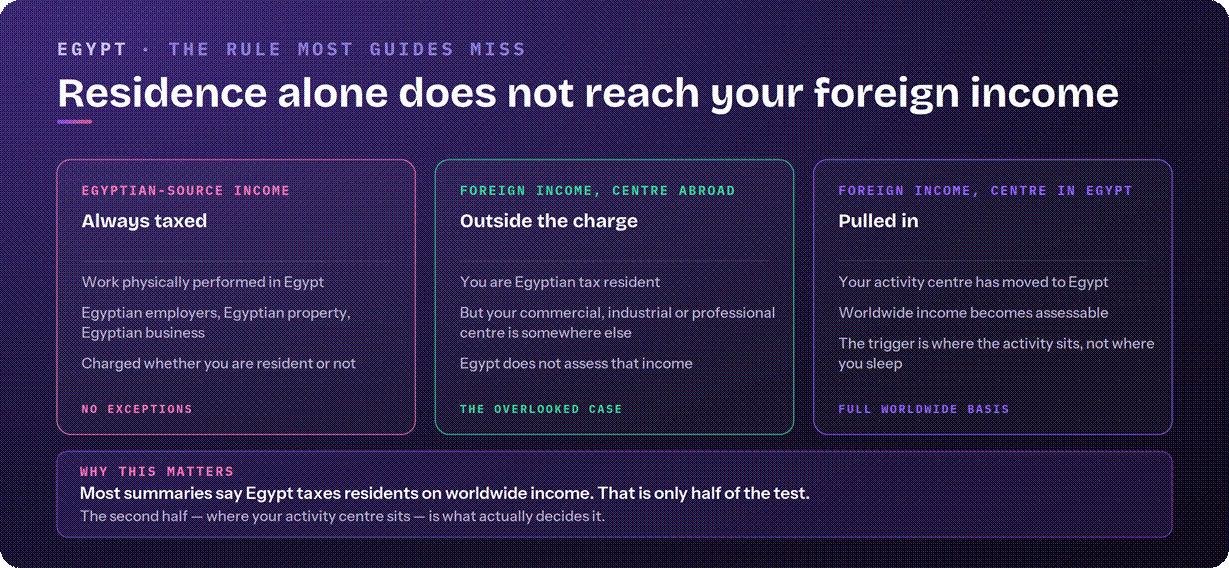
Residence and the activity centre test are separate questions, and both have to be answered.
How you become resident
Egyptian tax law sets out several routes into residence, and the day count is only one of them.
You are resident if you have a permanent home in Egypt. You are resident if you are present in Egypt for more than 183 days, continuous or intermittent, within a twelve-month period. And an Egyptian national working abroad but paid from an Egyptian treasury is also treated as resident.
The 183 days run across twelve months, not a calendar year. This is a rolling test rather than an annual one, which makes it harder to manage by splitting a stay across a year end. Keep entry and exit stamps, flight confirmations and accommodation records since they are what you will rely on if the position is reviewed.
Treaty provisions also feed into the residence question. Where a double tax agreement applies, its tie-breaker can affect how the period is treated, so the domestic test is not always the last word.
The activity centre test
Once you are resident, the scope of the charge turns on where your commercial, industrial or professional centre sits. Income earned in Egypt is assessable either way. Income earned outside Egypt is assessable only if that centre is here.
There is no simple checklist for it. It is a factual question about where the activity that generates the income is actually run from including where decisions are taken, where the work is performed, where clients and counterparties are dealt with, where the business has its operational base.
For a remote employee, the analysis cuts both ways. If you are performing your duties physically in Egypt, an argument that your employment activity is centred elsewhere becomes considerably harder to sustain. Separately, work performed in Egypt may be Egyptian-source in the first place. Where the employer is incorporated and where the salary is paid are not the tests.
For someone running a business abroad that continues to operate abroad, with staff, premises and customers outside Egypt, the position is much more comfortable. The distinction is worth taking advice on before you move rather than arguing about afterwards, because the evidence you would want is largely created in advance.
The tax rates
Egypt restructured its personal income tax under Law 175 of 2023 and again under Law 7 of 2024. Anything describing a top rate of 22.5% or a tax-free threshold of EGP 15,000 is describing a superseded system.
Annual taxable income (EGP) | Rate for 2026 |
Personal exemption | EGP 20,000, deducted first |
Up to 40,000 | 0% |
40,001 to 55,000 | 10% |
55,001 to 70,000 | 15% |
70,001 to 200,000 | 20% |
200,001 to 400,000 | 22.5% |
400,001 to 1,200,000 | 25% |
Above 1,200,000 | 27.5% |
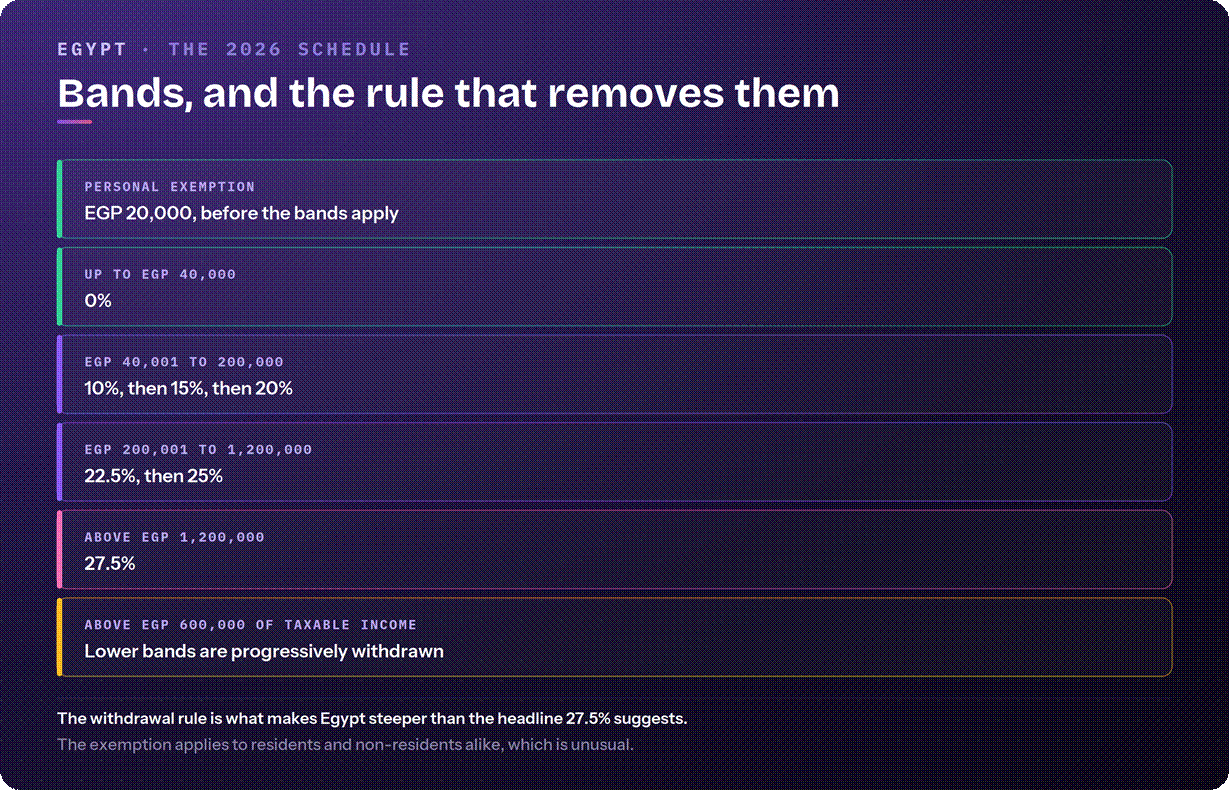
The bands, and the withdrawal rule that makes the effective rate steeper than it looks.
The lower bands do not survive at higher incomes. Above EGP 600,000 of taxable income, Egypt progressively withdraws the lower brackets, and once income exceeds EGP 1,200,000 the whole of the first EGP 1,200,000 is taxed at 25% with the excess at 27.5%. The result is a series of hard steps rather than a smooth curve, and it is why a naive marginal-rate calculation understates the bill at the top.
The personal exemption of EGP 20,000 applies to residents and non-residents alike, which is unusual when most systems reserve allowances for residents.
What else is charged
Dividends are generally taxed at 10%, reduced to 5% for shareholders holding at least 25%. Real estate is subject to an annual tax of 10% on annual rental value after a statutory deduction, with lower-value residential units exempt.
Treaties and filing
Egypt has an extensive treaty network, covering well over fifty countries including the United Kingdom, most of Europe, the United States, Canada and the Gulf states. That is a real advantage over lower-rate jurisdictions with thin networks: where two countries both claim you, there is usually an agreement to resolve it and a credit mechanism behind it.
The tax year is the calendar year. Employment tax is withheld monthly by the employer and remitted by the fifteenth of the following month, with an annual reconciliation. Individuals filing their own return generally do so by the end of the first quarter following the year end. The Egyptian Tax Authority has moved most processes online, and e-invoicing is mandatory for registered businesses, so a freelancer invoicing Egyptian clients will be inside that system.
Your checklist
• Track days on a rolling twelve-month basis, not by calendar year;
• Establish whether you have a permanent home in Egypt, since that alone creates residence;
• Work out where your commercial, industrial or professional centre genuinely sits;
• Separate the source question from the residence question — they are answered differently;
• If you work remotely from Egypt, assume the duties may be Egyptian-source until advised otherwise;
• Model the current bands, not the pre-2023 structure;
• Factor in the bracket withdrawal above EGP 600,000 of taxable income;
• Remember the EGP 20,000 exemption applies to non-residents too;
• Check the treaty between Egypt and your home country for the tie-breaker; and
• Keep evidence of where your activity is run from, created at the time rather than reconstructed later.
Frequently asked questions
Does Egypt tax my worldwide income?
Only if your centre of commercial, industrial or professional activity is in Egypt. Residents are always taxed on Egyptian-source income; foreign income comes into the net only when that activity centre is here.
How many days make me Egyptian tax resident?
More than 183 days, continuous or intermittent, within any twelve-month period. Because it is a rolling test rather than a calendar-year one, splitting a stay across a year end does not reset it.
Are there other ways to become resident?
Yes. Having a permanent home in Egypt is enough on its own. An Egyptian national working abroad but paid from an Egyptian treasury is also treated as resident.
What is the top rate of income tax?
27.5%, on taxable income above EGP 1,200,000, after a personal exemption of EGP 20,000. The rate structure was reformed in 2023 and adjusted again in 2024.
Why is my effective rate higher than the band suggests?
Above EGP 600,000 of taxable income the lower bands are progressively withdrawn, and above EGP 1,200,000 the whole of the first EGP 1,200,000 is charged at 25%. The schedule steps rather than curving.
I work remotely for a foreign employer from Cairo. What is my position?
Two separate questions arise. Whether the duties performed in Egypt make the income Egyptian-source, and whether your activity centre has moved here. Performing the work physically in Egypt makes both harder to argue the other way. Take advice before relying on a foreign-employer argument.
Do non-residents get the personal exemption?
Yes. The EGP 20,000 exemption applies to residents and non-residents alike, which is unusual. Non-residents are otherwise taxed only on income received from an Egyptian treasury or for work performed in Egypt, at the same bands.
Does Egypt have a tax treaty with my country?
Probably. The network covers more than fifty countries including the UK, the US, Canada, most of Europe and the Gulf. Check the specific agreement, since the tie-breaker and credit provisions vary.
Official sources and further reading
Important information
This article is general information and does not constitute tax, legal, immigration or financial advice, and does not create a client relationship. Tax outcomes depend on travel history, income sources, treaty status and the law applying to the relevant year. Rates, thresholds and regimes change, and some measures described may be proposed rather than enacted; this article reflects our understanding as at the date of publication. Obtain advice from a suitably qualified professional before acting or refraining from action.
