
If you run a location-independent business, Estonia’s corporate tax system looks remarkable. An Estonian private limited company — an OÜ — pays no corporate income tax on profits that are retained or reinvested. Tax arrives only when profits are distributed or used for certain non-business purposes.
The right question is not whether the rate is 0%. It is where you are personally tax resident, where the business is actually managed and operated, how you will take money out, whether another country will apply controlled foreign company or permanent establishment rules, and whether the running costs justify the structure at your scale.
How the corporate system works
An OÜ is Estonia’s private limited company, broadly comparable to a limited liability company elsewhere, and it can be owned by non-residents. Estonia is genuinely good at digital administration — online formation, electronic filing — which is part of the appeal.
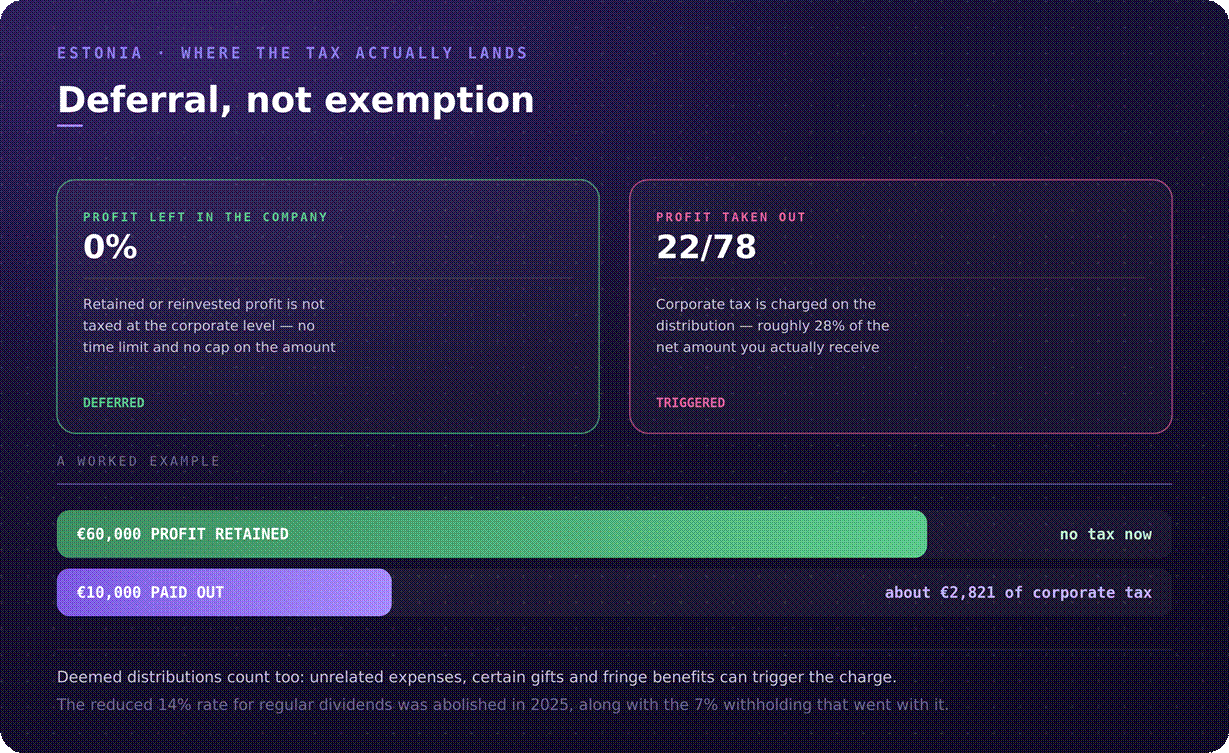
Retained profit is untaxed. Distributed profit is not.
The structure is deferral rather than exemption. Leave profit in the company and Estonia does not tax it at the corporate level at that point, with no time limit and no cap. Distribute it and the charge is triggered.
Tax on distributions is calculated as 22/78 of the net amount paid out. On a €10,000 net dividend that produces roughly €2,821 of corporate income tax — about 28% of what you actually receive, or 22% of the gross.
⚠️ Two changes worth knowing. The reduced 14% rate that applied to regular distributions was abolished in 2025, along with the 7% withholding that accompanied it. And a legislated increase of the rate to 24% from 2026 was repealed before it took effect, so the rate remains 22% — alongside the scrapping of the temporary defence tax package.
Deemed distributions are caught too: expenses unrelated to the company’s business, certain gifts and donations, fringe benefits, and payments treated as distributions under Estonian rules. Putting personal costs through the company does not convert them into tax-free business expenses.
The personal side
Estonia’s personal income tax is a flat 22%, applying to all income types — salary, business income, rental income, capital gains and crypto alike. There are no bands.
Item | Estonian position for 2026 |
Personal income tax | A flat 22% on all income types |
Basic exemption | €700 a month, now universal regardless of income |
The planned rise to 24% | Cancelled before it took effect |
Corporate tax on retained profit | 0%, with no time limit or cap |
Corporate tax on distributions | 22/78 of the net amount paid out |
The old 14% reduced dividend rate | Abolished in 2025 |
Capital gains | Taxed as income at the flat rate |
VAT | 24%, permanent since July 2025 |
A change in your favour from 2026. The basic exemption is now a universal €700 a month — €8,400 a year — for every resident regardless of income. The old tapering arrangement, which withdrew the allowance as income rose and produced an awkward effective rate spike, has been abolished.
Capital gains are taxed as ordinary income at the flat rate rather than under a separate regime. Estonia does operate an investment account system that allows gains to be rolled over within the account and taxed only on withdrawal, which is worth understanding if you hold a portfolio.
Does an OÜ mean you pay no personal tax?
No, and this is the most important limitation. An OÜ is a separate legal person, but your personal obligations are set by the laws of the countries connected to you — your tax residence, where you physically work, your domicile, nationality, family, accommodation and business activity.
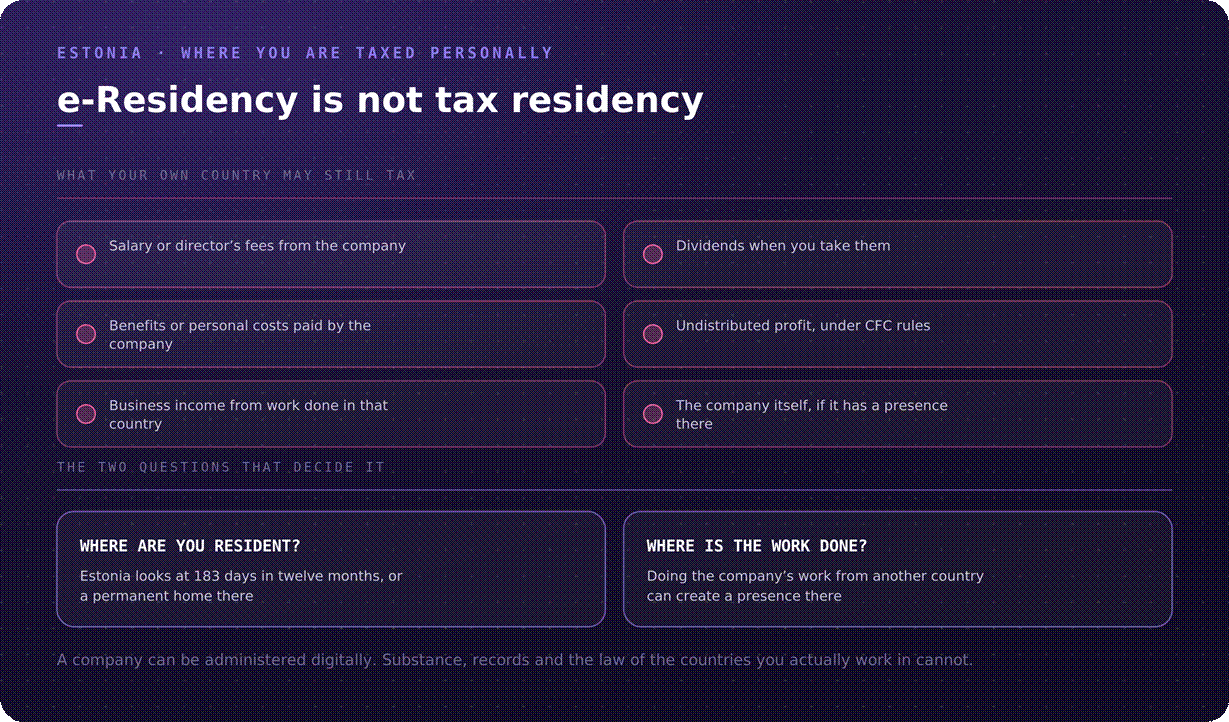
The questions an Estonian company does not answer for you.
e-Residency is not tax residency. Estonia’s own guidance says so explicitly. Holding an e-Residency card does not make you personally resident in Estonia, and it does not make your company tax resident there for every international purpose. Estonian personal residence turns on 183 days in any twelve consecutive months, or a permanent home in Estonia.
Your country of personal tax residence may tax salary or director’s fees from the OÜ, dividends received from it, benefits or personal expenses paid by it, undistributed profits under controlled foreign company rules, and business income attributed to activities carried out there.
Separately, if you personally perform the company’s work from another country, that country may consider whether the OÜ has a permanent establishment or other taxable presence. That is assessed by looking at where decisions are made, where services are performed, whether you can conclude contracts, and whether a fixed place of business exists.
Case study: Sarah's consultancy
Sarah is a freelance marketing consultant who travels regularly and intends to retain a good proportion of her profits to build a small agency. Her OÜ earns €80,000 after deductible expenses. She pays herself a reasonable salary for the work she performs and retains the rest to hire a contractor and buy software.
The OÜ may benefit from the 0% treatment on the retained profit. Sarah still has to analyse where she is personally tax resident, where she physically performs her consulting work, whether salary or director’s fee rules apply, whether another country considers the OÜ to have a permanent establishment, and whether controlled foreign company rules reach the retained profit.
If she later distributes €20,000, the Estonian corporate treatment is reviewed at that point, and she may also need to declare the dividend where she is personally resident.
When an OÜ makes sense
It may suit you where you operate a genuine ongoing business, expect to retain profits for months or years, plan to invest in software, marketing, staff or product development, need a formal company structure for commercial reasons, can maintain reliable accounting, understand where the work is physically performed, and have a clear plan for salary, fees, dividends and expenses.
When it does not. If you withdraw almost all revenue for living costs each month, the retained-profit benefit is largely theoretical — you trigger the charge anyway — while formation, accounting, banking, reporting and advisory costs all still arise. The structure rewards accumulation, not extraction.
Digital administration does not remove the need for commercial substance, accurate records, and compliance with the law of every country where you actually operate.
Other obligations
VAT is 24%, permanent since July 2025, with the registration threshold at €40,000 of annual turnover and a reduced rate applying to certain supplies including accommodation. If you invoice EU clients, place-of-supply rules and reporting will matter more than the headline rate.
Your checklist
1. Establish where you are personally tax resident before forming anything;
2. Identify where the company’s work is physically performed;
3. Model how much profit you genuinely expect to retain rather than withdraw;
4. Compare the total cost of the structure against the deferral benefit at your scale;
5. Check whether controlled foreign company rules apply where you live;
6. Assess permanent establishment risk in the countries you work from;
7. Plan the mix of salary, director’s fees and dividends deliberately;
8. Keep company and personal finances cleanly separated;
9. Confirm VAT registration and place-of-supply obligations; and
10. Take advice in your country of residence, not only in Estonia.
Frequently asked questions
Is Estonian corporate tax really 0%?
On retained and reinvested profit, yes, with no time limit or cap. On distributions the charge is 22/78 of the net amount — roughly 28% of what you receive. It is deferral, not exemption.
Did the rate go up to 24% in 2026?
No. The increase was legislated but repealed before taking effect, so both personal income tax and the distribution rate remain at 22%. The temporary defence tax package was also scrapped.
What happened to the 14% reduced rate?
It was abolished in 2025, together with the 7% withholding tax that applied alongside it on distributions to individuals. All distributions now follow the single 22/78 calculation.
Does e-Residency make me tax resident?
No. It is a digital identity for administering a company. Estonian personal tax residence requires 183 days in twelve consecutive months, or a permanent home in Estonia.
How are capital gains taxed?
As ordinary income at the flat 22% rate. Estonia also offers an investment account system that defers tax until funds are withdrawn from the account, which can be useful for a portfolio.
What is the tax-free allowance?
€700 a month, or €8,400 a year, and from 2026 it is universal rather than tapering away as income rises. The old effective-rate spike this created has gone.
Will my home country tax the retained profits?
It might, under controlled foreign company rules. Those rules exist precisely to catch profit accumulated in a low-tax company controlled from elsewhere, so check them before assuming deferral works for you.
Is an OÜ worth it for a solo freelancer?
Often not, if you withdraw most of what you earn each month. The benefit comes from retaining profit; the costs arrive regardless. Model both sides before forming one.
Official sources and further reading
• Estonian Tax and Customs Board
Important information
This article is general information and does not constitute tax, legal, immigration or financial advice, and does not create a client relationship. Tax outcomes depend on travel history, income sources, treaty status and the law applying to the relevant year. Rates, thresholds and regimes change, and some measures described may be proposed rather than enacted; this article reflects our understanding as at the date of publication. Obtain advice from a suitably qualified professional before acting or refraining from action.
