
Eswatini taxes income from a source within the country irrespective of whether the recipient is resident. Residence changes nothing about the scope — which makes it unusually simple to model.
Most tax systems make you work out whether you are resident before anything else. Eswatini does not. Income tax is levied on all income derived from a source within or deemed to be within the country, irrespective of whether the recipient of the income is actually resident in Eswatini.
The consequence is that residents and non-residents are assessed on exactly the same graduated basis. Residence does not change the scope, the rates or the reliefs.
What that buys an internationally mobile person is certainty. Income arising outside Eswatini is outside the charge, whatever your status, and there is no residence threshold to manage or accidentally cross.
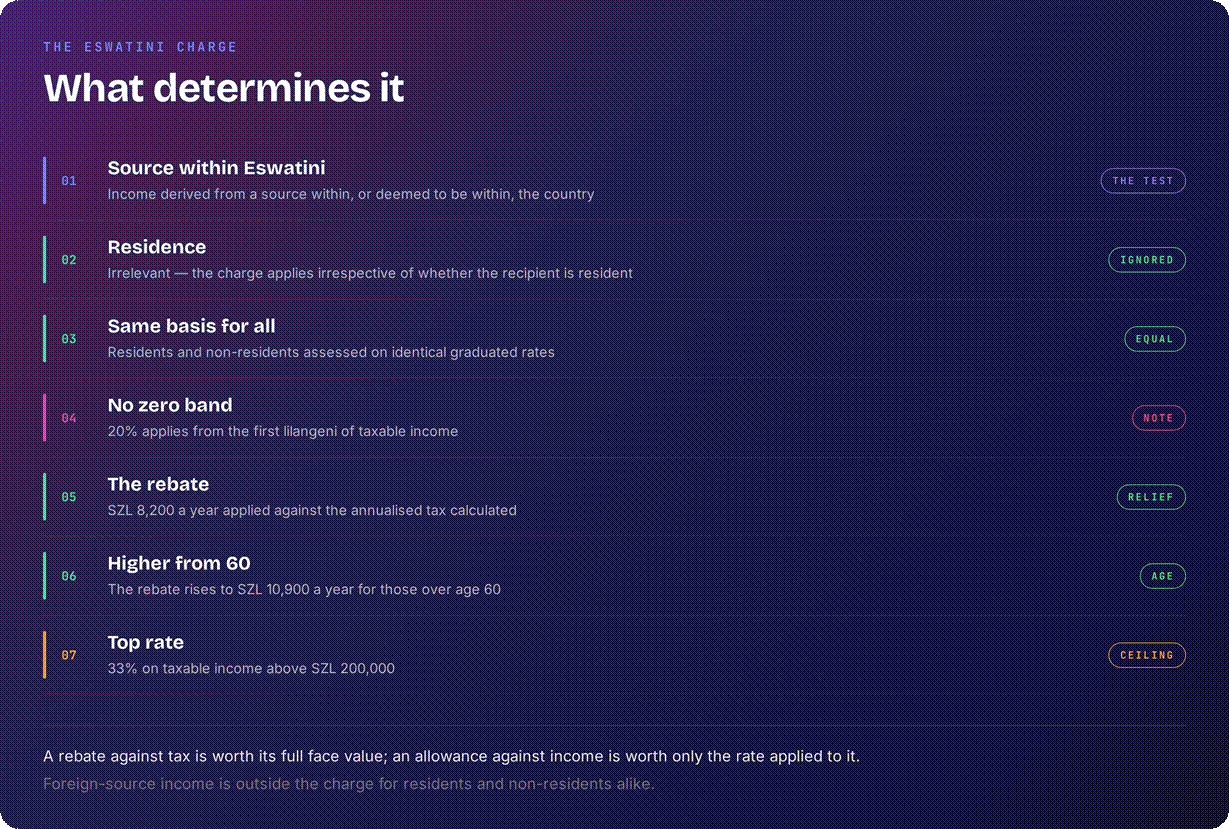
Everything that decides the charge.
Source is the only question
Because the charge follows source irrespective of residence, the analysis reduces to a single question: is this income derived from a source within, or deemed to be within, Eswatini?
For employment income that generally follows where the services are performed. For business income it follows where the activity is carried on. Income genuinely arising abroad falls outside the charge for anybody.
Maintain accurate records of:
• Where each service was physically performed;
• Where each business activity was carried on;
• The source of every receipt, Eswatini or foreign;
• Any income deemed to be from an Eswatini source;
• Your age, since the rebate is higher from 60; and
• Total annual income, for the band calculation.
The tax rates
Taxable income (SZL) | Tax |
0 to 100,000 | 20% of taxable income |
100,000 to 150,000 | SZL 20,000 plus 25% of the excess |
150,000 to 200,000 | SZL 32,500 plus 30% of the excess |
Above 200,000 | SZL 47,500 plus 33% of the excess |
Rebate, under 60 | SZL 8,200 a year against the tax |
Rebate, 60 and over | SZL 10,900 a year against the tax |
Basis | Source within Eswatini, residence irrelevant |
Applies to | Residents and non-residents alike |
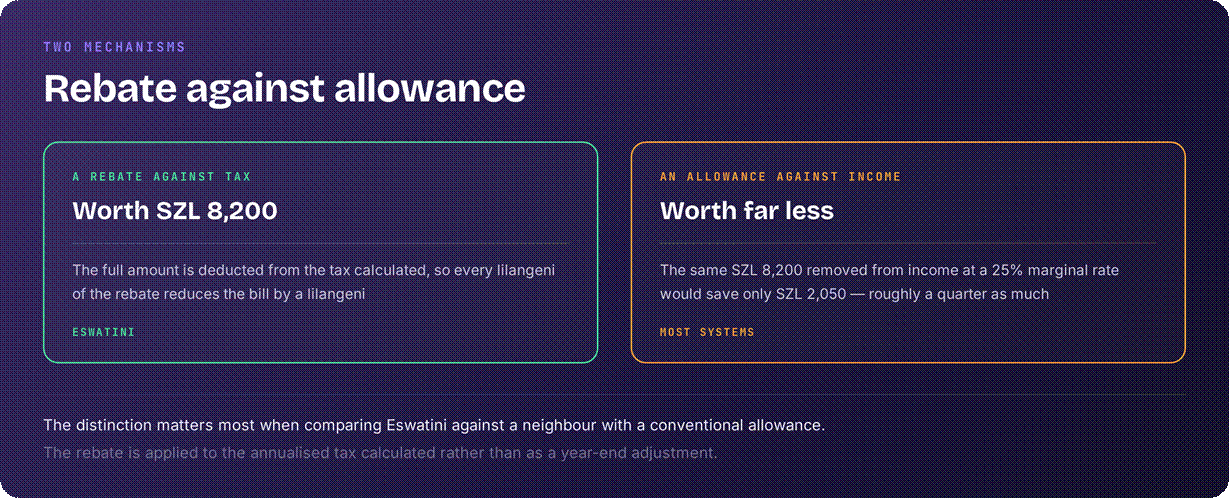
The rebate is worth understanding properly. An allowance of SZL 8,200 against income would be worth SZL 1,640 at the 20% rate. A rebate of SZL 8,200 against the tax is worth the full SZL 8,200. The mechanism is considerably more generous than it first appears, and it is worth most to lower earners in proportional terms.
Residence, and why it does not matter here.
What makes Eswatini attractive
The appeal is structural rather than about rates:
• Source-only taxation, applying irrespective of residence, so foreign income is outside the charge for everybody;
• No residence test to manage — there is no threshold to cross accidentally;
• A rebate against the tax rather than an allowance against income, which is worth substantially more;
• A higher rebate from age 60, at SZL 10,900;
• A top rate of 33%, moderate by regional standards; and
• Identical treatment for residents and non-residents, which removes a whole category of planning risk.
The honest qualifications are that there is no zero band, so 20% bites from the first lilangeni before the rebate is applied, and that the 33% top rate arrives at SZL 200,000 — a modest level of income.
Case study: the rebate, two ways
Someone with taxable income of SZL 120,000 faces SZL 20,000 on the first SZL 100,000 plus 25% on the SZL 20,000 above it — SZL 25,000 before relief.
The rebate of SZL 8,200 comes off that tax figure directly, leaving SZL 16,800. Had the same SZL 8,200 been an allowance against income, it would have removed SZL 8,200 from the top band at 25% — a saving of just SZL 2,050.
The difference is roughly four times over. Anyone comparing Eswatini against a neighbour with a conventional personal allowance should model the mechanism rather than the headline figure.
Filing and the compliance calendar
The rebate is applied to the annualised tax calculated, so it works through the year rather than as a year-end adjustment. Employers operate withholding on employment income in the usual way.
Prepare in good time:
• Registration with the Eswatini Revenue Service;
• Records establishing the source of each receipt;
• Evidence of where services were performed;
• Confirmation that the correct rebate has been applied;
• Proof of age, if claiming the higher rebate; and
• Records of any income deemed Eswatini-source.
Model the rebate, not an allowance
Consider:
• That source alone determines the charge;
• That residence changes nothing about scope or rates;
• That there is no zero band — 20% starts immediately;
• That the rebate is against tax, not income;
• That it is therefore worth its full face value;
• That it rises to SZL 10,900 from age 60; and
• That the 33% top rate arrives at SZL 200,000.
Your Eswatini checklist
1. Establish the source of every item of income;
2. Record where each service was performed;
3. Do not spend time on a residence analysis — it is irrelevant;
4. Note there is no zero band before the 20%;
5. Confirm the rebate has been applied against the tax;
6. Claim the higher rebate from age 60;
7. Model the rebate at face value, not at a marginal rate;
8. Check for any income deemed Eswatini-source;
9. Note the 33% top rate begins at SZL 200,000; and
10. Keep foreign-source income documented separately.
Frequently asked questions
Does residence matter in Eswatini?
No. Income tax is levied on all income derived from a source within or deemed to be within the country, irrespective of whether the recipient is actually resident. Residents and non-residents are assessed on the same graduated basis.
Is foreign income taxed?
No. Income from a source outside Eswatini is outside the charge, for residents and non-residents alike, because the charge follows source rather than the person.
What are the rates?
20% on taxable income to SZL 100,000, then SZL 20,000 plus 25% to SZL 150,000, SZL 32,500 plus 30% to SZL 200,000, and SZL 47,500 plus 33% above.
Is there a tax-free band?
No. The 20% rate applies from the first lilangeni. Relief comes instead through a rebate applied against the tax calculated.
How much is the rebate?
SZL 8,200 a year, rising to SZL 10,900 for those over age 60, applied against the annualised tax calculated.
Why does the rebate mechanism matter?
Because a rebate against tax is worth its full face value, while an allowance against income is worth only the marginal rate applied to it. SZL 8,200 against tax saves SZL 8,200; the same figure against income at 25% would save SZL 2,050.
Do non-residents get the rebate?
The rebate is applied to the annualised tax calculated, and residents and non-residents are assessed on the same basis. Confirm your specific position with the Eswatini Revenue Service.
When does the top rate apply?
On taxable income above SZL 200,000, where the charge is SZL 47,500 plus 33% of the excess.
Official sources and further reading
Important information
This article is general information and does not constitute tax, legal, immigration or financial advice, and does not create a client relationship. Tax outcomes depend on travel history, income sources, treaty status and the law applying to the relevant year. Rates, thresholds and regimes change, and some measures described may be proposed rather than enacted; this article reflects our understanding as at the date of publication. Obtain advice from a suitably qualified professional before acting or refraining from action.
