
The Gambia charges individuals the higher of the normal scale or a percentage of turnover. Owning a dwelling there makes you resident, and social contributions are not deductible.
Personal income tax in The Gambia is not simply the progressive scale. The Gambia Revenue Authority states it plainly: the rate is the higher of the applicable rates in the First Schedule, or 1% of turnover for audited accounts or 2% of turnover in any other case.
That turnover floor is unusual for a personal tax. It means a self-employed individual with a poor year can still face a charge computed on revenue rather than on profit, and that keeping audited accounts halves the floor from 2% to 1%.
The same structure applies to corporation tax, where the rate is the higher of 27% of net profit or 1% of turnover on audited accounts and 2% where unaudited.
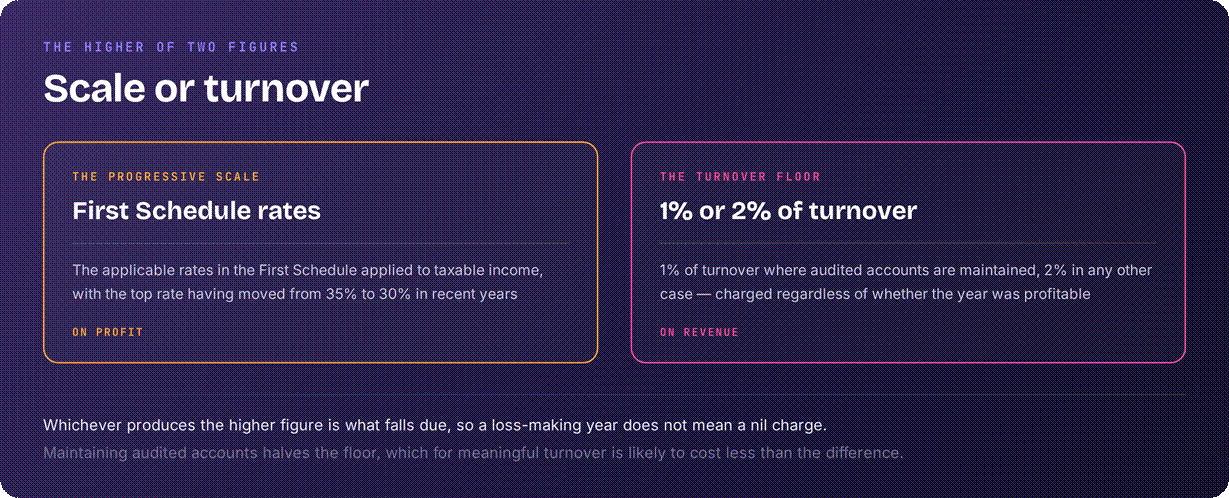
Two ways the charge is computed.
Your residency status is the first step
An individual is resident where any of three conditions is met:
• They spend 183 days of the tax year in The Gambia;
• They have an aggregated presence of 183 days in a tax year; or
• They own a dwelling in The Gambia.
That third limb is the one to watch. Property ownership alone establishes residence, with no presence requirement attached — so someone who buys a house in The Gambia and visits occasionally may be resident without realising it.
Residents are taxed on worldwide income; non-residents only on Gambian-source income. The GRA is explicit that all residents who earn employment income outside the country are liable to employment income tax, subject to the foreign source rule.
Maintain accurate records of:
• Days present, on both the single-period and aggregated tests;
• Whether you own a dwelling in The Gambia;
• Employment income earned outside the country;
• Turnover, for the 1% or 2% floor;
• Whether your accounts are audited, since that halves the floor; and
• Fringe benefits provided, which are taxed on the employer.
The tax rates
Item | Position |
Personal income tax | The higher of the scale or the turnover floor |
Turnover floor, audited accounts | 1% of turnover |
Turnover floor, otherwise | 2% of turnover |
PAYE threshold | Above D3,000 a month or D36,000 a year |
Capital gains | 15% |
Withholding on contracts, residents | 10% |
Withholding on contracts, non-residents | 15% |
Corporation tax | Higher of 27% of profit or 1% / 2% of turnover |
The top rate has moved from 35% to 30% in recent years and the band thresholds have been revised, so the current First Schedule should be confirmed with the GRA before computing a figure. The structure — a progressive scale subject to a turnover floor — is what matters most and is stable.
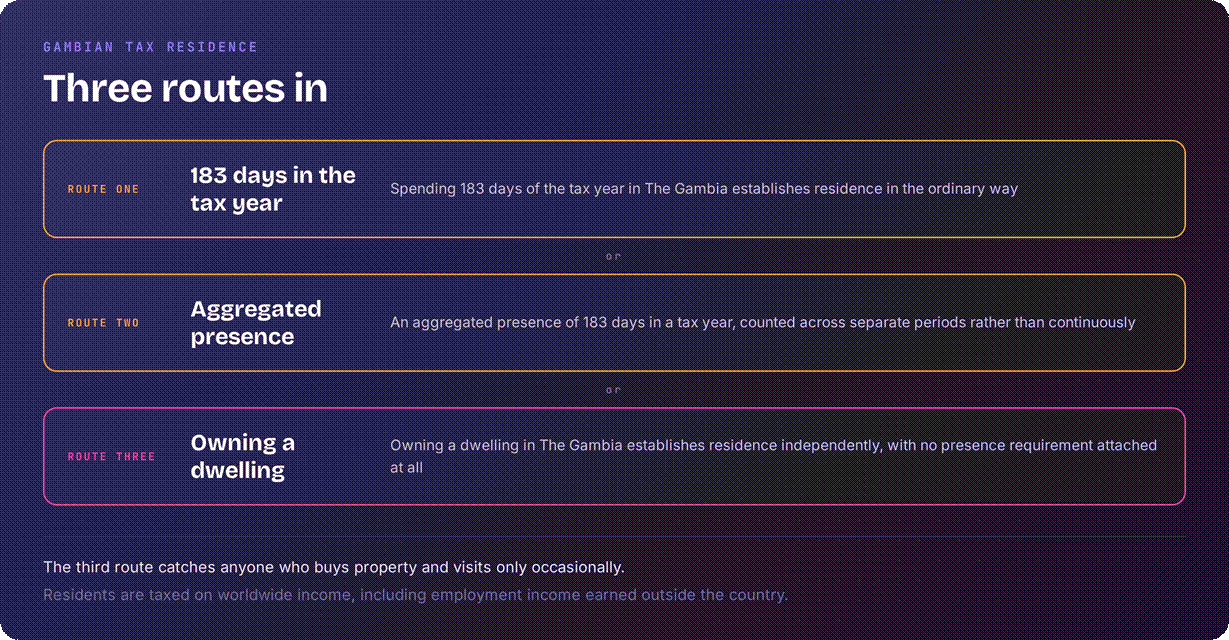
Three routes into Gambian residence.
Two features that catch people
The first is the treatment of social security. In most systems, employee contributions reduce taxable income. In The Gambia they do not — contributions are included in gross income and subject to income tax, so the overall liability is calculated before any social security deduction. That raises the effective burden relative to systems where contributions are deductible.
The second is fringe benefits tax, which is imposed on employers who provide benefits such as housing, motor vehicles and loans. It is a charge on the employer rather than the employee, which changes how a package should be negotiated — the cost of a housing allowance falls on the employer in a way it may not elsewhere.
Income is taxed under a schedular system, and joint filing is not permitted — each individual files separately where required.
What makes The Gambia workable
The position has some genuine features:
• A PAYE threshold of D3,000 a month, below which employment income tax does not apply;
• The turnover floor halved to 1% where audited accounts are maintained — a direct reward for good record-keeping;
• Capital gains at 15%, below the top rate on income;
• A foreign tax loss can be carried forward and set against foreign-sourced business income in a later year;
• Investment incentives and tax exemptions available through GIPFZA, the investment promotion and free zones authority; and
• Treaty coverage with Norway, Sweden, Switzerland, Taiwan and the United Kingdom.
The honest qualifications are that the treaty network is very small — around five agreements — that residents are taxed on worldwide income including employment income earned abroad, and that the turnover floor means a loss-making year does not necessarily mean a nil charge.
Case study: the turnover floor in a bad year
A consultant has turnover of D2,000,000 and, after a difficult year, profit of only D100,000. Under the progressive scale that profit would produce a modest charge.
But the tax is the higher of the scale or the turnover floor. With audited accounts the floor is 1% of D2,000,000 — D20,000. Without them it is 2% — D40,000. Whichever exceeds the scale figure is what falls due.
Two lessons follow. Margin matters, in the same way it does under a turnover tax anywhere. And maintaining audited accounts halves the floor, which for anyone with meaningful turnover is likely to cost less than the difference.
Filing and the compliance calendar
The system is administered by the Gambia Revenue Authority. Employment income is collected through PAYE, applying to any employee earning above D3,000 a month or D36,000 annually from employment in The Gambia.
Withholding on contracts is 10% for Gambian residents and 15% for non-residents. Investment incentives and tax exemptions can only be obtained through the Gambia Investment Promotion and Free Zones Authority.
Prepare in good time:
• Registration with the GRA;
• Audited accounts, if the halved turnover floor would help;
• Turnover records alongside profit records;
• Day-count records on both residence tests;
• Documentation of any dwelling owned in The Gambia; and
• Records of employment income earned outside the country.
Check the floor, not just the scale
Consider:
• That the tax is the higher of the scale or the turnover floor;
• That audited accounts halve that floor from 2% to 1%;
• That owning a dwelling makes you resident without any day count;
• That residents are taxed on employment income earned abroad;
• That social security contributions are not deductible;
• That fringe benefits tax falls on the employer; and
• That the current band thresholds should be confirmed with the GRA.
Your Gambia checklist
1. Compare the scale figure against the turnover floor;
2. Maintain audited accounts to halve the floor to 1%;
3. Keep turnover records alongside profit records;
4. Check whether you own a dwelling in The Gambia;
5. Count days on both the single and aggregated tests;
6. Declare employment income earned outside the country;
7. Expect social contributions to be taxed, not deducted;
8. Note that fringe benefits tax falls on the employer;
9. Confirm the current band thresholds with the GRA; and
10. Check whether GIPFZA incentives apply to your activity.
Frequently asked questions
How is Gambian personal income tax calculated?
As the higher of the applicable rates in the First Schedule, or a turnover floor — 1% of turnover for audited accounts, or 2% in any other case. Whichever produces the larger figure is what falls due.
Why does having audited accounts matter?
Because it halves the turnover floor from 2% to 1%. For anyone with meaningful turnover, the cost of an audit is likely to be less than the difference.
How do I become tax resident?
Through any of three routes — spending 183 days of the tax year in The Gambia, having an aggregated presence of 183 days, or owning a dwelling there. The third requires no presence at all.
Does The Gambia tax foreign income?
Residents are taxed on worldwide income. The GRA states specifically that all residents earning employment income outside the country are liable to employment income tax, subject to the foreign source rule.
Are social security contributions deductible?
No. Contributions are included in gross income and subject to income tax, so the liability is calculated before any social security deduction. That raises the effective burden relative to systems where contributions reduce taxable income.
Who pays fringe benefits tax?
The employer. It is imposed on employers who provide benefits such as housing, motor vehicles and loans to employees, which changes how a package should be negotiated.
What is the PAYE threshold?
Employment income tax applies to any employee earning above D3,000 per month, or D36,000 annually, from employment in The Gambia.
What treaty coverage exists?
A small network of around five agreements, with Norway, Sweden, Switzerland, Taiwan and the United Kingdom. Relief from a competing claim therefore depends largely on domestic rules.
Official sources and further reading
Important information
This article is general information and does not constitute tax, legal, immigration or financial advice, and does not create a client relationship. Tax outcomes depend on travel history, income sources, treaty status and the law applying to the relevant year. Rates, thresholds and regimes change, and some measures described may be proposed rather than enacted; this article reflects our understanding as at the date of publication. Obtain advice from a suitably qualified professional before acting or refraining from action.
