
Greece has built three separate regimes for people moving in, aimed at three different kinds of arrival. Choosing the wrong one is easy, because they sit consecutively in the same statute.
Most countries offering an inbound tax incentive offer one. Greece has three, in Articles 5A, 5B and 5C of its Income Tax Code, each targeting a distinct group: the wealthy, the retired, and the working.
They are not alternatives you pick between on preference. Each has its own entry conditions, its own duration and its own charge, and only one of them will usually be open to any given person.
Greece otherwise taxes residents on worldwide income at progressive rates reaching 44%. Non-residents are taxed on Greek-source income. All three regimes sit on top of that as time-limited alternatives, and all three leave Greek-source income taxable on ordinary rules.
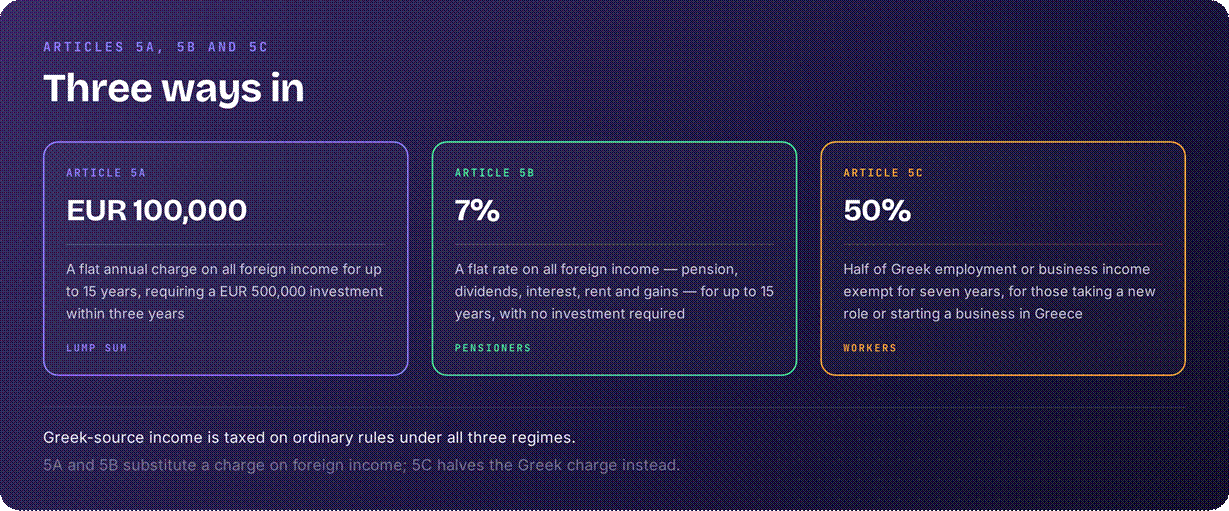
Three regimes, three entry tests, three different targets.
Your residency status is the first step
Greek tax residence broadly follows permanent or principal residence, habitual abode or centre of vital interests, and a presence of more than 183 days in any twelve-month period. All three regimes require you to transfer tax residence to Greece, so establishing it is the gateway rather than an afterthought.
Maintain accurate records of:
• Arrival and departure dates across rolling twelve-month periods;
• The tax years in which you were resident elsewhere, and where;
• Evidence of the required period of non-residence for your chosen regime;
• Investment documentation, where the lump sum regime is used;
• Your AFM registration and the date of transfer of residence; and
• Any other country that may also treat you as resident.
The three regimes side by side
Regime | What it does |
Article 5A | EUR 100,000 flat on all foreign income, up to 15 years |
5A family members | EUR 20,000 a year each, with no separate investment |
5A entry test | Not Greek resident for 7 of the last 8 years |
5A investment | At least EUR 500,000 within three years |
Article 5B | 7% flat on all foreign income for pensioners, up to 15 years |
5B entry test | Not Greek resident for 5 of the last 6 years |
Article 5C | 50% exemption on Greek employment or business income, 7 years |
5C entry test | A new role or business activity in Greece |
Greek-source income is taxed normally under all three. None of these regimes shelters what you earn inside Greece. 5A and 5B substitute a charge on foreign income; 5C does the opposite and halves the Greek charge while leaving foreign income on ordinary rules.
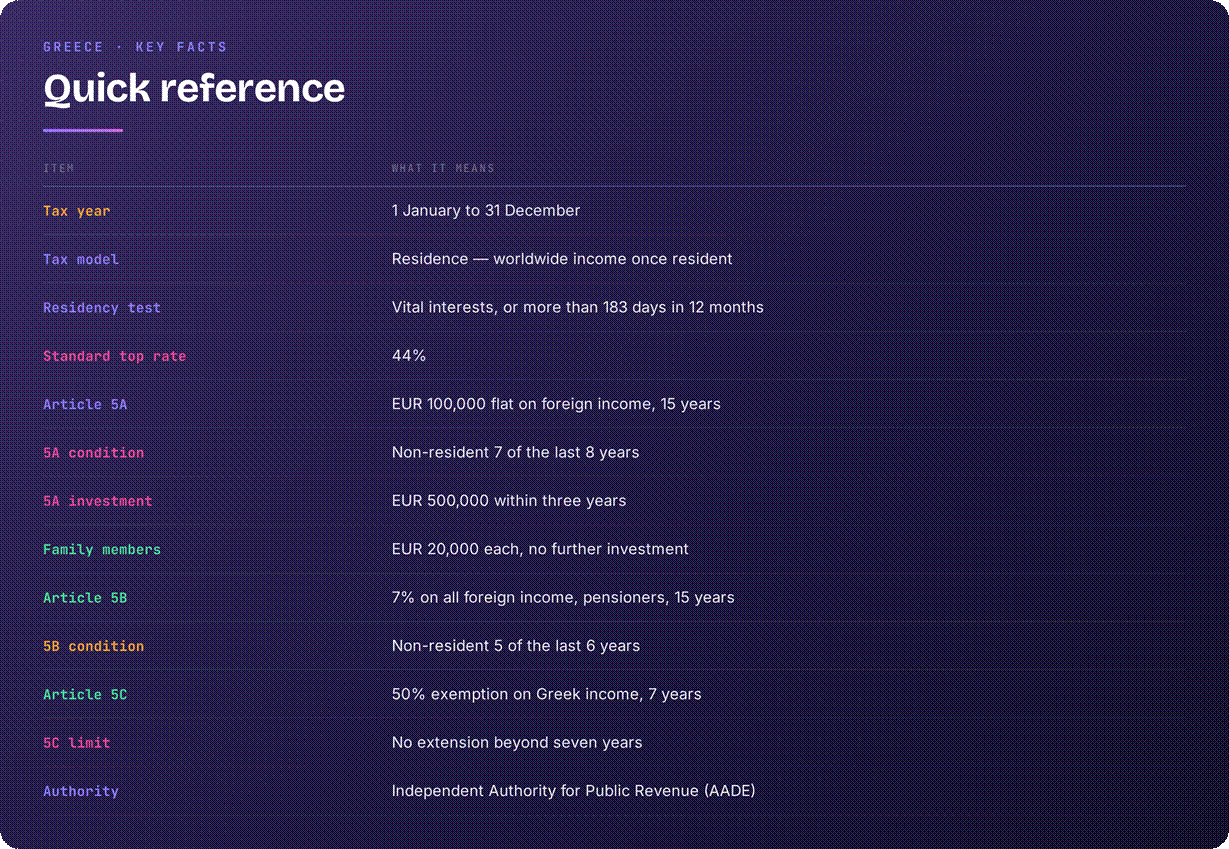
The Greek position at a glance.
Article 5A: the lump sum
A flat EUR 100,000 a year discharges Greek tax on all foreign-source income, whatever its size, for up to fifteen tax years. Family members can be included at EUR 20,000 each with no separate investment requirement.
Entry requires that you were not Greek tax resident in seven of the eight preceding years, and that you invest at least EUR 500,000 in Greek real estate, a business or securities within three years. An existing qualifying investment residence permit can satisfy that limb.
The arithmetic only works above a certain level of foreign income. Below roughly a million euros a year the ordinary rules, or one of the other regimes, will often produce a lower bill.
Article 5B: 7% for pensioners
A foreign pensioner transferring residence to Greece can elect a 7% flat rate on all foreign-source income for up to fifteen years. The breadth is the point: it is not confined to pension income but covers dividends, interest, rent and capital gains arising abroad.
You must not have been Greek tax resident in five of the six preceding years, and must transfer residence from a country with an administrative cooperation agreement with Greece. The tax is paid in a single instalment by the last working day of July, and double tax treaties continue to apply alongside it.
Article 5C: 50% for relocating workers
Someone moving to take up employment or start a business in Greece can exempt 50% of their Greek employment or business income for seven years. There is no extension.
The conditions mirror 5B on prior non-residence, and require a new role or business activity in Greece together with a commitment to remain resident. Foreign income is still declared and taxed on ordinary rules — 5C shelters the Greek side only, which is the mirror image of 5A and 5B.
Case study: Dimitra picks the wrong article
Dimitra retires to Crete from Germany with a pension and a portfolio producing around EUR 80,000 a year in total. She reads about the EUR 100,000 lump sum and concludes Greece is expensive.
The lump sum is not her regime. Article 5B would tax the whole EUR 80,000 — pension, dividends and rent together — at 7%, for fifteen years, with no investment requirement at all.
The regimes sit in consecutive articles and are frequently described together, which makes it easy to read the headline number attached to the wrong one and abandon the country on the strength of it.
Filing and the compliance calendar
The Greek tax year follows the calendar year and an AFM tax number is required before anything else. Annual returns are filed electronically, typically from spring through summer, with dates confirmed each year.
Election into a regime has its own deadline, which depends on the article and on when residence or the qualifying activity began — for 5C, a role commencing after early July can push the application into the following year. Confirm the applicable date rather than assuming the general filing deadline covers it.
Choosing between them
Model your position before you move, considering:
• Whether your income is foreign-source, Greek-source, or both;
• How many of the preceding years you were resident elsewhere, and where;
• Whether a EUR 500,000 investment is realistic and worth making;
• At what level of foreign income the lump sum beats 7%;
• Whether your Greek role qualifies as new for 5C purposes;
• How fifteen years compares with seven for your plans; and
• Whether a treaty affects income the regime does not shelter.
Your Greece checklist
1. Establish which of the three regimes your circumstances actually fit;
2. Count the preceding years of non-residence against the right test;
3. For 5A, confirm the EUR 500,000 investment is realistic within three years;
4. For 5B, confirm your former country has an administrative cooperation agreement;
5. For 5C, confirm the Greek role or business counts as new;
6. Separate foreign-source income from Greek-source before modelling;
7. Model the lump sum against 7% at your actual level of foreign income;
8. Register for an AFM before the transfer of residence;
9. Confirm the election deadline for your specific regime; and
10. Check the treaty position on income the regime does not shelter.
Frequently asked questions
Can I choose whichever Greek regime I prefer?
No. Each has distinct entry conditions and targets a different group, so usually only one will be open to you. The lump sum requires a substantial investment, the 7% rate requires pensioner status, and the 50% exemption requires a new Greek role or business.
Does the EUR 100,000 lump sum require an investment?
Yes — at least EUR 500,000 in Greek real estate, a business or securities within three years, or an existing qualifying investment residence permit. Summaries quoting only the headline figure routinely leave this out.
Does the 7% pensioner rate apply only to my pension?
No. It applies to all foreign-source income, including dividends, interest, rent and capital gains. That breadth is what makes it the most useful of the three for many retirees.
How long does each regime last?
Up to 15 tax years for Articles 5A and 5B, and seven years for Article 5C, which has no extension.
Is my Greek income sheltered?
Not under 5A or 5B — Greek-source income is taxed on ordinary rules under both. Article 5C works the other way, exempting half of Greek employment or business income while leaving foreign income taxable normally.
Can family members join the lump sum regime?
Yes, at EUR 20,000 each per year, with no separate investment requirement attached to them.
Do double tax treaties still apply?
Yes. The pensioner regime in particular does not displace treaty provisions, so the interaction between the 7% charge and your source country’s taxing rights needs checking rather than assuming.
When do I have to elect?
The deadline depends on the article and on when residence or the qualifying activity began. For Article 5C, an employment or business commencing after early July can push the application into the following year, so confirm the date for your circumstances.
Official sources and further reading
Important information
This article is general information and does not constitute tax, legal, immigration or financial advice, and does not create a client relationship. Tax outcomes depend on travel history, income sources, treaty status and the law applying to the relevant year. Rates, thresholds and regimes change, and some measures described may be proposed rather than enacted; this article reflects our understanding as at the date of publication. Obtain advice from a suitably qualified professional before acting or refraining from action.
