
Guatemala taxes only Guatemalan-source income, for residents and non-residents alike, and even that tops out at 7%. It is one of the lowest combinations of rate and scope anywhere.
Most countries offer either a low rate or a territorial system. Guatemala offers both. It taxes only Guatemalan-source income — for residents and non-residents alike — and the top rate on employment income is 7%.
Foreign earnings are outside the charge entirely. Not exempt on a remittance basis, not sheltered for a fixed number of years, not conditional on an election: simply not within the scope of Guatemalan income tax at all.
Employment income is charged at 5% on annual taxable income up to GTQ 300,000 and 7% on the excess. Before those rates apply there is an annual personal deduction of GTQ 48,000, plus further deductions for documented personal expenditure, qualifying life insurance premiums and donations up to 5% of gross income.
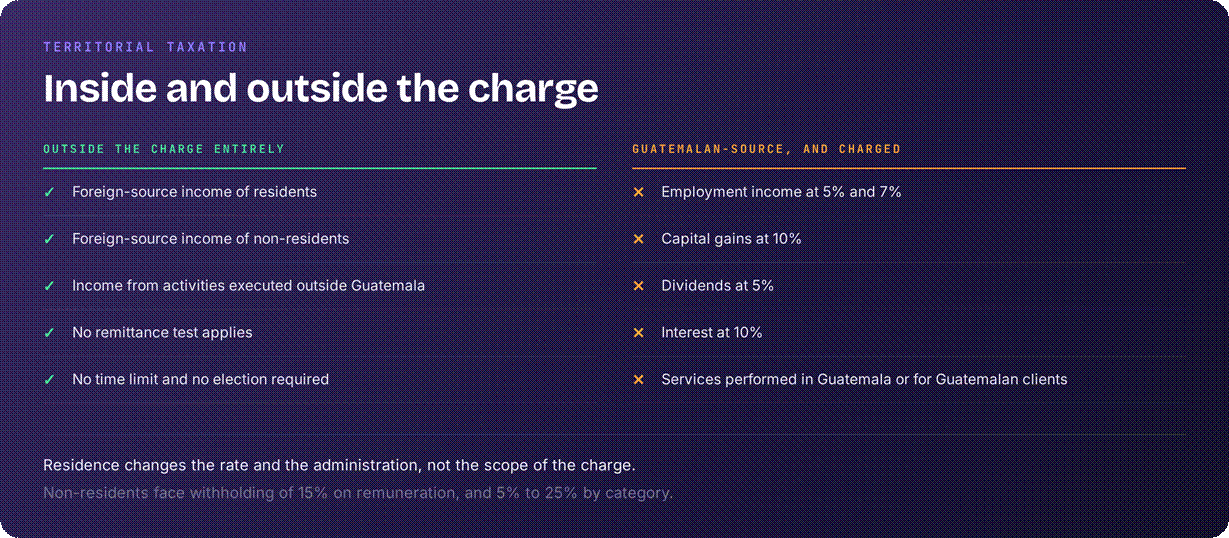
What falls inside the charge, and what never does.
Your residency status is the first step
An individual is considered a Guatemalan tax resident where either of the following applies:
• They remain in national territory for more than 183 days during the calendar year, whether or not continuously; or
• Their centre of economic interest is in Guatemala, unless the taxpayer proves residence or fiscal domicile in another country by means of a certificate issued by that country’s tax authorities.
The second limb has no day requirement and is rebutted only by documentary evidence from elsewhere. Anyone whose economic life is centred on Guatemala should expect to be treated as resident regardless of how much time they spend there.
In practice the distinction matters less than it would elsewhere, because the system is territorial either way. What residence changes is the rate and the administration, not the scope.
Maintain accurate records of:
• Days present in Guatemala during each calendar year;
• Where your centre of economic interest lies;
• A tax residence certificate from another country, if you rely on one;
• Income by source, Guatemalan and foreign;
• Where services were physically performed, since that drives source; and
• Documentation supporting deductions claimed.
The tax rates
Item | Rate |
Employment income up to GTQ 300,000 a year | 5% |
Employment income above GTQ 300,000 a year | 7% on the excess |
Annual personal deduction | GTQ 48,000 |
Optional business regime, on gross income | 5% and 7% |
Capital gains | 10% |
Dividends | 5% |
Interest | 10% |
Foreign-source income | Outside the charge entirely |
Non-residents are taxed by withholding on Guatemalan-source income, at 15% on salaries, wages, commissions, bonuses, fees and similar remuneration, and at rates from 5% to 25% depending on the category of income. Someone spending under 183 days in Guatemala and providing services there faces withholding rather than assessment.
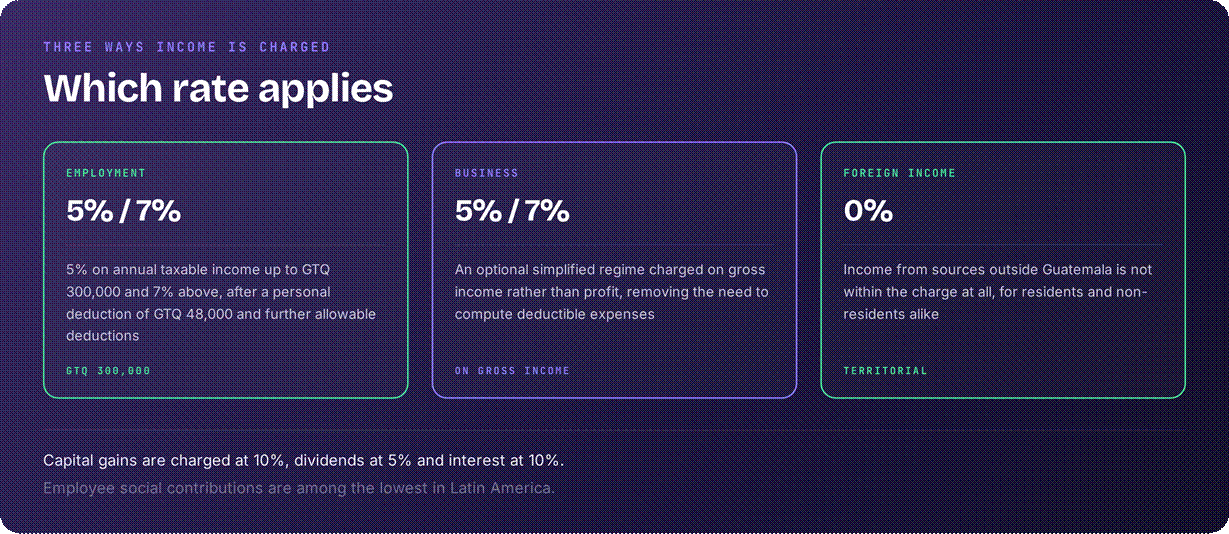
Three routes, and which rate applies to each.
What Guatemala does not tax
The absences do most of the work here:
• Foreign-source income of any kind is outside the Guatemalan charge — for residents and non-residents alike, with no remittance test, no time limit and no election;
• There is no tax on income from activities executed outside Guatemala, however the payment is routed; and
• Social contributions are among the lowest in Latin America, at 4.83% for employees.
What is charged is narrow and cheap. Capital gains on real property and other assets attract 10%, dividends 5% and interest 10% — all well below what a comparable European or North American system would take.
What makes Guatemala attractive
For a remote worker or investor with foreign income, the combination is unusually strong:
• Territorial taxation applying to residents as well as non-residents, so foreign income is genuinely untaxed rather than deferred;
• A 7% top rate on local employment income — among the lowest anywhere that is not a zero-tax jurisdiction;
• A GTQ 48,000 personal deduction before any rate applies, plus further deductions for documented expenditure and donations;
• Capital gains at 10% and dividends at 5%;
• An optional 5% and 7% regime on gross business income, removing the need to compute profit;
• Residence at 183 days, with no investment, property purchase or capital requirement; and
• Low social contributions by regional standards.
The qualifications are practical rather than fiscal. Guatemala has a very limited treaty network, so relief depends on domestic rules rather than agreements, and services delivered to Guatemalan clients or performed in the country are Guatemalan-source regardless of where payment originates. A remote worker physically in Guatemala needs to establish the source position rather than assume it.
Case study: Laura works from Antigua
Laura moves to Antigua and continues consulting for clients in the United States and Spain, none of whom have any Guatemalan presence. She crosses 183 days and becomes resident.
Because the system is territorial, her resident status does not bring her foreign income into charge. What determines the position is whether the income is Guatemalan-source — and services delivered to foreign clients for use abroad generally are not.
The point to get right is the one she nearly missed. Had she picked up a Guatemalan client, or performed work for use inside Guatemala, that income would be Guatemalan-source and taxable — at 5% or 7%, but taxable. Source, not residence, is the whole question here.
Filing and the compliance calendar
The Guatemalan fiscal year follows the calendar year and the annual return is generally due by 31 March. The system is administered by the Superintendencia de Administración Tributaria. Employers withhold on employment income, and anyone providing services independently may need to register an economic activity to obtain authorisation to issue invoices.
Prepare in good time:
• Registration with the tax administration and invoicing authorisation;
• Day-count records for the calendar year;
• Evidence of where your centre of economic interest lies;
• Contracts and invoices establishing the source of each receipt;
• Receipts supporting documented personal deductions; and
• A foreign tax residence certificate if you rely on one.
Get the source position right
Consider:
• That the system is territorial for residents as well as non-residents;
• Whether any client or engagement makes income Guatemalan-source;
• Where services are physically performed, since that drives source;
• Whether the centre of economic interest limb would catch you;
• Whether the optional gross-income business regime suits your activity;
• That capital gains are 10% and dividends 5%; and
• That the treaty network is very limited, so domestic rules do the work.
Your Guatemala checklist
1. Establish the source of every receipt before anything else;
2. Check whether any client or engagement is Guatemalan;
3. Record where services are physically performed;
4. Count days against the 183-day calendar-year test;
5. Consider whether the centre of economic interest limb applies;
6. Obtain a foreign residence certificate if relying on one;
7. Compare the employment rates against the optional gross-income regime;
8. Register an economic activity if invoicing independently;
9. Keep receipts for documented personal deductions; and
10. Diarise the 31 March filing deadline.
Frequently asked questions
Does Guatemala tax foreign income?
No. The system is territorial and taxes only Guatemalan-source income, for residents and non-residents alike. Foreign income is outside the charge entirely, with no remittance test, no time limit and no election required.
What are the income tax rates?
5% on annual taxable employment income up to GTQ 300,000 and 7% on the excess, applied after an annual personal deduction of GTQ 48,000 and further allowable deductions.
How do I become tax resident?
By remaining in Guatemala for more than 183 days during the calendar year, or by having your centre of economic interest there — the second limb applying without a day count unless you produce a tax residence certificate from another country.
Does residence change what is taxed?
Not the scope, because the system is territorial either way. It changes the rate and the administration — residents are assessed at 5% and 7%, while non-residents face withholding at 15% on remuneration and 5% to 25% by category.
Are capital gains taxed?
Yes, at 10% on real property and other assets. Dividends are charged at 5% and interest at 10%. All three are well below what comparable systems take.
I work remotely from Guatemala for foreign clients. Am I taxed?
Generally not, because the income is foreign-source. But services performed in Guatemala or delivered to Guatemalan clients are Guatemalan-source regardless of where payment comes from, so the source position needs establishing rather than assuming.
What is the optional business regime?
A simplified alternative charging 5% and 7% on gross income rather than on profit, available to smaller taxpayers as an alternative to computing deductible expenses. It is a separate choice from the employment rates.
Does Guatemala have tax treaties?
Very few. Relief therefore depends on domestic rules rather than on agreements, which matters if another country also claims you as resident.
Official sources and further reading
• Superintendencia de Administración Tributaria (SAT)
Important information
This article is general information and does not constitute tax, legal, immigration or financial advice, and does not create a client relationship. Tax outcomes depend on travel history, income sources, treaty status and the law applying to the relevant year. Rates, thresholds and regimes change, and some measures described may be proposed rather than enacted; this article reflects our understanding as at the date of publication. Obtain advice from a suitably qualified professional before acting or refraining from action.
