
Guyana gives a personal allowance of a fixed sum or one-third of income, whichever is greater. For a higher earner that means a third of everything is exempt before any rate applies.
Guyana’s personal allowance works differently from almost anywhere else. A resident individual is entitled to GYD 1,020,000 or one-third of their income per annum, whichever is greater.
The second limb is the interesting one. For anyone earning above roughly GYD 3,060,000, the fixed figure is irrelevant and a third of total income is exempt before any rate applies. The allowance scales with income rather than being fixed against it.
Above the allowance, chargeable income below GYD 2,040,000 is taxed at 28%, and the incremental rate above that is 40%.
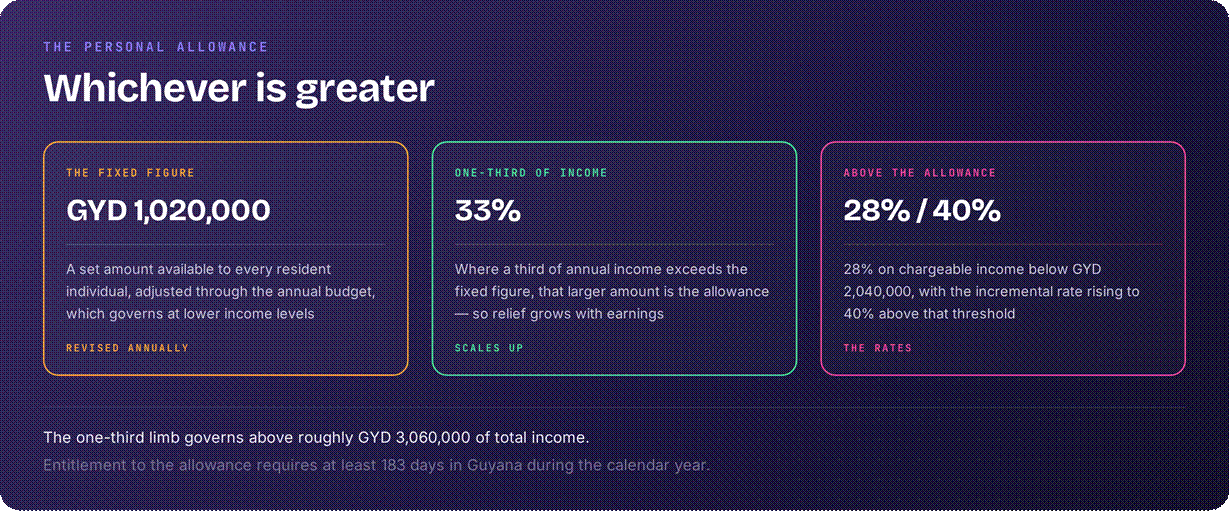
Two limbs, and the greater one applies.
Your residency status is the first step
Individuals resident in Guyana are subject to tax on their worldwide income. A non-resident individual is liable only on income derived from Guyana. A temporary resident is not liable to tax on income arising abroad, whether received in Guyana or not.
Resident individuals — those present in Guyana for at least 183 days in the calendar year — are entitled to the personal allowance. That entitlement is what makes residence worth having here, because the allowance is substantial.
Maintain accurate records of:
• Days present in Guyana during the calendar year;
• Total annual income, since the allowance is a third of it;
• Whether you qualify as a temporary resident;
• Income by source, Guyanese and foreign;
• Acquisition and disposal records for chargeable assets; and
• The allowance figure published for the year in question.
The tax rates
Item | Position |
Personal allowance | GYD 1,020,000 or one-third of income, whichever is greater |
Chargeable income below GYD 2,040,000 | 28% |
Chargeable income above GYD 2,040,000 | 40% incrementally |
Residents | Taxed on worldwide income |
Non-residents | Taxed on income derived from Guyana |
Temporary residents | Not liable on income arising abroad |
Capital gains tax | 20% on net chargeable gains |
Residence test | At least 183 days in the calendar year |
Capital gains tax applies at 20% on net chargeable gains accruing in Guyana or elsewhere, whether or not received in Guyana, on a change of ownership of property — sale, disposal, transfer, exchange, redemption of shares or debentures, dissolution or liquidation, among others. Exceptions apply.
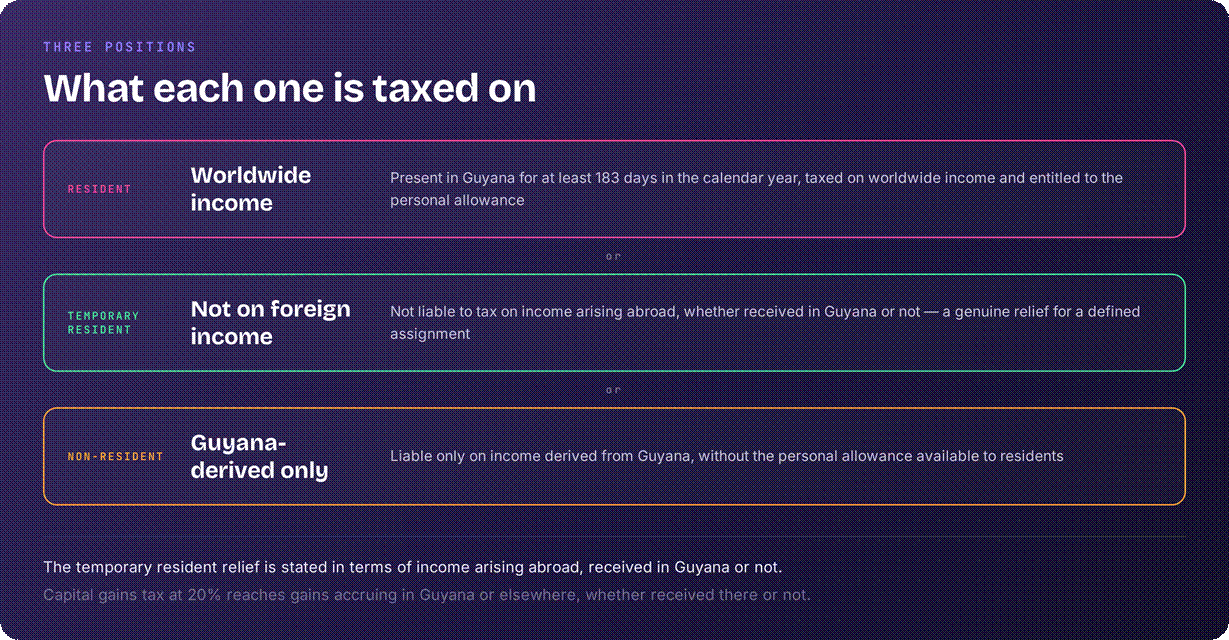
Three positions, three very different outcomes.
What makes Guyana attractive
The allowance structure is the core of it:
• A personal allowance of one-third of income where that exceeds the fixed figure, so the relief scales with earnings;
• A 28% rate on chargeable income below GYD 2,040,000, after that allowance;
• Temporary residents not liable on foreign income, whether received in Guyana or not;
• A clean 183-day residence test with no investment or property requirement;
• Dividends received by resident companies from other resident companies exempt; and
• A rapidly growing economy following the oil discoveries, with rising demand for professional skills.
The honest qualifications are that the 40% incremental rate arrives at a modest level of chargeable income, that residents are taxed on worldwide income, and that capital gains tax at 20% reaches gains accruing anywhere, received in Guyana or not.
Case study: Marcus and the one-third allowance
Marcus earns GYD 9,000,000 a year in Georgetown. The fixed allowance of GYD 1,020,000 is well below a third of his income, so the one-third limb applies — GYD 3,000,000 exempt.
His chargeable income is therefore GYD 6,000,000. The first GYD 2,040,000 is taxed at 28% and the balance at 40% incrementally.
Without the one-third limb his chargeable income would have been GYD 7,980,000 — nearly two million more falling into the 40% band. The allowance structure does real work at higher incomes, and it is unusual enough that it is easy to overlook.
Filing and the compliance calendar
The tax year follows the calendar year and the system is administered by the Guyana Revenue Authority. Employment income is withheld at source under PAYE, and individuals with other income sources file an annual return.
Interest received on bank deposits and certificates of deposit held at financial institutions in Guyana, and interest on bonds and similar instruments, are taxable. Dividends received from non-resident companies paid from profits not derived from or accruing in Guyana are taxed.
Prepare in good time:
• Registration with the Guyana Revenue Authority;
• Day-count records for the calendar year;
• Total income figures, for the one-third allowance calculation;
• Evidence of temporary resident status, if claiming the foreign income relief;
• Records of interest and dividend receipts; and
• Acquisition and disposal records for capital gains purposes.
Work the allowance before the rate
Consider:
• That the allowance is the greater of a fixed sum or one-third of income;
• That the one-third limb bites above roughly GYD 3,060,000 of income;
• That the 40% incremental rate arrives at GYD 2,040,000 of chargeable income;
• Whether temporary resident status would exempt your foreign income;
• That residents are otherwise taxed on worldwide income;
• That capital gains tax reaches gains accruing anywhere; and
• That the fixed allowance figure is revised in the annual budget.
Your Guyana checklist
1. Calculate one-third of your income before assuming the fixed allowance;
2. Confirm the fixed allowance figure for the year in question;
3. Count days against the 183-day calendar-year test;
4. Check whether temporary resident status applies to you;
5. Note that temporary residents escape foreign income entirely;
6. Model where the 40% incremental rate begins;
7. Remember residents are taxed on worldwide income;
8. Keep acquisition and disposal records for capital gains;
9. Note that local bank interest is taxable; and
10. Register with the Guyana Revenue Authority.
Frequently asked questions
What is the Guyanese personal allowance?
GYD 1,020,000 or one-third of income per annum, whichever is greater. For anyone earning above roughly GYD 3,060,000 the one-third limb governs, so a third of total income is exempt.
What are the rates?
28% on chargeable income below GYD 2,040,000 and 40% incrementally above that threshold, applied after the personal allowance.
What is a temporary resident?
Someone whose residence in Guyana is temporary, who is not liable to tax on income arising abroad, whether received in Guyana or not. It is a genuine relief for anyone on a defined assignment.
Does Guyana tax foreign income?
Residents are subject to tax on worldwide income. Non-residents are liable only on income derived from Guyana, and temporary residents are not liable on income arising abroad at all.
How do I become tax resident?
By being present in Guyana for at least 183 days in the calendar year. That is also the condition for entitlement to the personal allowance.
Is there capital gains tax?
Yes, at 20% on net chargeable gains accruing in Guyana or elsewhere, whether or not received in Guyana, on a change of ownership of property — sale, transfer, exchange, redemption, dissolution or liquidation among others, subject to exceptions.
Is bank interest taxed?
Yes. Interest received on bank deposits and certificates of deposit held at financial institutions in Guyana, and interest on bonds and similar instruments, are taxable.
Does the allowance change?
The fixed figure is revised through the annual budget, so it should be confirmed for the year being computed. The one-third limb is structural and does not move.
Official sources and further reading
Important information
This article is general information and does not constitute tax, legal, immigration or financial advice, and does not create a client relationship. Tax outcomes depend on travel history, income sources, treaty status and the law applying to the relevant year. Rates, thresholds and regimes change, and some measures described may be proposed rather than enacted; this article reflects our understanding as at the date of publication. Obtain advice from a suitably qualified professional before acting or refraining from action.
