
If you are considering Hong Kong as a base, separate two questions from the outset: do you qualify as a Hong Kong tax resident, and is your income sourced in Hong Kong?
These questions are related, but they do not produce the same answer. Hong Kong follows a territorial tax system, which means the source of your income is generally more important than your residence status when determining whether Hong Kong income tax applies.
This guide explains the key points for digital nomads, remote workers, freelancers and internationally mobile employees, based on TaxPilot's Hong Kong tax index.
Your income source is the first issue to establish
Begin by determining whether your income is sourced in Hong Kong. Under Hong Kong's territorial model, local-source income may be taxable even if you do not meet the relevant Hong Kong tax residency tests.
Conversely, foreign-source income is generally outside the scope of Hong Kong salaries tax, even if you spend significant time in Hong Kong. This does not mean the income is automatically tax-free globally, because another country may still have taxing rights.
For employment income, the source is typically assessed by looking at factors such as:
• Where your employment contract was negotiated and enforceable;
• Where your employer is resident; and
• Where your remuneration is paid.
The place where you physically perform your duties also matters. If you work from Hong Kong, the portion of your employment income attributable to services performed there may be subject to Hong Kong salaries tax.
The Hong Kong Government explains that salaries tax applies to income arising in or derived from Hong Kong from an office, employment or pension. In some cases, a non-Hong Kong employment may be assessed on a time-apportionment basis according to the number of days you work in Hong Kong.
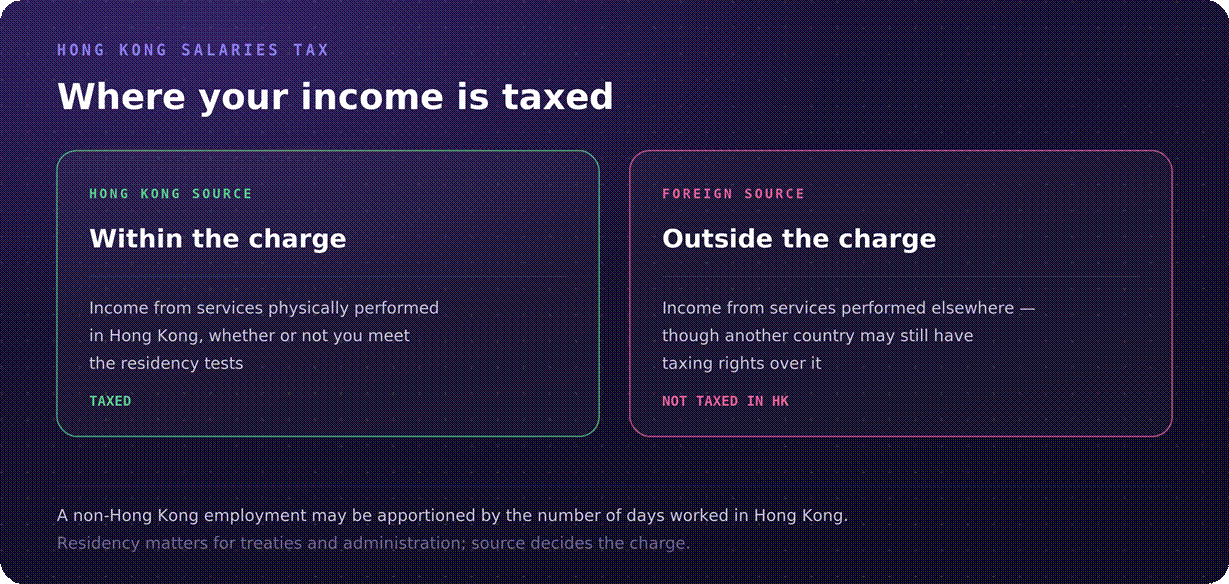
Source decides the charge; residency matters for treaties and administration.
Practical example: remote employment
Mark works for a company based in the United Kingdom. He relocates to Hong Kong and performs his employment duties from a Hong Kong apartment for eight months.
Mark may not automatically become taxable on all of his worldwide income merely because he is present in Hong Kong. However, the income connected with services performed in Hong Kong may be considered Hong Kong-source employment income.
Mark should therefore document:
• His travel dates;
• The location from which he performed his duties;
• The terms of his employment contract;
• His employer's location; and
• The allocation of workdays inside and outside Hong Kong.
With careful recordkeeping, the relevant portion of income can be assessed more accurately.
What do the Hong Kong tax residency rules assess?
Tax residency in Hong Kong is relevant for particular purposes, including double taxation agreements, Certificates of Resident Status, automatic exchange of financial account information and certain personal assessment rules.
Based on TaxPilot's Hong Kong tax index, you may be regarded as a Hong Kong tax resident if you satisfy either of the following presence tests:
Test | Period assessed | Threshold |
Single-year presence | One tax year | More than 180 days |
Three-year presence | Current and two previous tax years | More than 300 days |
The relevant tax year runs from 1 April to 31 March, rather than from 1 January to 31 December.
You should also be aware that ordinary residence may be relevant in some contexts. This is typically assessed by considering whether you reside in Hong Kong voluntarily and for a settled purpose — such as employment, business, education or family reasons — with a sufficient degree of continuity.
Counting days is therefore necessary, but it may not be the only factor that matters.
Residency does not automatically determine your Hong Kong income tax
The central distinction. Hong Kong residency may matter for treaty and administrative purposes, while the source of your income generally determines whether Hong Kong salaries tax applies.
If you satisfy the 180-day test, you may be treated as resident for particular purposes. However, that status does not, by itself, mean Hong Kong will tax all your worldwide income.
Similarly, if you do not satisfy the relevant residency test, Hong Kong may still tax income arising from work physically performed in Hong Kong.
This is why you should avoid the general assumption that spending fewer than six months in a country means no local tax obligations arise.
Hong Kong's 17% top personal income tax rate
Hong Kong's highest personal income tax rate on employment and self-employment income is 17%.
The rate applies within a progressive tax system, and your final liability will depend on your taxable income, deductions, allowances and the way your income is assessed. In some cases the standard-rate calculation may also be relevant, meaning the final amount payable is not necessarily calculated simply by applying 17% to gross income.
For a freelancer or independent professional, the analysis may involve profits tax or personal assessment considerations rather than a straightforward employment calculation. The classification of your activities, the nature of your business and the location where services are performed should be reviewed carefully.
You may wish to use the TaxPilot Digital Nomad Tax Guide to understand the broader process of identifying your residence status, tax system and filing obligations.
What reliefs and special rules should you consider?
Hong Kong does not generally operate a broad, automatic expat tax exemption simply because you are a foreign national or a digital nomad. Instead, the outcome depends on the source of your income and whether specific exemptions or reliefs apply.
The 60-day employment exemption
A separate 60-day rule may apply to certain employment situations. Income from services performed in Hong Kong during visits that do not exceed a total of 60 days in the relevant year of assessment may be excluded from salaries tax, subject to the applicable conditions.
⚠️ Watch out. This is not a residency test. It is a limited employment-income exemption, and the way days are counted can differ depending on the circumstances. If you are travelling to Hong Kong for meetings, training or short work assignments, do not assume every visit qualifies automatically.
Personal assessment
If you meet the relevant eligibility requirements, personal assessment may reduce your overall liability in certain circumstances. This can be particularly relevant where you have different categories of income, deductions or allowances.
You may be eligible where you are ordinarily resident in Hong Kong or satisfy the applicable temporary-residence test. An election is generally made through your individual tax return, although a separate application form may be available.
The election must be made within the prescribed time limits. For example, the Hong Kong Government states that an election may generally be made within two years after the end of the relevant year of assessment, or within two months after the issue of an assessment, whichever is later.
Double taxation agreements can provide additional protection
Hong Kong has 50 double taxation agreements with other jurisdictions.
A double taxation agreement, or DTA, is a treaty intended to allocate taxing rights between Hong Kong and another country and to reduce the possibility that the same income is taxed twice.
If you receive overseas income while living in Hong Kong, the source country may continue to claim taxing rights. A DTA may restrict that country's taxing rights or provide a mechanism for tax relief, depending on the relevant treaty article and your circumstances.
You may also need a Certificate of Resident Status to claim benefits under a DTA. The certificate can support your position, but it does not guarantee that the treaty partner will grant relief. The other country will still assess whether you satisfy its own treaty requirements.
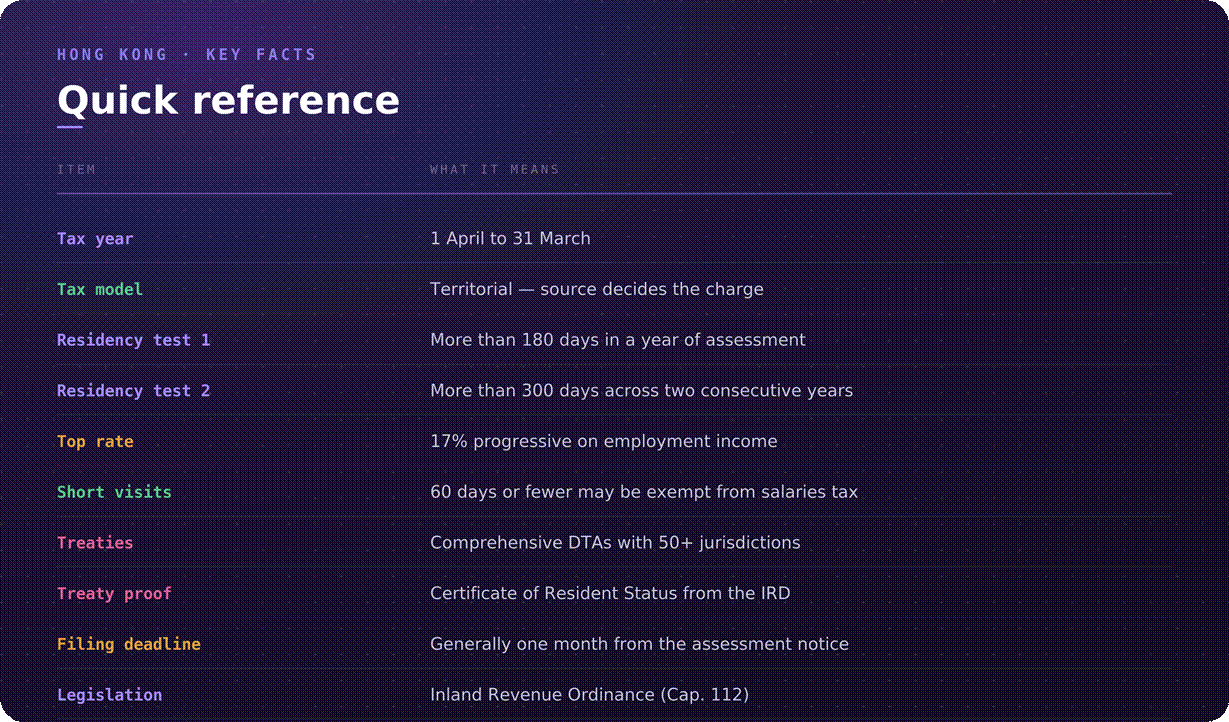
The Hong Kong position at a glance.
Practical example: foreign investment income
Felicity becomes resident in Hong Kong and receives dividends from a company located overseas. The dividends may generally fall outside Hong Kong's territorial income tax charge if they are not Hong Kong-source income.
However, the country where the company is located may impose withholding tax. Felicity should therefore check:
• Whether withholding tax applies;
• Whether Hong Kong has a DTA with that country;
• Whether she can claim a reduced treaty rate; and
• Whether the source country requires a Certificate of Resident Status.
Hong Kong's territorial model may reduce her Hong Kong liability, but it does not necessarily remove tax obligations elsewhere.
Your Hong Kong filing deadline is linked to the assessment notice
The Hong Kong tax year runs from 1 April to 31 March.
According to TaxPilot's Hong Kong tax index, your deadline to file your tax return and settle the tax liability is generally one month from the date the Hong Kong tax authority issues the tax assessment. You should check the precise date and instructions stated in your notice, because individual circumstances and extensions may affect the applicable deadline.
Advance payments may also be required. In practice, you may need to settle the current liability while making a provisional payment towards a future tax year.
Take the following steps when a tax return or assessment is issued:
1. Record the issue date immediately;
2. Identify the filing and payment deadline;
3. Review the income figures and source analysis;
4. Check whether deductions, allowances or reliefs have been included;
5. Consider whether personal assessment is beneficial;
6. Retain travel and workday records; and
7. Arrange payment or professional review in good time.
Your Hong Kong tax checklist
If you are moving to Hong Kong or already working there, maintain a practical compliance file containing:
• Passport entry and exit records;
• A day-count schedule for each 1 April to 31 March tax year;
• Employment contracts and assignment letters;
• Details of where you physically performed your work;
• Payslips and payment records;
• Evidence of foreign taxes paid;
• Foreign income and withholding tax statements;
• Copies of tax returns and assessments; and
• DTA or Certificate of Resident Status correspondence.
Bringing it together
Hong Kong can provide a relatively clear and potentially efficient personal tax framework, but only where residence, source, treaty status and compliance obligations are reviewed together.
With proper planning, you can make informed decisions about Hong Kong while reducing the risk of missed filings, unexpected assessments and avoidable double taxation.
Frequently asked questions
Does spending more than 180 days in Hong Kong make me taxable on everything?
No. The 180-day test is about resident status, which matters mainly for treaty claims and certain administrative purposes. Whether Hong Kong actually taxes a particular amount of income depends on where that income is sourced, not on the day count alone.
Does Hong Kong tax my worldwide income?
Generally no. Hong Kong operates a territorial system, so foreign-source income usually falls outside the salaries tax charge. That does not make the income tax-free everywhere — another country may still have taxing rights over it.
I work remotely from Hong Kong for a foreign employer. Is my salary taxable there?
It may be. The place where you physically perform your duties is a significant factor, so income attributable to services performed in Hong Kong can fall within salaries tax even where your employer and contract sit elsewhere. A non-Hong Kong employment may be assessed by apportioning income across your workdays.
What is the 60-day exemption?
Income from services performed during visits to Hong Kong that do not exceed 60 days in total in the relevant year of assessment may be excluded from salaries tax, subject to the applicable conditions. It is an employment-income exemption rather than a residency test, and the way days are counted can differ by circumstance.
When does the Hong Kong tax year run, and when do I have to file?
The year of assessment runs from 1 April to 31 March. The deadline to file and settle the liability is generally one month from the date the Inland Revenue Department issues the assessment, so always work from the date stated on your own notice.
Do I need a Certificate of Resident Status?
You will usually need one to claim benefits under a double taxation agreement. The certificate supports your position, but it does not guarantee relief — the treaty partner still applies its own requirements before granting it.
Is foreign dividend or investment income taxed in Hong Kong?
Foreign-source investment income generally falls outside the Hong Kong charge under the territorial model. The country where the payer is located may still apply withholding tax, so check whether a treaty rate or other relief is available.
What is personal assessment, and should I elect for it?
Personal assessment aggregates your income and can reduce the overall liability in certain circumstances, particularly where you have different categories of income, deductions or allowances. It is not automatically beneficial, and the election must be made within the prescribed time limits.
Official sources and further reading
• Inland Revenue Ordinance (Cap. 112)
• Inland Revenue Department guidance for employees
• GovHK guidance on reporting employment income
• Inland Revenue Department tax rates
• Inland Revenue Department BIR60 filing guidance
• Inland Revenue Department Certificate of Resident Status guidance
• Inland Revenue Department list of comprehensive double tax agreements
Important information
This article is general information and does not constitute tax, legal, immigration or financial advice, and does not create a client relationship. Tax outcomes depend on travel history, income sources, treaty status and the law applying to the relevant year. Rates, thresholds and regimes change, and some measures described may be proposed rather than enacted; this article reflects our understanding as at the date of publication. Obtain advice from a suitably qualified professional before acting or refraining from action.
