
India has a middle status between resident and non-resident that keeps foreign income out of the charge. It is genuinely valuable, and two separate rules can drag you into residence without your day count changing at all.
Indian residence is not binary. Between the non-resident and the fully resident sits Resident but Not Ordinarily Resident — RNOR — a transitional status that keeps foreign income outside the Indian charge while Indian income remains taxable.
For someone returning to India after years abroad, RNOR is typically worth two to three years of protection on overseas investments, foreign rental income and offshore accounts. It is one of the more useful transitional regimes anywhere, and it applies automatically rather than on election.
The financial year runs 1 April to 31 March, and status is determined afresh each year. Being a non-resident last year does not carry over.
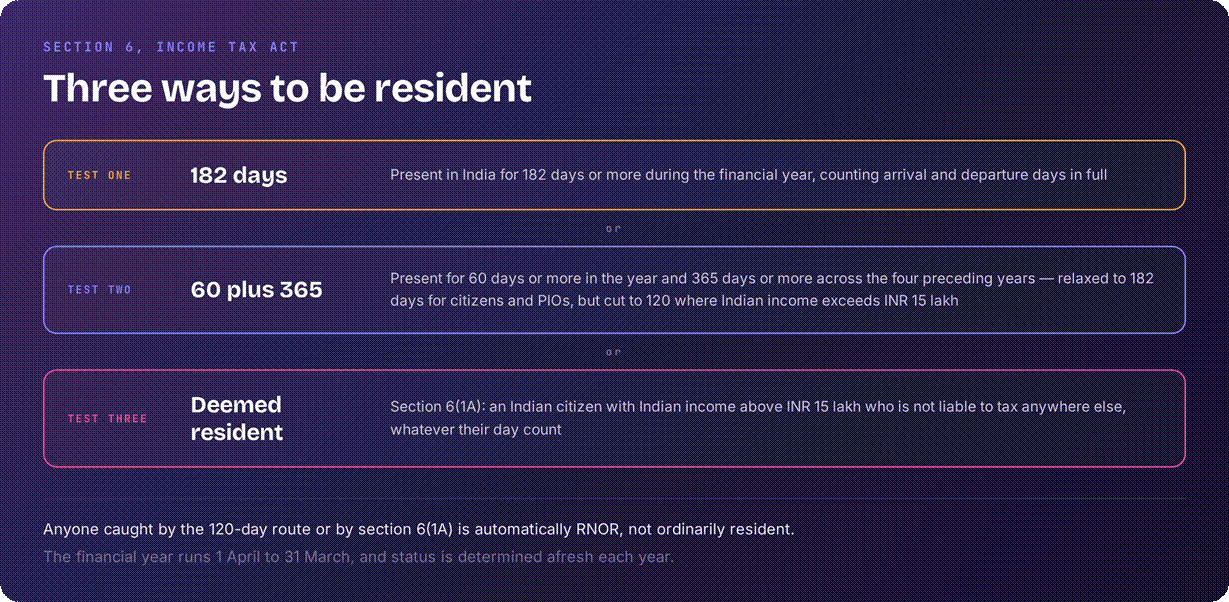
Three routes into residence, and only one of them is the day count people watch.
Your residency status is the first step
Under section 6 you are resident if you were in India for 182 days or more in the financial year, or for 60 days or more in the year combined with 365 days or more across the four preceding years.
The 60-day limb is relaxed to 182 days for Indian citizens leaving for employment abroad, and for citizens and persons of Indian origin visiting India. But since the Finance Act 2020, that relaxation is cut to 120 days where total Indian income, excluding foreign sources, exceeds INR 15 lakh. Someone with substantial Indian rent or investment income has a materially smaller safe window than they may believe.
Maintain accurate records of:
• Arrival and departure dates, counting both as full days;
• Day counts for the financial year and each of the four preceding years;
• Indian-source income, tested against the INR 15 lakh threshold;
• Whether you are liable to tax in your country of residence;
• The years in which you were non-resident, for the RNOR tests; and
• Passport stamps and flight records as supporting evidence.
What RNOR actually gives you
The three statuses are taxed very differently:
Status | What India taxes |
Non-resident | Indian-source income only |
RNOR | Indian income, plus foreign income from a business controlled in India |
Resident and ordinarily resident | Worldwide income |
RNOR test one | Non-resident in 9 of the 10 preceding financial years |
RNOR test two | In India for 729 days or fewer across the 7 preceding years |
Automatic RNOR | Those caught by the 120-day route or by section 6(1A) |
❌ Either RNOR test alone is enough. A long-absent returnee will typically satisfy at least one for the first two or three financial years after returning, which is the practical planning window — time to realise foreign gains, restructure overseas holdings or wind up offshore accounts before worldwide taxation begins.

Same days, same country, different rules.
The deemed-resident rule
Section 6(1A), introduced by the Finance Act 2020, deems an Indian citizen to be resident in India where total Indian income exceeds INR 15 lakh and they are not liable to tax in any other country by reason of domicile, residence or a similar criterion. Days spent in India are irrelevant to it.
The target was individuals resident nowhere at all. In practice it reaches Indian citizens in the Gulf states, where there is no personal income tax to be liable to. It applies to citizens only — holders of foreign citizenship with OCI or PIO status are outside it.
The mitigating feature is that anyone caught is automatically RNOR rather than ordinarily resident. Exposure is therefore Indian income plus foreign income from a business controlled in India, which is significant but not worldwide.
Case study: Ravi in Dubai
Ravi is an Indian citizen working in Dubai. He spends sixty days a year in India and earns INR 22 lakh from Indian rental property and mutual funds. He has always treated himself as non-resident.
On the day counts he is right. Sixty days is below every threshold that applies to him. But he is an Indian citizen, his Indian income exceeds INR 15 lakh, and the UAE levies no personal income tax, so he is not liable to tax there by reason of residence. Section 6(1A) deems him resident.
He is automatically RNOR, so his Dubai salary stays outside the Indian charge. His filing position changes entirely, though, and he had no idea any of this applied to him.
The Income Tax Act 2025
The Income Tax Act 2025 takes effect from 1 April 2026, replacing the 1961 Act. On residence it introduces no new substantive change: it codifies the existing framework, including the 120-day route and the section 6(1A) deeming rule, into the new statute.
What changes is the reference points. Section numbers and terminology move, so guidance written against the 1961 Act will cite provisions that no longer exist even where the underlying rule is identical.
Filing and the compliance calendar
The financial year ends 31 March and the return for most individuals not subject to audit is due by 31 July following. A PAN is required, and residents generally have to disclose foreign assets and income in the return schedules regardless of whether tax is payable on them.
India also operates two rate regimes. A newer default regime with lower rates and fewer deductions, and the older regime with the traditional deductions, which remains available by election. Which suits you depends on your deductions rather than on your residence status.
Timing matters more than anything
Model your position before you return, considering:
• How many of the last ten financial years you were non-resident;
• How many days you spent in India across the last seven years;
• Whether your Indian income exceeds INR 15 lakh, triggering the 120-day rule;
• Whether you are liable to tax in your country of residence at all;
• How many RNOR years you can expect after returning;
• Whether foreign gains should be realised inside that window; and
• Which provisions your adviser is citing, given the 2025 Act.
Your India checklist
1. Count days for the financial year and the four preceding years;
2. Test your Indian income against the INR 15 lakh threshold;
3. Check whether the 120-day limb applies instead of 182;
4. Establish whether you are liable to tax in your country of residence;
5. Work both RNOR tests — either one alone is sufficient;
6. Identify how many RNOR years you can expect after returning;
7. Plan foreign disposals and restructuring inside that window;
8. Keep passport stamps and flight records as evidence;
9. Obtain a PAN and check the foreign asset disclosure schedules; and
10. Confirm which statute your adviser is working from after 1 April 2026.
Frequently asked questions
What is RNOR?
Resident but Not Ordinarily Resident — a middle status where Indian income is taxable but foreign income generally is not, except foreign income from a business controlled in or a profession set up in India. It applies automatically where the conditions are met.
How long does RNOR last?
You qualify if you were non-resident in 9 of the 10 preceding financial years, or in India for 729 days or fewer across the 7 preceding years. Either alone is enough, and a long-absent returnee typically gets two to three years.
What is the 120-day rule?
For Indian citizens and persons of Indian origin visiting India, the usual 60-day limb is relaxed to 182 days — but cut to 120 days where total Indian income, excluding foreign sources, exceeds INR 15 lakh.
Can I be resident without spending time in India?
Yes. Section 6(1A) deems an Indian citizen resident where Indian income exceeds INR 15 lakh and they are not liable to tax in any other country by reason of domicile or residence. Days are irrelevant to it.
Does the deeming rule apply to OCI holders?
No. It applies to Indian citizens only, so holders of foreign citizenship with OCI or PIO status fall outside it regardless of their Indian income.
If I am deemed resident, is my foreign salary taxed?
Generally not. Anyone caught by section 6(1A) is automatically RNOR rather than ordinarily resident, so exposure is Indian income plus foreign income from a business controlled in India — significant, but not worldwide.
Does the Income Tax Act 2025 change the residence rules?
Not substantively. It takes effect from 1 April 2026 and codifies the existing framework, including the 120-day route and the deeming rule. What changes is the section numbering, so older citations will no longer match.
When is the Indian return due?
The financial year ends 31 March and the return for most individuals not subject to audit is due by 31 July following. A PAN is required, and foreign assets generally have to be disclosed whether or not tax is payable.
Official sources and further reading
Important information
This article is general information and does not constitute tax, legal, immigration or financial advice, and does not create a client relationship. Tax outcomes depend on travel history, income sources, treaty status and the law applying to the relevant year. Rates, thresholds and regimes change, and some measures described may be proposed rather than enacted; this article reflects our understanding as at the date of publication. Obtain advice from a suitably qualified professional before acting or refraining from action.
