
New foreign residents can be taxed on Indonesian income alone for four years. Almost nobody who moves to Bali to work remotely qualifies, and the reason sits in the fine print of PMK 18/2021.
If you are moving to Jakarta or Bali and you have read that Indonesia only taxes new arrivals on Indonesian income for four years, the rule is real. The question is whether it applies to you, and for most people arriving with a laptop and foreign clients the answer is no.
Indonesia follows a residence taxation model. Residents are taxed on worldwide income; non-residents are taxed on Indonesian-source income, usually through a 20% withholding. The four-year window is a carve-out sitting between those two positions.
It was introduced by Law 11/2020, the Job Creation Law, which amended Article 4 of the Income Tax Law, and is implemented by Minister of Finance Regulation 18/2021 — PMK 18/2021. Foreign nationals who become Indonesian tax residents can be taxed only on income received from Indonesia, for four tax years from the year they become resident.
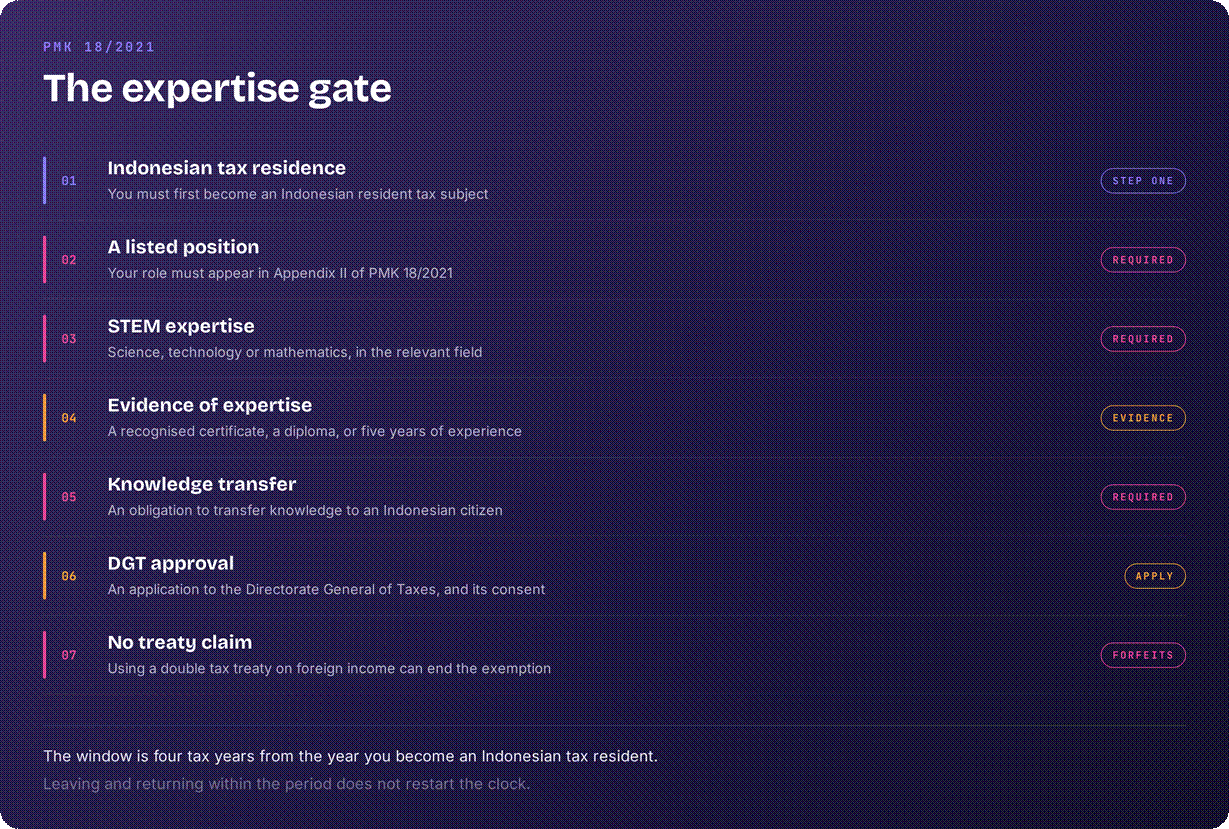
The conditions run together — failing any one of them closes the window.
Your residency status is the first step
Establish your position before assessing how your income is treated. You become an Indonesian tax resident if you are present in Indonesia for more than 183 days in any 12-month period, or if you reside in Indonesia, or if you are in Indonesia during a fiscal year with an intention to stay.
PMK 18/2021 gives content to those phrases. "Residing in Indonesia" covers having a place of residence at your disposal that is accessible at any time and is not merely transit accommodation, or having your centre of personal and economic activity in Indonesia, or having your habitual abode there. Intention to stay is evidenced by documents — a residence permit, an employment contract, or other evidence of a stay beyond 183 days.
Maintain accurate records of:
• Arrival and departure dates across rolling 12-month periods;
• Accommodation arrangements and whether the property is continuously available to you;
• Where your family is based;
• Where your business and personal interests sit;
• Permit and contract dates evidencing intended length of stay; and
• Any other country that may also treat you as resident.
Immigration status and tax status are separate questions in Indonesia, as elsewhere. Holding a permit is evidence of intention, not a determination of tax residence in itself.
What the four-year window actually does
For a qualifying foreign national, Indonesia charges tax only on income received or obtained from Indonesia for four tax years, beginning from the year they become an Indonesian tax resident. Foreign-source income sits outside the Indonesian charge during that period.
Income | Treatment during the four years |
Salary from an Indonesian employer | Indonesian-source — taxable |
Work physically performed in Indonesia | Indonesian-source — taxable |
Income from an Indonesian business | Indonesian-source — taxable |
Rent from Indonesian property | Indonesian-source — taxable |
Foreign dividends and interest | Outside the charge, if you qualify |
Foreign rental income | Outside the charge, if you qualify |
Foreign business income | Outside the charge, if you qualify |
⏱️ Leaving does not reset the clock. If you depart Indonesia and return within the four-year period, the window continues to run from the date you first became a resident tax subject. There is no pause and no second entitlement.
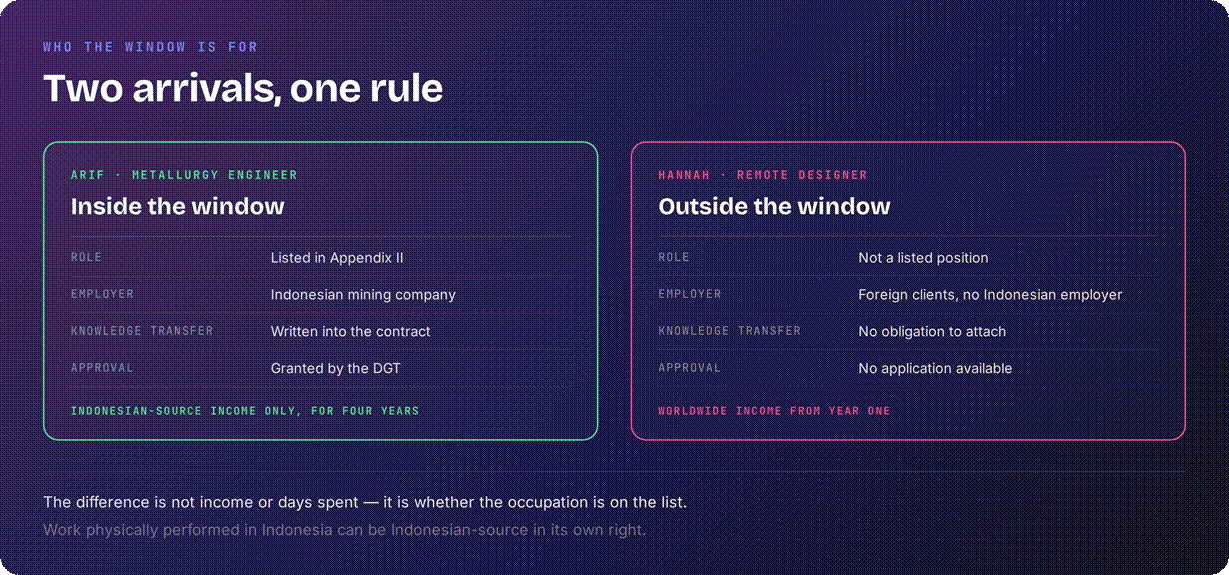
Two arrivals in the same year, with very different results.
The expertise test in detail
This is where most plans fail. The window is available only to foreign nationals with certain expertise, and the term is defined narrowly rather than generally. The requirements run together:
• Your role must appear among the positions listed in Appendix II of PMK 18/2021 — a specific schedule of occupations;
• You must have expertise in science, technology or mathematics;
• That expertise must be evidenced by a certificate from an institution appointed by the Indonesian government or your home government, an education diploma, or at least five years of work experience in the relevant field;
• You must carry an obligation to transfer knowledge to an Indonesian citizen; and
• Your employment must be in a position permitted by the Minister of Manpower, or you must be a researcher appointed by the relevant minister.
The application is made to the Directorate General of Taxes, and the exemption applies only if approved. A self-employed remote worker with foreign clients and no Indonesian employer has no listed position, no employer to impose a knowledge-transfer obligation, and nobody to apply on their behalf.
The treaty trap
There is a further condition that catches people who do qualify. The territorial treatment may not apply where the foreign national receives income from overseas and uses the double tax treaty between Indonesia and the source country.
In practice this means the two reliefs are alternatives rather than complements. Claiming treaty benefits on foreign income can bring the four-year exemption to an end, so the choice needs making deliberately and early rather than discovered when a return is prepared.
Rates if the window does not apply
Standard Indonesian rules apply, and residents are taxed on worldwide income at progressive rates:
• 5% on taxable income up to IDR 60 million;
• 15% from IDR 60 million to IDR 250 million;
• 25% from IDR 250 million to IDR 500 million;
• 30% from IDR 500 million to IDR 5 billion; and
• 35% above IDR 5 billion.
A non-taxable income threshold, the PTKP, exempts a base amount for each taxpayer with additions for dependants. Non-residents are generally subject to a 20% withholding on Indonesian-source income, subject to treaty reduction.
Filing and the compliance calendar
The Indonesian tax year follows the calendar year. The annual individual return — the SPT Tahunan, filed on form 1770, 1770 S or 1770 SS depending on your circumstances — is due by 31 March of the following year, with tax paid before filing.
You will need an NPWP, the Indonesian tax identification number, before any of this is possible. Employers withhold monthly under PPh 21, and taxpayers with business or self-employment income generally make monthly instalments under PPh 25 that are reconciled on the annual return.
📑 An exemption is not an exemption from filing. Where the four-year window applies, Indonesian-source income still has to be reported, and the annual return requires a listing of assets.
Timing matters more than the headline rule
Model your position before you move, considering:
• Whether your occupation genuinely appears in Appendix II;
• Whether an employer exists to support the application and the knowledge-transfer obligation;
• When you will first become an Indonesian tax resident, because the four years run from then;
• Whether work performed physically in Indonesia will be Indonesian-source regardless of who pays you;
• Whether you would rather rely on a treaty than on the exemption, since you may not have both;
• What happens in year five, when worldwide income enters the charge; and
• Whether your home country will release you at all.
Case study: Hannah and the Bali assumption
Hannah is a product designer who moves to Canggu and works for clients in Australia and Singapore. She spends 300 days a year in Indonesia and has a long lease on a villa.
She is comfortably an Indonesian tax resident. She is not within the four-year window: design is not a listed STEM position, she has no Indonesian employer, and there is no knowledge-transfer obligation to satisfy. Her worldwide income is within the Indonesian charge from the first year.
Work she performs physically in Indonesia may also be Indonesian-source in its own right, regardless of where her clients are. The assumption that foreign clients mean foreign income is the error, and it is an expensive one.
Your Indonesia checklist
1. Check whether your occupation appears in Appendix II of PMK 18/2021;
2. Confirm whether an Indonesian employer can support the application;
3. Gather evidence of expertise — certificate, diploma or five years of experience;
4. Track days across rolling 12-month periods, not calendar years;
5. Record when accommodation first became continuously available to you;
6. Identify the year you first became an Indonesian tax resident;
7. Decide between the exemption and treaty relief before claiming either;
8. Separate work physically performed in Indonesia from work performed elsewhere;
9. Register for an NPWP and diarise the 31 March deadline; and
10. Plan for year five before you reach it.
Frequently asked questions
Does every foreigner get four years of territorial treatment?
No. The window applies only to foreign nationals with certain expertise, defined by reference to a list of positions in Appendix II of PMK 18/2021, a STEM field, evidence of that expertise and a knowledge-transfer obligation. It is not a general relief for new arrivals.
Do I have to apply, or is it automatic?
You have to apply. The application goes to the Directorate General of Taxes, and the territorial treatment applies only where it is approved.
I work remotely for foreign clients from Bali. Do I qualify?
Almost certainly not. Without a listed position, an Indonesian employer and a knowledge-transfer obligation, there is nothing to apply on. Your worldwide income is within the Indonesian charge once you are resident.
Is income from foreign clients automatically foreign income?
No, and this is the most common misreading. Where you physically perform the work carries significant weight, so services performed from Indonesia can be Indonesian-source even though the client and the payment sit abroad.
What happens if I leave Indonesia during the four years?
The period continues to run from the date you first became a resident tax subject. Departing and returning within the window does not pause it or restart it.
Can I use a tax treaty as well as the exemption?
Generally not on the same foreign income. Claiming treaty relief on income from overseas can bring the territorial treatment to an end, so the two should be treated as alternatives and the choice made deliberately.
When does Indonesia consider me resident?
Broadly, when you are present for more than 183 days in any 12-month period, or when you reside in Indonesia, or when you are present during a fiscal year with an evidenced intention to stay. A permit supports the intention test rather than deciding residence on its own.
What is the filing deadline?
The annual individual return is due by 31 March following the calendar tax year, with tax paid before filing. An NPWP is needed first, and monthly withholding or instalments generally apply during the year.
Official sources and further reading
• Direktorat Jenderal Pajak (Directorate General of Taxes)
Important information
This article is general information and does not constitute tax, legal, immigration or financial advice, and does not create a client relationship. Tax outcomes depend on travel history, income sources, treaty status and the law applying to the relevant year. Rates, thresholds and regimes change, and some measures described may be proposed rather than enacted; this article reflects our understanding as at the date of publication. Obtain advice from a suitably qualified professional before acting or refraining from action.
